

Unlock the Editor’s Digest for free
Roula Khalaf, Editor of the FT, selects her favourite stories in this weekly newsletter.
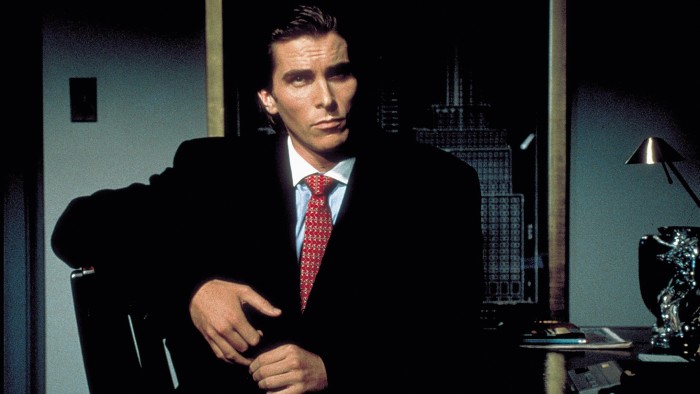
Bad guys on screen are given the best looks, and often the most admiring ones in real life. Psychopaths are defined by the cut of their cloth, from the obvious example of Patrick Bateman’s 1980s Valentino power suits in American Psycho to Klaus Kinski as a bounty hunter in his fringed head shawl, furs and high fedora in The Great Silence.
That 1968 spaghetti Western saw him rocking a look that predated Malcolm McLaren’s Buffalo Gals by more than a decade, evidence that Kinski’s canon contains an inexhaustible supply of fashion inspiration. Take a look at his eponymous Fitzcarraldo – not a villain per se, more an amoral aesthete or anti-hero, trying to drag a steamship over the impassable mud banks of the Andes. It was an unhinged mission, executed in admirable fashion, wearing a fabulously impractical white suit that looks like next-season John Alexander Skelton.
On the streets of the real world, a touch of danger and a long shadow – literal or allegorical – make for a strong look. Menace may come from an exaggerated silhouette, a soupçon of kink, or the nuanced refined camp that codified men in classics of film noir as gay (equating at the time to “degenerate”). Want to create an air of mystery? Buy a big ol’ diamond pinkie ring.
Rick Owens is a genius at exploring this territory. His AW25 show was full of XL hooded tunics and frilled rubber garments by latex artisan Matisse Di Maggio, styled on models wearing black contact lenses. These were villains out of an X-Men comic strip. “I find menace delicious,” says Owens. “Who doesn’t want to explore their ruthlessly selfish side and consider releasing their destructive inner id?”
Owens showed some amazing boots on the runway, but the most talked about men’s footwear this season are the £3,350 thigh-high Joe boots by Anthony Vaccarello at Saint Laurent, who took inspiration from Robert Mapplethorpe. The looks at Saint Laurent mixed flashy double-breasted tailoring with collars and ties, but also leather coats, gloves and trousers. The overall impression was suitably severe – here are men who’d do more than give you a peck on the cheek.
Leather artisans Patrick Whitaker and Keir Malem have created sculpted bodysuits for blockbuster movies and built the all-black bulletproof exoskeleton suit for Brixton Lore, the baddie played by Idris Elba in the Fast & Furious spin-off Hobbs & Shaw. Cheap knock-offs of the jacket have since become an internet phenomenon. “The collarless suit is a trope,” says Whitaker. “The elegant super-villain was defined by the early Bond films, with the Mao-style suit that appeared on Dr No during the cold war xenophobia of the early 1960s. The clean lines confer an air of in-control cool.” It was also, of course, shorthand for something foreign, ipso facto inherently suspect.
At the other extreme, British designer Maximilian Raynor, who won the prestigious ITS jury prize in Trieste this year, creates an air of menace with his Dagger Collar shirts. “There’s a certain flamboyance to a villain in any story,” he says. “I created a character called ‘The Assassin’ for my autumn/winter collection, imagining a hired gun for the elite, roaming the streets, sleazy and devious, with a perverse sexuality and glamour. I channel it through proportion and graphics – we made that look for this season in an ocelot print.”
Some of the best villains from the canon of pop culture are minimalists. John, the vampire cellist played by David Bowie in The Hunger (which inspired Alexander McQueen’s SS96 collection of the same name), is a poster boy for this. His 1980s tailoring is gorgeous. The shiny black blazer he wears in the opening scene – cruising for victims at a nightclub with Catherine Deneuve – recalls this season’s Tom Ford by Haider Ackermann. One standout look from that collection: a killer narrow-cut leather peak collared coat with matching top underneath, gloves and shades. There’s also some clear and present danger at MM6 this season, with Maison Margiela’s men dressed in full leather tailoring, with boots and leather gloves with giant pockets integrated – handy for concealing contraband.
You can’t, of course, discuss villainy in menswear without acknowledging the cultural impact of true evil: German military attire of the early 1930s. Those cuts, and coats in particular, are shorthand for the unspeakable. They’re also, like a lot of awful things, compelling. Milquetoast tie-dye could never go toe to toe with a sweeping great coat and magnificent lapels. There’s a double-breasted black wool example in the new Dries Van Noten collection that’s as perfect as can be, while one of this year’s fashion design BA graduates at the University of Westminster, Misa Ricchiuti, researched Italian fascist-era architecture and the tropes of fascist military dress for his final collection: “It’s about function and geometry,” says Ricchiuti. “Sharp lines and angles can be associated with blades that are inherently aggressive.” The university’s course leader, Robert Leach, points to German expressionism, cubism and art deco as movements that led to what’s now a classic silhouette: “Tadeusz Lempicki vividly embodies this aesthetic as portrayed by his wife, Tamara, in her 1928 portrait of him.”
Lempicki looks wickedly Weimar Republic, engulfed in his dark coat with white scarf tucked beneath it. A century on, scoundrels can be more frivolous. The designer of the Doublet label, Masayuki Ino, themed its AW25 collection on the notion of “the villain”, with a jacket and matching trousers covered with buckles and zips reminiscent of Michael Jackson’s 1987 single “Bad”, which was released with a Scorsese-directed pop video.
Scorsese has made a career of telling stories populated with miscreants, and works with Oscar-winning costume designer Sandy Powell to create them. Powell has dressed profoundly flamboyant villains, from Lestat of Interview with the Vampire to Jordan Belfort in The Wolf of Wall Street and Gangs of New York’s Bill “The Butcher” Cutting – both Scorsese creations. “Marty saw Bill as a peacock, perfectly dressed,” says Powell of his style evolution. “Daniel Day-Lewis, who played him, imagined the opposite – grimy and down-and-out looking. But when I put him in the clothes, with fine fabrics, the slightly exaggerated narrow trousers and frock coat, and the top hat that was higher than normal, he stood back and said, ‘OK, I get it’.” Sometimes all it takes is a touch of evil.
Read the full article here