

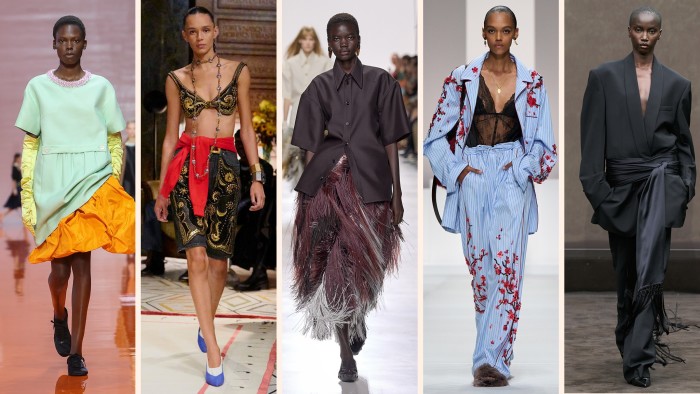
For all the new beginnings this season, in Milan it was impossible to ignore the end of a life that had loomed large across Italian fashion for decades: that of Giorgio Armani.
Before his death aged 91 this month, his brand had planned a blockbuster 50th anniversary runway show to close fashion week on Sunday night, set within the Pinacoteca di Brera art museum and the last exhibition curated by Armani. Now, the great and the good would still come to pay their respects. But this was no longer just a tribute to a towering figure. As the final fashion collection he worked on, it was also a farewell.
Armani had no children, and surprises in his will have thrown ownership of his family-owned empire up for grabs. Many in Milan are shocked that two of his preferred suitors, LVMH and L’Oréal, are French. At a time when consumer malaise is hitting the luxury market, and the reputation of the “Made in Italy” label is under threat, the dynasties that still dominate much of Italian fashion would prefer Armani to stay as one of their own.
“Obviously we would be disappointed to see Armani end under foreign control,” said Lorenzo Bertelli this week.
Bertelli’s mother, Miuccia Prada, one of the most powerful and admired designers in the world, has made it her mission to fly a flag for emphatically, defiantly Italian fashion. She takes risks that question beauty and make you think, and her influence can be seen constantly across other brands’ runways. This season, she and co-creative director Raf Simons were pondering what defines elegance now; in uncertain times of news and cultural overload.
Tightly tailored drill uniforms garnished with dazzling earrings from Prada’s new jewellery line; a puffy yellow party dress under a parka with opera gloves and a clutch; work shirts tucked in underpants; and uselessly flimsy bras dancing away from the body like shadows, paired with structured pencil skirts with tight ruffles down the side. In striking pleasingly off-kilter palettes, said Miuccia Prada backstage, such clothes were designed to engender shift and change. “In the combination of the different elements, in this idea of composition,” she added, “there is a choice and freedom, authority and agency for the woman wearing them.”
But plenty of women do not want Prada’s challenging ugly-chic. Hence more conventionally pleasing ideas of elegance on offer elsewhere, albeit all still playing with ideas of lightness for heavy times. At Tod’s, Matteo Tamburini was inspired by the last days of summer, offering loose buttery soft leather in airy silhouettes and plenty of stripes. Maximilian Davis at Ferragamo had a sexy, slouchy mood to his silky tailored sets and sheer dresses belted with tasselled scarves. And over at Roberto Cavalli — a label legendary for high hemlines, low necklines and lashings of leopard print — Fausto Puglisi decided to double down with an entirely gold collection, drawing whoops from a front row that included Italy’s most famous, and controversial, influencer, Chiara Ferragni, on the eve of her major court trial.
After all, for every purist Armani, or intellectual Prada, much of Italian fashion has always been about making women feel beautiful. Billions of dollars have been made from offering a slice of la dolce vita and a hefty side of fun. Take Dolce & Gabbana, where the audience nearly fell off their seats when Stanley Tucci and Meryl Streep arrived to film a segment for The Devil Wears Prada 2. Streep, dressed in character as Miranda Priestly, sat directly across the runway from Anna Wintour, who broke into a rare grin. On the models, raunchy barely-there lace bras and bodies were tamed by striped poplin pyjamas and preppy shirts covered with embellishments (likely to prove popular with the under-30s crowd, who seem to live largely in loose casual wear these days).
But there were also those trying to turn the page. Louise Trotter made her debut on Saturday for Bottega Veneta — the only woman out of the 13 new designers at top houses in Europe this season. Trotter is a woman’s woman, a plush yet practical minimalist who makes very carefully cut or tailored pieces that consider the curves of feminine bodies. Her first outing was just that, with an homage to the Italian craftwork that is the luxury brand’s speciality. Beyond bags were rich chocolate coats, jeans and backless tops made entirely from intrecciato woven leather; simple suit slacks or sweaters that were offset with tops and skirts made from dense gleaming fringes of recycled fibreglass that swished hypnotically; plus plenty of the exaggerated volumes that have long been her signature.
Who went wild for it? The internet. But the online masses were less happy with Dario Vitale’s first outing at Versace, though it was a hit with industry insiders and reviewers (including this one). Vitale came to Versace after a 14-year stretch as design director at Prada-owned brand Miu Miu, where sales have been booming. Not long after he was hired, Prada announced that it was going to buy Versace for €1.25bn in April, uniting two cornerstone names in Italian fashion.
In a challenging trading climate, however the deal is yet to be completed. Things, people whisper, have been complicated, with questions for weeks over what Vitale could, or would, show. It might have behoved the first non-family-member to ever design for the house’s main label, to play it safe for now, and lean into the high glamour and high fantasy of the Versace aesthetic so associated with his predecessor, Donatella Versace.
He did not do that. Instead, this felt like a full rebrand, albeit one that flirted with late 1980s and 1990s Gianni Versace references — graphic prints, high-waisted denim, leather waistcoats and bras, gold beads and rhinestones — while also claiming the brand as his own. Held in the winding shadows of the Pinacoteca Ambrosiana, a former private home turned museum, the collection was rooted in sex — always at the core of Versace — but less the performative and exotic, rather more sensual and ordinary.
Cotton vests with slashed sides tucked into belted jeans; draping belted dresses with bare backs that exposed a flash of the elasticated waist underwear; unstructured backless bralettes and boldly clashing colours, which also gave a respectful nod to what once came before. Not just deliberately, to the Versaces, but also perhaps unintentionally to Miuccia Prada, with faint parallels to her collection 48 hours earlier.
Conspicuously, Prada wasn’t there for her former protégé’s big night (Donatella was not there either). One couldn’t help but wonder, with her silence and absence, what she has made of Vitale’s next steps. But that’s life, isn’t it, along with beginnings and endings, tussles for power and loyalty, and the question of how to pass things on to the next generation. These aren’t just the constant messy dynamics of Italian fashion — they’re also what still lies at its heart: family.
Follow us on Instagram and sign up for Fashion Matters, your weekly newsletter about the fashion industry
Read the full article here