

It was a modest, screen-like structure erected in the car park of Skulptur Projekte Münster in western Germany in 2007 that made Nairy Baghramian’s name. Resembling scaffolding, it could easily have gone unnoticed. Those who did stop to look encountered a minimalist intervention that served to obscure the view and divide the car park into two spaces, making a subtle statement about boundaries and segregation.
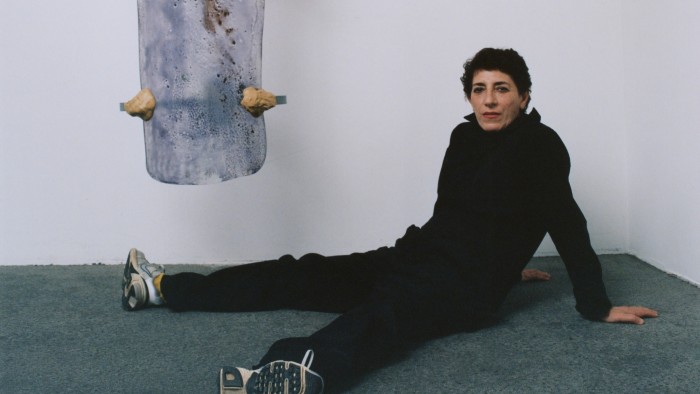
Since then, the Iran-born German artist has become known for embracing marginality and tackling political subjects like exclusion and integration, but always with playful levity. She has affixed her sculptures to the façades of buildings and used white Carrara marble to make huge prosthetic-limb like forms. Mottled textures and eccentric compositions infuse her work with dark humour, while soft materials like wax and silicone poke fun at the permanence of sculpture. “I need the tension between centre and periphery,” says Baghramian, 54, sitting in her apartment in Berlin’s western Charlottenburg neighbourhood. “My sculptures need a certain rootlessness, some playfulness, so I don’t become too monumental in my thinking.”
We are meeting for breakfast in the flat she shares with her longtime partner, former gallerist Michel Ziegler. Fittingly, the space resembles a very chic crèche. In the living room, oversized pillows shaped like cats’ faces rest on amorphous benches by the Swiss-French designer Janette Laverrière, with whom Baghramian collaborated on a series of exhibitions before Laverrière’s death in 2011. There are dusty-pink sofas designed by director Luca Guadagnino (an avid collector of the artist’s work). Silver mobiles dangle gracefully from the ceiling.
Dressed in an understated white shirt, Baghramian stands out against her colourful surroundings. Sitting at the kitchen table with buttered pretzels and omelettes, we discuss her forthcoming exhibition at Wiels in Brussels, opening later this month. Spread across two floors, it will feature drawings, wall-mounted pieces and a new series of glass sculptures made in collaboration with Murano and Veneto glassmakers (a first for her).
It’s the latest in a stream of solo shows and commissions. Recent years have seen her show at the Venice Biennale and Documenta 14 in Kassel, make work for the façade of the Met in New York and win the Nasher Prize laureate, awarded biennially to artists who have significantly advanced sculpture. She has become a bankable artist: her works now regularly sell for tens of thousands of dollars, and in 2023 she was photographed dressed in an oversized Argyle sweater for a Loewe campaign, alongside Hans Ulrich Obrist and Aubrey Plaza. “Everybody’s expecting my next pieces to be larger, bigger, more. So I thought I would go against myself,” she says, wryly, of the Wiels show. “The exhibition is all about ephemerality and invisibility.”
Baghramian was born to a teacher mother and a building contractor father in 1971 in Isfahan in central Iran. When she was 13, the family fled the country and relocated to Berlin. “My father, sister and brother were imprisoned in Iran under the mullahs – for speaking, for thinking, for existing,” she says. “Leaving offered more than escape: a chance to imagine a life unbound by oppression.”
It was from her family, who were vocal critics of the Shah and later the Islamic Republic, that Baghramian learnt the spirit of dissent that shapes her art and her identity as an artist. “We were encouraged to form our own perspectives, to resist indifference and mindless repetition,” she says. As a teenager in 1980s Berlin, she immersed herself in the city’s theatre, dance and music scenes, experiences she sees as pushing her towards sculpture and “discovering multiple ways of inhabiting form”. She also became involved in social causes, working at a women’s shelter while studying at university.
Since then, she has staked out her own space by upending expectations. When she was offered retrospectives at Minneapolis’s Walker Art Center and Ghent’s SMAK in 2017, she insisted on producing new pieces in response to her previous works. “I enjoy taking opportunities to be challenged. Save the retrospectives for some rainy afternoon,” she says.
It’s tempting to link her fragile figures, with their pervasive sense of transience, to Baghramian’s early life, marked by revolution and political persecution. But she resists autobiographical or overtly political readings of her work. “I believe in the autonomy of the art object,” she says. “Once you start giving concrete answers, the work stops being interesting.” Still, her 2023 façade commission for New York’s Metropolitan Museum, a suite of sculptures in which loudly coloured rocks, grids and squiggles balanced precariously in the niches of the 19th-century building, prompted New York Times art critic Roberta Smith to write that Baghramian’s fragmented works, leaning from their alcoves, seemingly on the verge of departing, reminded her of refugees.
“I can imagine what she means,” Baghramian says. “I think it’s about grappling with what a work of art becomes when situated in front of the Met, a site dense with historical resonance, when the work is impermanent. Temporariness is inseparable from the notion of refuge… The placing and positioning of the piece suggested the feeling of ‘Tomorrow I’m gone’.”
Her Brussels show, titled nameless, also explores transience. It will feature recent drawings and maquettes that offer insight into what Wiels director Dirk Snauwaert describes as her “doodling, automatic practice”, which he connects to the surrealist tradition of automatic drawing. Baghramian has also collected old neon signs that will be melted down and reblown by artisans into curvaceous abstract forms, emptied of their former meaning as advertising signs.
“It is a reminiscence of the tradition of neon lettering, stripped of its function, like a whisper,” she says. Snauwaert describes them as “anti-signs”. “Of course, neons are usually immediate, comprehensive signs,” he adds. “In times when overdefinition regulates everything, how do you avoid this kind of overdetermination? You do it by fluidifying the language.”
But, as ever, the show carries a poignant undertone. It’s “about how sculpture has the potential in difficult times to recreate and reshape itself,” she says. “Something positive always involves a collapse and a re-creation, to create something that’s always built on each other, pushing things out, building again, assembling things again.”
At the end of our conversation, she hands me a tote filled with her catalogues. One of them contains a misprint, a duplicate page. Ziegler searches for the correct version, but the artist insists I take the flawed copy. I leave their home glad to be bringing some of Baghramian’s imperfect world away with me.
nameless is at Wiels Brussels from 25 October until 1 March 2026
Read the full article here