

This article is part of FT Globetrotter’s guide to Istanbul
Few bodies of water have inspired as many legends as the Bosphorus Strait, the serpentine waterway that divides Turkey’s largest city of Istanbul between Europe and Asia. Its name derives from Greek for “oxford” from the myth of Zeus’s lover Io, who was transformed into a cow, then driven into the water by his wife Hera’s wrath. Jason and the Argonauts were fabled to have sailed through the Bosphorus on their quest for the Golden Fleece, and modern scientists speculate that a massive deluge through the channel flooded the Black Sea basin some 8,000 years ago, giving rise to the biblical story of the Great Flood and Noah’s Ark.
A century ago, pristine swimming spots dotted the Bosphorus, a sea passage linking the Black Sea with the Mediterranean system. But today many Istanbulites eye the 19-mile strait as a bottleneck as they commute across its three suspension bridges. Ceding the Bosphorus to the domain of oil tankers and ferry boats, residents prefer Black Sea beaches or the Princes’ Islands in the adjoining Sea of Marmara, while the well-heeled snub Istanbul all together and head to resorts on the Aegean or Mediterranean.
But a growing number of İstanbullus are breaking the taboo of swimming the Bosphorus’ fast-moving waters to rediscover its many pleasures. Although, as Nobel laureate Orhan Pamuk imagined it, the “skeletons of Celts and Ligurians, their mouths gaping open in deference to the unknown gods of prehistory” lurking below the blue depths are beyond reach, swimmers are rewarded with stunning views of waterside Ottoman architecture, frequent sightings of bottlenose dolphins and the thrill of a wild swim in a city of 16mn people.
The endeavour requires an abundance of caution. There are no lifeguards present as you battle the Bosphorus’s currents, which have claimed lives in the past. The strait acts like a giant siphon between the less saline Black Sea and the denser Sea of Marmara, and two layers of currents move in opposite directions at the same time. You will encounter lighter Black Sea water at the surface, and the current along much of the shore runs between one and two knots – manageable for strong swimmers (though it can be four knots in some places).
Swimmers must avoid the centre of the channel and its much faster flow due to shipping traffic. To swim from Asia to Europe, consider signing up for the Bosphorus Cross-Continental Swimming Race in August, when ships are halted and safety boats monitor participants.
Swimming is generally prohibited south of the First Bridge in the busiest section of the strait. Further north along the waterway are areas with less treacherous waters and fewer obstacles. Wearing a bright safety buoy and bringing a companion are advisable.
Shimmering on a bright summer day, the Bosphorus’s cool and surprisingly low-saline waters feel medicinal in the heat. Temperatures range from 20-24C in summer and about half that in winter — chilly but never freezing, thanks to the sea’s thermal mass. The water is now cleaner than in previous decades and at other sites around Istanbul, although northerly winds and rainstorms can bring rubbish and other debris, and jellyfish with mild yet harmless stings are part of the experience.
Most of these spots lack cabins or other facilities where you can change into a swimsuit, so wear your costume beneath your clothing or do a quick towel change on shore. Leave your valuables at home.
Bebek Park
An Art Nouveau palace that now houses the Egyptian consulate was once the summertime residence of Emina Ilhamy, the mother of the last khedive of Egypt and the only Ottoman woman to hold the honorific of pasha (comparable to “lord”). A 200-metre stretch of waterfront where oarsmen once docked ornate caïques to transport nobility over the Bosphorus is now marked off by buoy lines for swimmers.
You can find swimming duo Murat Öz and Yasemin Altıntaş at Bebek most mornings throughout the year as they train for major open-water events. Their quest to swim the Oceans Seven across the world’s straits and channels was cut temporarily short in May when a cookie-cutter shark attacked Öz between Moloka’i and Oʻahu in Hawaii.
“The Bosphorus is still in first place,” said Öz, 43, who grew up near Bebek. “It has a magnificent landscape: mansions on the left, castles on the left. It’s enchanting.”
Access to the water is by steps in the park adjacent to the Egyptian consulate, the main green space in the upscale district of Bebek on the European shore. The shallow water also attracts paddleboarders, who can steal glances into the palace’s neighbouring yalıs, or seaside mansions. Directions
Aşiyan
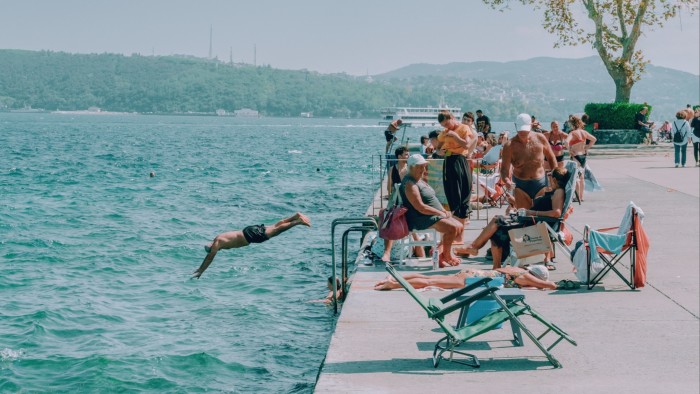
About 1.5km up the European coast from Bebek Park is the neighbourhood of Aşiyan, graced with a long esplanade that attracts fishermen hunting bluefish and anchovy in the swift-moving waters. The location also draws delikanlıs, or “crazy-blooded youth”, who perform backflips and somersaults from the platform into the deep water.
This is the narrowest point of the Bosphorus, with less than half a mile separating the continents, and the current along the coast picks up speed here. Swimmers enter the water from a set of stairs near Rumeli Hisarı, the fortress built by Sultan Mehmet the Conqueror ahead of his siege of Constantinople in 1453, and emerge on a second set of steps about 400 metres downstream — a return trip is almost impossible. Hug the shore closely so that you can navigate your exit and avoid the small ferry boat terminal situated 200 metres further down.
A bridge named after Sultan Mehmet spans the divide, and from the shore you will get a close look of the behemoth tankers carrying crude oil, grain and other commodities from Black Sea ports through one of the world’s busiest shipping lanes. Directions
İhtiyarlar Beach
The name translates as “Geriatric Beach” after the retirees who gather here early in the morning to spend the day sunning themselves into polished bronze statues. “Beach” is a misnomer, as the water is entered from an esplanade by rickety steps.
The promontory is located on a small bay of protected water on the European shore and is among the safest for a dip in the Bosphorus, especially in the early morning, when the drift tends to slow considerably. The swimming area extends for about 400 metres along the shore, and a return trip is easy. Tired athletes can decompress with a cup of hot tea from the vendor selling snacks from his mobile cart.
Without a club dedicated to Bosphorus swimmers, enthusiasts have formed informal groups to practise together at İhtiyarlar, Bebek and other spots, organising mainly over WhatsApp. Your best bet is to visit one of the spots around 7am and approach the friendly racers.
The Turkish health ministry publishes updates on the water quality at popular beaches, but information on Bosphorus swimming conditions is sparse. “We have a rule — we don’t swim the day after it rains,” said Öz. Surface run-off from Istanbul streets and rooftops drains into the strait, and in some parts of the city, sewage pipes may overflow, if the rain is particularly intense. Directions
Büyük Liman Beach
Close to the mouth of the Black Sea, the Bosphorus twists past forested hills and small fishing villages, where protected woodland still holds back Istanbul’s sprawl. The pressure of development looms, and one of the world’s longest suspension bridges, the Yavuz Sultan Selim Bridge, opened here in 2016.
Near the European foot of the bridge is one of the few Bosphorus beach clubs open to the public in summer. The Büyük Liman (Grand Harbour) Beach is reachable by car, then a steep hike down to a strand with fine, natural sand. The club, which charges an entrance fee of TL600 (£10/$14.50) that includes use of a sunlounger and umbrella, has showers, changing cabins and snacks. Lifeguards are on duty.
The water is relatively clear, and the bed is covered in seagrass, a critical filter of pollutants and a nursery for marine life. A flotilla of day-trippers on pleasure boats throngs the cove on summer weekends, so keep one eye out of the water to avoid anchor chains during busy times. Instagram; Directions
Paşabahçe Beach
At the bottom of a grove of trees in the Asian-side district of Paşabahçe lies a free beach along a recess of the Bosphorus. The water here is clean and the current less intense, and horse mackerel and silverside dart among the rocks in the shallows.
Families descend with tents and camping chairs to make themselves comfortable on the rough sand and brew tea in double-stacked kettles atop gas stoves on the water’s edge. An early-morning or midweek visit will help you to avoid the crowds. Directions
Locals flock to a handful of other spots on the Asian side, including to the north of Anadolu Hisarı, Rumeli’s twin fortress — together they formed a co-ordinated chokepoint of the Byzantines in the 15th century. Close to the city centre, the delikanlıs dive in from a tiny park in the neighbourhood of Kuzguncuk, where the rapid waters make swimming a more perilous pursuit.
Do you have a favourite swimming spot in the Bosphorus? Share your tips in the comments. And follow us on Instagram at @ftglobetrotter
Read the full article here