

Unlock the Editor’s Digest for free
Roula Khalaf, Editor of the FT, selects her favourite stories in this weekly newsletter.
A Swedish low-carbon steel start-up that is one of Europe’s highest-profile green industrial projects is scrambling to survive as it struggles to resolve a growing funding gap.
Stegra, formerly known as H2 Green Steel and started by the same Swedish financiers as bankrupt battery maker Northvolt, needs as much as €1.5bn in new funding after a trebling of its needs in the past three months, according to people familiar with its financing.
The risk of insolvency was discussed at a board meeting last Monday on the advice of the group’s lawyers after delays and cost overruns affected the plant it is building in northern Sweden, the people said.
“Equity investors are beginning to accept that they’re almost certainly going to be wiped out,” one of them added.
Stegra’s troubles come less than a year after battery start-up Northvolt, which was launched by the same group of Swedish private equity executives, went bankrupt despite having raised $15bn of debt, equity and government funds.
Several European “green steel” projects — in which furnaces are either electrified or powered by carbon-free hydrogen instead of coke or coal — have been abandoned or delayed in the past year as high energy costs make the low-carbon alloy too expensive for many customers.
Stegra has raised €6.5bn from some of the biggest names in European industry such as the Agnelli, Maersk, and Wallenberg families as well as Mercedes-Benz, Siemens, and Scania. Its biggest investors include Singaporean sovereign wealth fund GIC, Swedish private equity firm Altor and French investor Hy24.
Henrik Henriksson, chief executive, said he did not recognise “the very one-sided picture conveyed”.
He added that work on a new funding round was under way with “initial equity commitments from both founders and lead investors”, and that total proceeds were expected to represent up to 15 per cent of Stegra’s total project budget, or close to €1bn.
“Our ongoing discussions are constructive and progressing according to plan, and I’m confident we will succeed with our financing round,” he added.
Just Climate, an investment fund that is one of Stegra’s biggest shareholders, said it was “fully supportive” of the company. “This is a complex, transformational project, and it has made significant progress both in terms of its construction and future economics.”
Citigroup has indicated it wants to stop being a lender to Stegra because of concerns over the company’s future and has placed the company in its “work out group”, according to people familiar with the situation who say some other banks share its worries.
“They’ve got their work cut out,” said one lender. “It is crucial for them. But there is a solid case there, a basis to conduct fundraising, that there wasn’t for Northvolt.”
Stegra’s funding gap was only as much as €500mn in July, but the worst-case scenario presented to its board last week put this at €1.5bn. The central scenario was a funding gap of €1.25bn.
The start-up is burning through about €280mn of cash a month and will run out in less than two months if it is unable to draw down on existing debt commitments, according to people familiar with its financing.
Executives — led by Henriksson, a former head of truckmaker Scania who has no experience in the steel industry — are desperate to avoid comparisons with Northvolt, arguing that Stegra has a more proven business model and stronger customer demand.
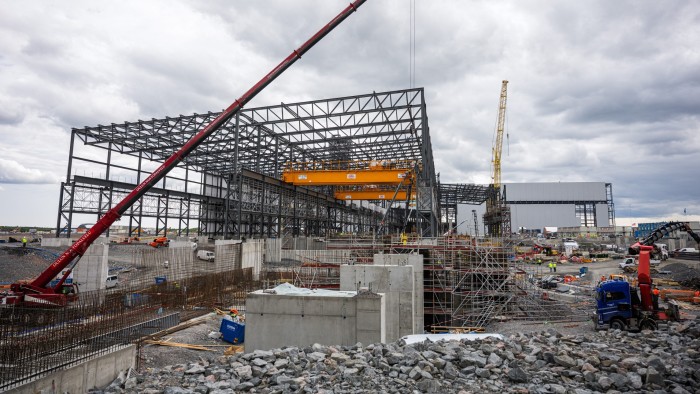
The company’s funding gap has risen not just because of increased costs and a new three-month delay to operations but also after it had to bring in-house some infrastructure it had hoped others would operate. This includes a railway at its factory in Boden, just below the Arctic Circle, and a nearby harbour.
Stegra has delayed parts of the plant — including a galvanising line — to save money and is looking at outsourcing some of its hydrogen and power assets to raise more, but this could take many months.
The company has been hurt by a refusal by the Swedish government to issue a €150mn grant already approved by the EU, complicating its funding efforts. Stegra has had difficult relations with the government after criticising several state-owned companies for causing delays to its expansion plans as well as its access to electricity and iron ore.
Read the full article here