

Stay informed with free updates
Simply sign up to the Arts myFT Digest — delivered directly to your inbox.
The British Museum was the first public national museum in the world, so in some ways, it’s kind of the museum. It has always been free, something that was very deliberate when it was founded in 1753 – it had to be for the benefit of all persons. Over the past almost three centuries – 272 years – the collection has grown and grown. Now it’s probably the greatest in the world.
I first visited when I was four years old. My family had just moved back from America – my parents were British but I was born in the US – which was quite a big upheaval. We stayed in one of those little hotels on Gower Street and my mum brought me to the British Museum. I remember seeing the mummies, of course, which a lot of children make a beeline for, but also just feeling this sense of solace and belonging in a world that was changing. I could see that I had a place in the world and that there was a bigger one around me as well. Since then, like a lot of people, I’ve come very regularly.
In a good sense, I never thought that I would work here. I’ve interned and worked at different museums – the Guggenheim, The Met, the National Portrait Gallery – but never here. The job of director came up a couple of years ago and the more I thought about it – what I could do with it, what the potential was – the more excited I got. I’ve held the position since March 2024.
Encyclopedic museums are going through a period of questioning, which is a good thing; it’s great to question things. As the museum moves toward its 300th anniversary, we want to collectively reimagine it for the widest possible audience. The belief that culture belongs to and enriches everyone remains at the heart of everything we do.
With a collection of more than eight million things, it’s hard to pick a favourite. It’s more about what’s occupying my thoughts. The latest is the Tudor Heart, a solid-gold chain with with an enamelled hand holding a heart-shaped pendant. It has the initials of Henry VIII and Catherine of Aragon on it; it’s astonishing.
One of the things we do here is oversee the Portable Antiquities Scheme, a system where metal detectorists find treasure – objects that are often centuries old and contain precious metals. Every year, thousands of things are discovered. If an object is deemed to be something that should be acquired by a museum, a government committee decides on a value; half usually goes to the finder and half goes to the landowner. The Tudor Heart was found by an amateur detectorist in a field in Warwickshire. The museum is trying to raise £3.5mn to acquire it.
Lions are also one of the museum’s great emblems. They’re on the door handles when you come in through the south entrance; there are two big stone sculptures by the north entrance and there’s an amazing photograph of Alfred Hitchcock, who shot a scene from Blackmail here, straddling one. And then, of course, lions proliferate in our collection – whether it’s the lions from Halicarnassus, the ancient Greek city, or in 18th-century Islamic paintings. They’re interesting in that they’re not of one particular culture or country – lions are from Africa and India, but are also incredibly British.
Here’s a hot tip: in the Prints and Drawings Study Room, anyone can make an appointment to go and see whatever they want. And bear in mind that we have one of the greatest collections of works on paper in the world – Leonardos, Michelangelos, Rembrandts. When I was a teenager, my mum wanted to see the Canalettos, so we came down to London and, lo and behold, someone got out the drawings for us.
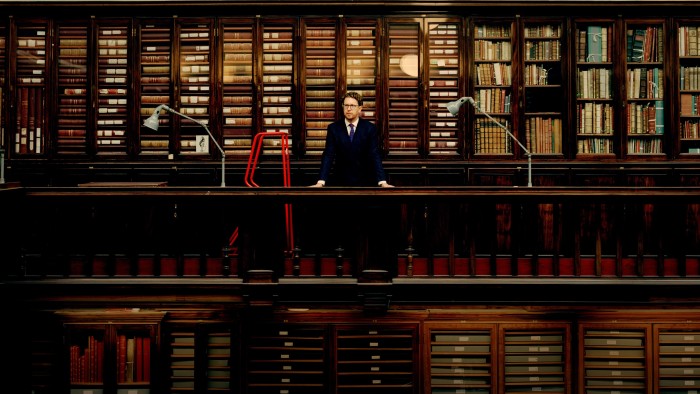
There’s a section of the Western Range that was open until the 2000s, when access laws changed; it’s like a ghost museum down there. I would love to open up more parts of the building. Last summer we reopened the Round Reading Room, which had been closed for 10-plus years. So many writers have used it. Karl Marx spent pretty much every day here for 30 years writing Das Kapital. Lenin also visited using a pseudonym. Just before Mikhail Gorbachev became leader of the Soviet Union in 1985, he came to Britain and made a point of visiting the Round Reading Room. He looked at where Marx and Lenin had reputedly sat and said, “If people don’t like Marxism, they can blame the British Museum”, which is amazing. How many museums get credit for an entire political order?
This weekend we’re hosting the first British Museum Ball. Having done galas at the National Portrait Gallery that were really good, it’s been a sort of holy grail for London to have an event of real scale and profile. The British Museum feels like the place to do it. It’s really about creating a moment that brings lots of people from different disciplines together – artists such as Hew Locke and Grayson Perry, filmmaker David Olusoga and writers including Zadie Smith and Elif Shafak. Also, people love a good party.
Every day, people queue around the block to visit us. It gives me hope that people want to spend their free time in museums. We’re working on making the experience more frictionless – new welcome pavilions and security scanners. We want to make it compelling for people to just walk in on their lunchbreak. Museums should be places where you could spend a lifetime, a whole day or just see one thing. You don’t have to make a big commitment, financial or otherwise.
We need encyclopedic museums more than ever. In an age where we’re being divided – whether that’s through politics, chauvinism or social media – they are a way of confronting people with different cultures and ideas. We need places and spaces and moments where we can be brought together, even if we disagree.
Read the full article here