

Stay informed with free updates
Simply sign up to the Oil & Gas industry myFT Digest — delivered directly to your inbox.
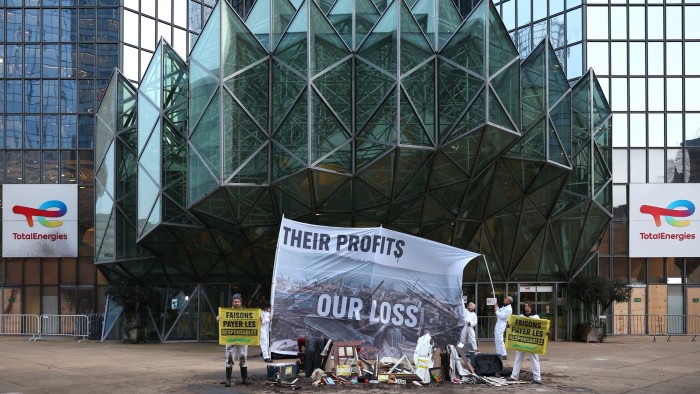
TotalEnergies lost a landmark greenwashing case on Thursday after a French court found it misled consumers with claims about its contributions to tackling climate change.
The oil and gas group was guilty of “misleading commercial practices” by saying that it planned to reach carbon neutrality by 2050 and be a “major actor in the energy transition”, the civil court found in a case brought by Greenpeace, Notre Affaire à Tous and Friends of the Earth France.
The judgment is the first win for activists against a key player in the oil industry under French law, although advertising regulators including the UK body have previously made findings on corporate green claims.
Shell last year won an appeal against a landmark order for it to cut greenhouse gas emissions in a Dutch court, which nonetheless said the company had an obligation to limit its emissions.
The Paris court ordered Total to stop communicating to consumers that it was “a major actor in the energy transition”, and to pay the non-government organisations €8,000 each. It must also publish the court’s decision on its website for 180 days, or face fines.
Justine Ripoll, a campaign lead at Notre Affaire à Tous, said the decision “sends a clear message — climate disinformation isn’t an acceptable commercial strategy. Citizens have a right to honest information and fossil businesses must give an account of the reality of their businesses.”
Jonathan White, a lawyer at the non-profit group Client Earth, which is supporting the case, said that it set an important precedent as other companies had made similar claims to both consumers and investors.
The court said on Thursday that Total led consumers to believe that its climate goals were aligned with the scientific opinion that fossil fuel production should fall rapidly if the goals outlined in the 2015 Paris agreement to limit global warming are to be reached.
Instead, the company had its own scenarios to reach carbon neutrality and continued to increase production and investments in oil and gas, the court said. By failing to communicate this, the company misled consumers.
However, the court rejected claims relating to TotalEnergies communications about biofuels and gas being cleaner than other fossil fuels, saying these were not linked to promotion, sale or provision of energy to consumers.
The action centred on 44 pieces of communication ranging from advertisements to social media posts and statements on TotalEnergies’ website.
The case is the latest in a string of action taken against oil and gas companies across Europe. In April, the UK’s Advertising Standards Authority banned a TotalEnergies ad that highlighted its investments in renewable energy, for “misleading by omission”. It has previously banned ads by companies including Shell, Repsol and Petronas for promoting their green goals without mentioning their larger polluting operation.
But courts have not so far upheld significant legal rulings against oil majors for greenwashing, nor ordered them to stop emitting or pay for climate-related damages.
Earlier this year, a German court dismissed a climate lawsuit brought by a Peruvian farmer against power company RWE over the threat to his home from global warming. But it upheld its previous position that polluters could be held accountable for damages under German civil law — this was interpreted, like the Shell case, as a marginal win for activists.
This week, Shell was also asked to pay compensation by dozens of Filipino citizens who lost family members or homes in a powerful typhoon that leading scientists found was made twice as likely by man-made climate change.
Shell said it agreed that action was needed on climate change, but that it never had “unique knowledge” about the problem. “As we supply vital energy the world needs today, we are transforming our business to supply lower-carbon fuels for the future.”
TotalEnergies did not immediately reply to a request for comment.
TotalEnergies’ strategy since its name change has involved investing more in renewables than rivals to increase electricity generation, while also increasing oil and gas production.
The company aims to produce 100TWh of electricity by 2030, using a combination of renewables, gas power plants and batteries, while also continuing to grow fossil fuel production by about 3 per cent each year.
Read the full article here