

Unlock the Editor’s Digest for free
Roula Khalaf, Editor of the FT, selects her favourite stories in this weekly newsletter.
In many ways, the odds are in favour of The Hunger Games: On Stage. Like all great dystopian literature, Suzanne Collins’ 2008 young adult novel extrapolated from real world trends to create a nightmarish vision of a future post-apocalyptic North America, where deprived children play a brutal survival game for the entertainment of the wealthy (the idea came to her while channel-surfing between TV game shows and war footage). This new iteration for the stage could scarcely be more resonant, opening in London just after the storming success of the BBC’s reality show The Celebrity Traitors and against a political backdrop of global inequality and ideological extremes.
It also fields a huge, custom-built venue in the aptly sleek Canary Wharf area, and a crack creative team: writer Conor McPherson (whose masterpiece The Weir is currently in the West End), director Matthew Dunster (whose thriller 2:22 — A Ghost Story is on tour) and brilliant designer Miriam Buether, whose glittering dark arena feels like a modern-day equivalent of the Colosseum. They seize on the opportunity offered by live performance to turn the audience into complicit spectators. Meanwhile, Collins has talked about structuring her books like three-act plays, which supports a transition to stage. Yet despite all this, though visually impressive and sometimes ingenious, the resulting show proves a curiously empty spectacle.
The best adaptations often honour the spirit of the original while finding a voice natural to the new medium. Here the script, drawing on the first novel in Collins’ trilogy and the 2012 Lionsgate film, never quite achieves that unique, independent dramatic life. In the book, we experience events through the eyes of 16-year-old Katniss, who, since the tragic death of her father, has become a wily hunter to support her mother and younger sister. So when she, together with the baker’s son Peeta, become “tributes”, competing for their district in the grotesque Hunger Games, it’s through her that we encounter the excesses of the Capitol, the horrors of combat, the fear of betrayal.
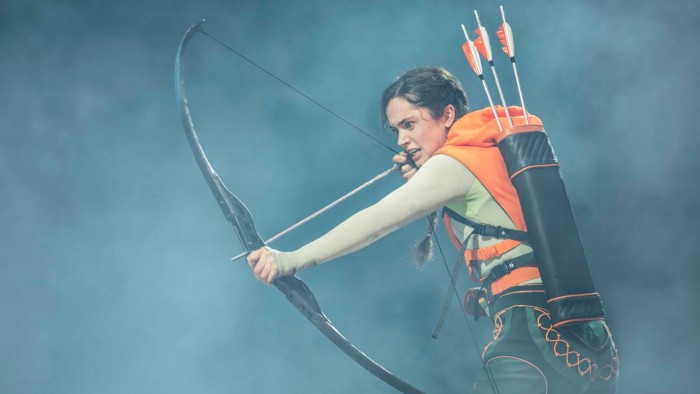
But first-person narrative can be hard to pull off on stage, and that, together with inevitable compression, means Mia Carragher’s charismatic, spirited Katniss mostly pinballs through the opening sections filling in exposition as she goes. It also means that her character frequently narrates her own thoughts and feelings, which has a flattening effect. The play hits the same beats as the novel but with less shading and subtlety and often feels rushed. Complex issues, such as Katniss’s conflicted feelings about Peeta, land with less nuance.
The show certainly pulses with energy, with the fine, athletic young cast tumbling across the space and fighting as they hang horizontally from the rafters. It also makes spectacular use of the scope of the arena: at one point Katniss and Peeta soar above the audience in flaming robes and a fiery chariot. Some seating blocks move to sculpt the playing space, while characters often burst out of a pit beneath the stage. Chris Fisher provides smart illusions, Lucy Carter dramatic lighting, and huge screens flash up video-game-style menus or filmed pronouncements from John Malkovich’s coldly remote President Snow.
But there are also some strangely redundant dance sequences and confusing plot twists. Audience interaction feels oddly halfhearted. And, perhaps most crucially, there’s little emotional impact. We are watching children die — that should hit hard, but it doesn’t. The show is at its most moving when it becomes more intimate. Joshua Lacey finds depths in games mentor Haymitch. And when Euan Garrett’s likeable Peeta is injured, both he and Carragher have space to act quietly, subtly and truthfully. Suddenly you really see them as brave, complex teenagers defying hatred with compassion. More of that would be welcome.
★★☆☆☆
Booking to October 2026, thehungergamesonstage.com
Read the full article here