

Most holidaymakers whizz through Burgundy on the A6 – the famous Autoroute du Soleil – on their way to sunnier and more glamorous destinations in the south of France. That’s excellent news for those of us who have come to love the region’s cooler, and less crowded, charms. We cheerily wave them on their way.
Whether it’s for climbing the Roche de Solutré to survey the voluptuous Mâconnais vineyards below, or attending a Bach concert in the majestic Romanesque basilica at Vézelay, or truffling around the markets and museums of Dijon, Burgundy will entice anyone who loves the French countryside, culture and cuisine.
Even at the busiest times of the year, the region seems to enjoy undertourism but still welcomes visitors, albeit on its own terms and in its somewhat fastidious and understated way. For curmudgeons like me, who have lost any desire to jostle in airport queues and broil on a beach, Burgundy has become a welcome sanctuary, little more than a 60-minute train ride south-east from Paris on a high-speed TGV. When we were living in Paris in the mid-2000s, my wife Carol and I bought a house in a tiny village in the Côte-d’Or and we have been regular visitors to Burgundy ever since.
In some ways, Burgundy is the embodiment of la France profonde, a politically loaded term that emerged in the 1980s to describe the traditional, rural heartlands of France but has since morphed into a sense of reactionary rebelliousness against much of the modern world. The pace of life is slow; your teenage children may say glacial. But slowing down the clock is often the purpose of a good holiday – and teenagers may well be pacified by renting a holiday house with a pool and good wi-fi.
Burgundy is certainly rich in history and culture. In the 14th and 15th centuries, it was home to the most ostentatious and powerful dynasty in Europe, with a succession of quirkily named dukes holding sway over a sprawling territory stretching from the Low Countries to the Alps. If a few twists of history had twisted in different ways, Burgundy could well have emerged as the pivotal Middle Kingdom between France and Germany. During the 100 Years’ War (which lasted 116 years), its dukes were often aligned with the English invaders in opposition to the French crown. The rest of France has not forgotten that in 1431 the Burgundians sold Joan of Arc to the English, who later burned the French heroine at the stake.
As Bart van Loo, the Belgian historian and author of The Burgundians has written, the region has always been on the frontline of European history but has all too often been whisked away in a footnote. For much of its existence, the duchy’s politics resembled a kind of Game of Thrones psychodrama, pockmarked by treachery, adultery, skulduggery, intrigue and murder. Burgundy reached the height of its powers under Philip the Good, who ruled from 1419 to 1467. A statuesque man with shaggy eyebrows, he was a generous patron of the arts, an enthusiastic host of lavish feasts (some 20 musicians once emerged from a massive pie during one of his festivities, according to the chroniclers) and an erotomaniac who sired at least 18 illegitimate children, the so-called bâtards de Bourgogne. Van Loo’s interview on The Rest is History podcast on Europe’s forgotten superpower is also well worth a listen for all the colourful details.
The riches of that era are displayed in the Museum of Fine Arts, one of the oldest and largest collections in provincial France housed in the formal ducal palace in Dijon, Burgundy’s capital. Along with the tombs of Philip the Bold and John the Fearless, surrounded by miniature statues of weeping mourners, the museum contains several masterpieces of renaissance and modern European art as well as a surprisingly eclectic display of Egyptian antiquities, Asian porcelain and African masks.
A short walk away, you can wander into Dijon’s incomparable indoor market, known as Les Halles, open four days a week. Inspired by one of the city’s most famous sons, Gustave Eiffel, the market is an ironwork and glass cathedral to gastronomy with dozens of stands bursting with local produce, including Dijon’s famous mustard, crème de cassis liqueur (used to make Kir Royale) and giant wheels of Comté cheese from the nearby Jura. A special New Year treat is to consume oysters and a glass of Chablis at a stand-up bar.
This is also the perfect place to buy the beef for your boeuf bourguignon. Many and contested are the ways in which you can cook this most traditional of French dishes. Is it essential to use beef from the local white Charolais cows? Does a non-Burgundian red wine not make a better sauce? Should the dish be cooked atop the stove or in the oven? Such controversies are likely to endure through the ages. But you are certain to find a delicious variant at one of the many brasseries and restaurants that surround the market.
A short drive south from Burgundy’s capital will take you to the legendary Route des Grands Crus, weaving 60km through 37 winemaking villages and some of the world’s most renowned vineyards, including Gevrey-Chambertin, Vosne-Romanée, Pommard, Santenay, Meursault and Puligny-Montrachet. The variety, depth and subtlety of the wines that can be produced from just two types of grape – Chardonnay for white and Pinot Noir for red – is worthy of extensive investigation that can last a lifetime. One of the other striking features of these vineyards is the size of the plots of vines. Even the smallest parcels of land can change hands for astronomical prices. The average price of a hectare of Burgundy premier cru white wine property was €2.55mn last year. The cachet of the land is reflected in the prices the vintages themselves command. Some of the best wines that Burgundy has to offer are put on sale every November at the Hospices de Beaune, a 15th-century almshouse. First held in 1859, the sale is the world’s most famous charity wine auction. Wine lovers from around the world flock to the centre of Beaune to bid for a barrel or two, drawn from plots donated by benefactors over the past 500 years.
They say that in Burgundy the vignerons have dirt under their fingernails because they are farmers who work the land, not grand-estate owners to be found in the far bigger vineyards of Bordeaux. That also means that few domains are set up to cater to tourists; you are better off buying wine from the many cavistes in the region.
Thanks to some very kind friends, we were once invited to an extraordinary seven-course dinner hosted by the prestigious Burgundian wine society, La Confrérie des Chevaliers du Tastevin. Some 500 guests were crammed into the dining hall at Clos de Vougeot, the spiritual home of Burgundy wine established by the Cistercian monks in the 12th century. That evening, the famous French chef Alain Passard was inducted into the wine fraternity after being dubbed with a twisty vine branch. This ceremony was accompanied by comic speeches, energetic hand clapping and several choruses of drinking songs, including “Chevaliers de la table ronde”, which memorably concludes with the words: “If I die, I want to be buried in a cellar where the wine is good.”
Burgundy is composed of four departments – the Côte-d’Or, Nièvre, Saône-et-Loire and the Yonne – each one with a slightly different character. The region’s watery highlands, which irrigate its vineyards, are the source of the Seine and major tributaries of the Loire and the Rhône that run into the Channel, the Atlantic and the Mediterranean. The region is also criss-crossed by canals carrying slow-moving passenger boats, a fine way to savour the local countryside at an even more leisurely pace.
In the more open south of Burgundy, in the Saône-et-Loire department near Mâcon, is one of my favourite sites: the Roche de Solutré. It takes less than an hour to scramble to the top of this jagged limestone outcrop, which affords spectacular views of the Mâconnais vineyards below. At the foot of the rock, near a prehistoric encampment, is a plaque in memory of the French president François Mitterrand, who served as a parliamentary deputy for the neighbouring Nièvre department. Even as head of state, Mitterrand would make an annual pilgrimage on Pentecost Monday to climb the rock with his wife, family and friends, sometimes giving interviews to accompanying TV crews along the way.
Like many other regions of France, Burgundy hosts a series of classical music festivals during the summer, often in unusual settings, such as the courtyard of the Hospices de Beaune itself, a jewel of Burgundian architecture that was originally established as a hospital for the poor. We have also attended memorable concerts in the austere basilica in Vézelay, in the Yonne department. On visiting the 900-year-old abbey, the great Russian cellist Mstislav Rostropovich said how its symmetrical architecture reminded him of Bach. He then proceeded to record Bach’s six cello suites in the chilly church – the remarkable performance is still available on YouTube.
This year, we attended a candlelit concert of Bach, Sibelius and Rameau at Abbaye de Fontenay, near where we live, with bats flitting through the high-vaulted church and cloisters. Visiting Cistercian monks also regularly perform their chants here. Founded in 1118, the abbey contains a large trout pond, a forge and serene gardens that were the backdrop for Cyrano de Bergerac’s final tear-jerking meeting with the love of his life Roxanne in the 1990 film of Edmond Rostand’s play.
For me, the other main attraction of Burgundy is that it is God’s own cycling country, with well-paved roads and very few vehicles. The rolling Burgundian countryside, boasting some challenging hills but few daunting mountains, is perfectly suited to the amateur cyclist. Pedalling past sunflower fields and vineyards on a summer’s day with family and friends and stopping at a village brasserie for a café crème and a croissant is one of the great pleasures of life.
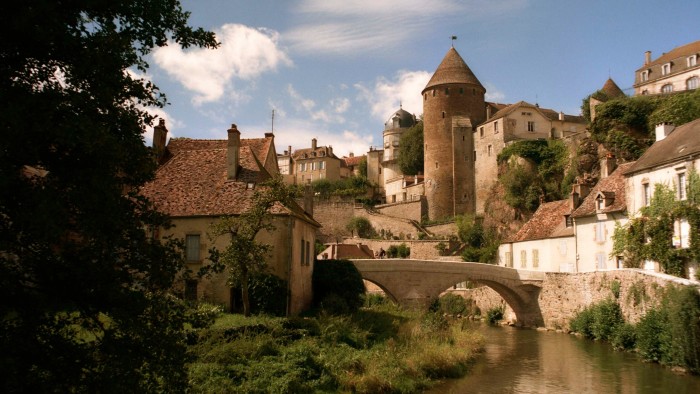
I first fell in love with cycling in 2007, the year we bought our house. That summer, the nearby medieval town of Semur-en-Auxois hosted a départ for the Tour de France following which the bewhiskered British cyclist Bradley Wiggins mounted a stunning, but doomed, solo attack 190km from the finishing line.
For several years, I have participated in a somewhat less demanding cycling event called the Courir pour la Paix, or the race for peace, commemorating the victims of the atomic bomb attacks on Japan and raising money for charity. The race was started 21 years ago by a somewhat eccentric Japanese businessman called Mike Sata, who owns the château at Chailly-sur-Armançon, where the race begins. It has now become an annual tradition with the results being published in Le Bien Public (The Public Good) – surely the best name ever for a newspaper.
On the morning of the race, several hundred cyclists gather in the courtyard of the château to be welcomed by the town’s dignitaries and blessed by the local priest standing beside a life-size Madonna. The fittest and leanest cyclists participate in the 133km race (Hiroshima), older and more experienced veterans (and keen youngsters and once a younger me) enter the 104km race (Nagasaki), and the rest of us ride in the 80km race (Tohoku, named after the 2011 tsunami and Fukushima nuclear accident). Bernard Hinault, the five-times winner of the Tour de France nicknamed “The Badger” for his fighting spirit, also regularly participates in the race – in spite of now being in his 70s – and hands out the prizes. I once desperately clung on to the back of Hinault’s mini-peloton for 43km before being dropped. My bike computer told me this was the fastest I have ever travelled over 75 minutes – although I suspect it was probably the slowest that Hinault has ever gone.
For me, the race encapsulates many of the things I most love about Burgundy: the opportunity to savour some glorious countryside in the heart of France; fun times with family and friends; a quiet respect for history and community; and a warm glow of virtue after completing some strenuous exercise.
To be sure, there are more exciting, and modish, holiday destinations elsewhere in France but there are few that so deftly combine a love of the good things in life with a traditional respect for how they should best be pursued. Every January, Burgundians celebrate the feast of Saint Vincent, the patron saint of winemakers, with costumed processions through their village streets and the sampling of a fine vintage or two. “Make us as good as our wine,” their prayer runs. That’s an appeal that chimes with me.
The 2025 Hospices de Beaune charity auction takes place on Sunday, 16 November. Visit hospices-beaune.com for details
Read the full article here