

Unlock the Editor’s Digest for free
Roula Khalaf, Editor of the FT, selects her favourite stories in this weekly newsletter.
It was wine in Beginning, hot milk in Middle. Each of the soul-baring encounters in David Eldridge’s tender, loosely affiliated trilogy of plays about love takes place in a kitchen — and each time there’s a beverage in the offing. In End, the quietly moving conclusion of the series, it’s tea. Though it never quite gets drunk.
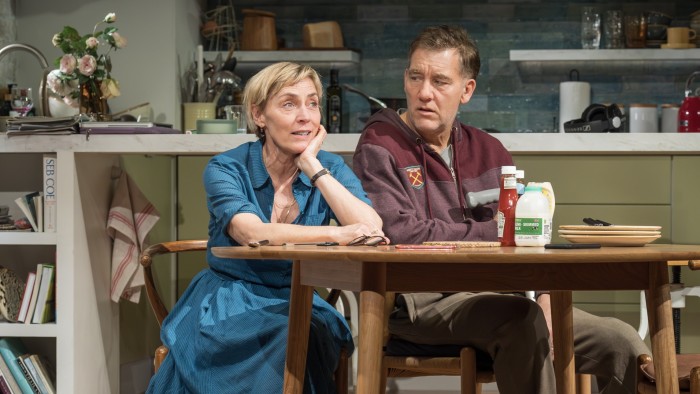
They are, in their own way, a daring set of plays. In terms of plot, very little happens, but in each there are seismic emotional shifts as a couple faces a moment of truth. Beginning traced the tentative first steps of two lonely souls; in Middle a different pair found themselves in a mid-relationship rut. And now is the turn of 58-year-old Alfie (Clive Owen) and Julie (Saskia Reeves), forced by Alfie’s cancer to confront the untimely end of their time together.
Alfie has made his name as a club DJ, so he knows the importance of a big finish. He declares to Julie that he wants no more treatment. Moreover, scarred by the prolonged demise of his own father, he wants her and their adult daughter to be spared the ordeal of sitting by his deathbed. But is that what they want? The question as to what makes a good end hangs in the air: for Alfie, for Julie, for all of us — and, on a meta-level, for Eldridge, bringing this compassionate series to a close.
If that sounds grim, it’s not the case. Frank, yes: candour is one of the qualities that has marked this trilogy out. Eldridge writes with honesty about the messy inconsistencies of human beings, particularly in love, and with a keen recognition that so many life-changing conversations unfold in the kitchen — here it’s a comfortable open-plan room in a sizeable north London house (a lovely, precise design from Gary McCann).
But End is also often funny. Spiky humour plays a large part in the palpable mutual affection between Owen’s Alfie and Reeves’ Julie. There’s touching absurdity in even the most profound moments. And Eldridge mischievously weaves multiple other endings through the piece. It’s 2016, and the EU referendum is just days away. Alfie, an ardent West Ham fan (like Eldridge), is mourning the team’s move from its beloved Upton Park stadium.
Some aspects of the play ring less true — Julie’s desire, as a novelist, to write about their relationship feels slightly engineered. But there are moments that are immensely moving: Alfie’s description of his long farewell to his father will strike home for many. And Rachel O’Riordan’s gentle production is delivered with superb care and precision by Owen and Reeves: in him we see the young man who once danced till dawn, but also the gruelling effects of constant pain; Reeves, meanwhile, can summon a wealth of mixed emotions in just one glance.
Each play works as a standalone drama. But delicate threads link them; together, for instance, they chart the passage from late night to early morning. And time is a key preoccupation. All three are haunted by memories and possibilities. When does something begin? When does it end? The heartbreaking irony of End is that it isn’t the love that is ending, it’s a life. That’s what makes this play beautiful: in defiance of its own title, it’s about what endures.
★★★★☆
To January 17, nationaltheatre.org.uk
Read the full article here