

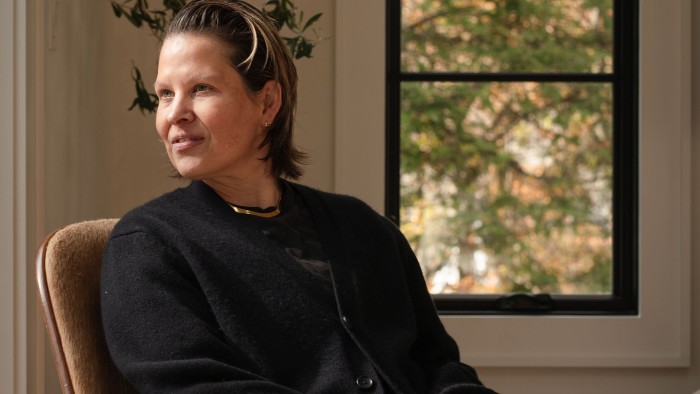
In September, watch collector Joyce Solano commuted from Connecticut to Manhattan to attend Rolliefest, the industry’s largest gathering of vintage watch enthusiasts. Founded in 2019 by Geoff Hess, head of watches at auctioneer Sotheby’s, the popularity of the invitation-only event — which has a $1,600 entrance fee — has grown because attendees want to catch a glimpse of the world’s most prolific collectors casually depositing their most important watches on a long table for all to see. Of the presiding collectors flexing their most prized possessions, each worth six figures, Solano was the only woman. “It was lonely,” she says.
A vice-president of brand at financial services business Capital One, Solano has been attending meetups since 2017 after buying her first luxury watch — a 1980s Rolex Datejust. What began as an online hobby on collector forums evolved into regular meetings in San Francisco and New York, where she is now part of another group called the Classic Watch Club. “I’m the single most active female in the group,” she laughs. “Just by showing up as a woman is a journey in itself. My passion is bigger than my need to feel totally represented.”
Her experience reflects a long-standing imbalance. The watch world remains overwhelmingly male-dominated, from the boardrooms of Swiss watchmakers to collector culture itself. But that balance is shifting. According to the 2025 Deloitte Swiss Watch Industry Study, “Willingness to buy a timepiece is now equally strong among men and women, signalling that demand is no longer driven solely by male collectors.” The Germany-based online reseller Chrono24 reports that approximately a quarter of its users are women, a slight rise from the 20 per cent reported in 2017. Sotheby’s says the number of female watch bidders has risen more than 70 per cent since 2015, with total spending by women doubling since 2020, driven largely by the US.
“To move the needle towards a more inclusive community, we need to redefine what collecting means,” says Charity Mhende, a collector and content creator who left a decade-long technology career in New York to study the business of luxury in Paris. “When it comes to speaking to women, we need to focus more on emotion and experience, not just ownership.”
Brooklyn-based collector and interior designer Olivia Song agrees. “I don’t think collecting is about owning expensive objects — it’s about finding something that speaks to you,” she says. “Whether my friends wear a [battery-operated] G-Shock or a [mechanical] Audemars Piguet, they choose it carefully. It’s something we bond over.” Still, Song admits she’s never been to a collector meetup. “It’s just not something I would do,” she says.
Karine Szegedi, managing partner at Deloitte Switzerland and lead author of its annual watch industry study, thinks psychology has something to do with it. “I’m generalising, but women do not have that ‘hunt’ mentality around acquiring a watch that men do,” which they then bond over during meetups at bars. The difference lies partly in approach. “For more women to host get-togethers around watches, it would have to be in a different spirit than what the men are doing. Maybe something else will resonate, but I don’t know if we’ve found it yet.”
Some watch companies are paying attention. Ilaria Resta, chief executive of Audemars Piguet, expects that by 2030, nearly half of the independent brand’s mechanical watch buyers will be women. This industry desire coincides with the foothills of the “great wealth transfer”, where women are set to inherit tens of trillions of dollars by 2045.
Since joining the Swiss watchmaker in 2024 after a 25-year career in the beauty industry, Resta has emphasised listening over segmentation. In October, she hosted a gathering of female clients at the company’s headquarters in Le Brassus, describing it as “a space where our clients can share their views and experiences openly with us”.
Resta argues that women’s participation in watch collecting is being driven less by marketing and more by dialogue — a point acknowledged by other companies, which are channelling their efforts into creating a sense of community among women collectors. For example, in Geneva last October, Sotheby’s hosted an all-female collectors’ event, pairing timepieces with handbags, jewellery and even manicures — the last element admitted with a touch of irony over a phone call with Clara Kessi, a watch specialist at Sotheby’s: “We’re laughing, but we all love it.”
Social media is also playing a role in sparking women’s interest in watches, from a much wider potential clientele. “Since the pandemic, female interest in vintage and pre-owned watches has grown,” says Kessi, a watch specialist at Sotheby’s. “This is not driven by brands, but by other collectors. Now information about watches is so much more accessible — female collectors can look up to others through social media.”
Conversations and trends that started online also affect auction sales. Kessi says that 20 per cent of watches in last month’s “Important Watches” auction at Sotheby’s were originally made for women — a proportion that would have been unthinkable even a decade ago.
But that online enthusiasm has yet to be translated into the wider collector community that meets in person. Mhende is keen to change that, hosting her own events and discussion panels across the US and Europe, to help people, as she puts it, “bridge the gap between Instagram and reality”.
For example, last year in New York, Mhende partnered with the Women’s Jewelry Association and vintage retailer Analog Shift on an event titled “How to Build a Watch Collection 101”, aimed at newcomers who might not yet own a watch. The focus of the event was to improve accessibility for all potential watch collectors.
“These spaces can feel intimidating when you don’t have the language,” she says. “For me, it’s about making those spaces feel accessible. You can jump in from whatever level you’re at — whether you’re a total novice or you’re confidently sharing your watch collection at Rolliefest.
“I started my journey watching videos on Instagram and YouTube, but you can’t compare that to the experience of actually getting to meet people who share the same thing as you.”
According to Solano, accessibility is personal. “I wasn’t born into a ‘luxury watch family’,” she says. “We’re Latinos, we’re hardworking, and I was the first person in my family to graduate from college.”
For women like Solano, the act of collecting is self-made. “There was never a time when I wasn’t into watches,” she says, recalling her childhood obsession with entry-level Swatches. “The only difference is that I now have the opportunity to access pieces that otherwise are inaccessible to most people.”
Read the full article here