

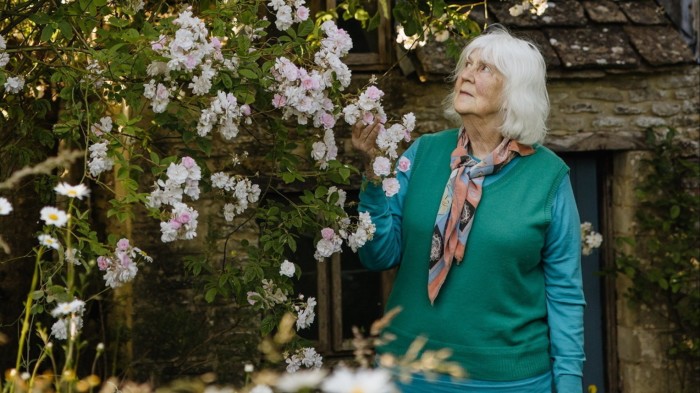
The Horticultural Trades Association estimates that in Britain about 43mn people cultivate or have access to a private garden and 26mn of them use the space to grow plants, trees or flowers. I owe knowledge of this estimate to a long-established gardener and writer on gardening, Mary Keen. In her aptly titled new book, Diary of a Keen Gardener, she well asks what the other 17mn are “doing with their plots”. It bothers her, she says, “that for so many, gardening represents a chore, a sterile space” in which shrubs and hedges are “savagely clipped so that the whole place feels punished rather than loved”.
Well put indeed, but the other 26mn are an opportunity too. Many of them are young recruits to gardening, often converted during the lockdowns in 2020-21. How can these recruits be encouraged to persist?
In this context, long-practised gardeners are an invaluable resource. I am not just pleading my own corner after years of writing here on gardens, often with new gardeners in mind. I am reflecting on all I personally continue to learn from older gardeners and their writings. Horticultural memory matters, just as collective memory matters in every context.
When I last sat on a university committee, I was shocked that the discussion was guided as if institutional memory was an obstacle. It is a resource, not an irrelevance, and it also shapes how reform will be received: at times, mercifully, it aborts it. When I said as much, the chair retorted that the question before us was how to proceed, beginning from “now”, with a clean sheet. I call that the Pol Pot method: declare Year One and ruin the future by wiping out its past.
Gardens too are heirs to long chains of practical wisdom. Some of it has been refuted: we no longer spray with DDT, a chemical commended in the 1940s but discredited by subsequent research into its side effects. However, it takes more than one or two ill-advised links to discredit a chain’s entire length. New gardeners gain by taking on the living core of what older gardeners have learnt. It speeds them to gardening’s frontiers, from which they can devise yet more wisdom of their own. Young gardeners have no need to reinvent the wheelbarrow.
As repositories of long experience, three recent books, written in notably varying tones, are the ones I am choosing to recommend. One is by Carol Klein, well known as a presenter on TV’s Gardeners’ World where her experience for decades as a nurserywoman in Devon marked out her contributions. Another is Keen’s aforementioned book, a diary of a year in the most recent of her gardens, where she has been refining, but not jettisoning, all she has learnt from experience and from the many skilled gardeners she has befriended. The third book is by Jamaica Kincaid, the subtlest writer of the three. Born in Antigua, she gardens in Vermont, constantly thinking about the garden’s role in her and others’ lives and her own responses to it and them.
The three span a wide social spectrum, itself a fascinating arc. They each give their hortobiographies, Klein’s neat title for her life. She evokes her challenging childhood, during which her father, proud acquirer of a television shop, had to serve a year in prison after participating in a scam in his former job in the Ministry of Pensions and National Insurance. Even so, like him, Klein won a place at a grammar school where she confronted hard facts of social class and accent. “My Pa’s car is a Jaguar and Pa drives rather fast”, pupils had to recite in school assemblies in order to raise socially the flatness of their Lancashire spoken “a”s.
Keen, or Lady Mary, had no need for socially uplifting elocution, though I cannot picture her driving a Jaguar. She has gained from her many travels and commissions to plant flowery gardens for clients, including Rothschilds, but she also retains an open heart for keen gardeners of all backgrounds. She quotes the artist Kandinsky (noted for her by her daughter Alice Oswald, the celebrated poet): “In the hierarchy of colours, green represents the social middle class: self satisfied, immovable, narrow.” She disagrees, but not as brusquely as I would: each side of this equation is a travesty.
As for Kincaid, she had nothing to do with jaguars on four wheels: she grew up on Antigua, an island, she notes, denuded of trees by colonial settlers in the 17th century. She would surely have an even sharper riposte to Kandinsky on green. What unites these three disparate authors is their awareness of gardening as children, often through their mothers and female relations, and their life-long reflection on what flower gardening, especially, is aspiring to achieve. Broadly they agree, responding memorably to flowers in wild nature and to gardens. Keen well describes hers after returning from a stay in hospital, as “blowy . . . while roses are swarming up trees and daisies are charging across the meadow where love in a mist has managed to seed itself into a dense overgrowth”. Kincaid’s book, Putting Myself Together, arranges a collection of her essays from 1974 onwards: “The Kind of Gardener I Am Not”, written in 2018, is highly Keen and Klein compatible.
I like the way Klein intersperses chapters on particular plants, giving precious advice about her favourites and their preferences, based on years of growing them for a living. Unintentionally, her choices sometimes overlap with Keen’s and even with Kincaid’s, on poppies especially, where Kincaid wins on points for her evocation of what she sees in annual Californian poppies, including resonances in the history behind their naming.
Repeatedly, horticultural memory gives us invaluable wisdom, concluding with lists of plants now grown by the selective Keen, an excellent starting point for new gardeners, but spanning tips, too, on growing and choosing primroses and foxgloves, Klein’s excellent overview of lupins, and Kincaid’s of hellebores and moving her peonies tyrannically from place to place.
They all understand that gardening is a process and never stands still, a crucial lesson for recruits who may have been hoping for an obedient exterior design. Kincaid, however, is the one with the deepest range. She presents herself as “never really making a garden so much as having a conversation”, rightly stressing how our tastes in plants keep changing, how curiosity propels her, how gardens are not places of “rest and repose”, how disturbance and resentment are endemic to them, how wildlife fights in them and ruins them, and how for her, threads run back to the idea of Eden with its Tree of Life (“Agriculture”) and its consequent Tree of Knowledge (“Horticulture”). Underpinning it is a division of labour, most evident in America, because Black people, slaves, were the labour there on which Life depended in the world after the Fall.
In her deft essay, “A Letter to Robinson Crusoe”, written as if from the character Friday’s perspective, Kincaid warns that the “triumph” of Robinson’s “individual resilience and ingenuity” is bound up with his white identity, but that the “people who laid claim to the ‘Enlightenment’ needed enlightenment and the rest of us were perfectly OK”. We need to remember the roses these authors pick as best, but we also need to remember what Kincaid’s hard-learnt wisdom conveys.
Find out about our latest stories first — follow @ft_houseandhome on Instagram
Read the full article here