

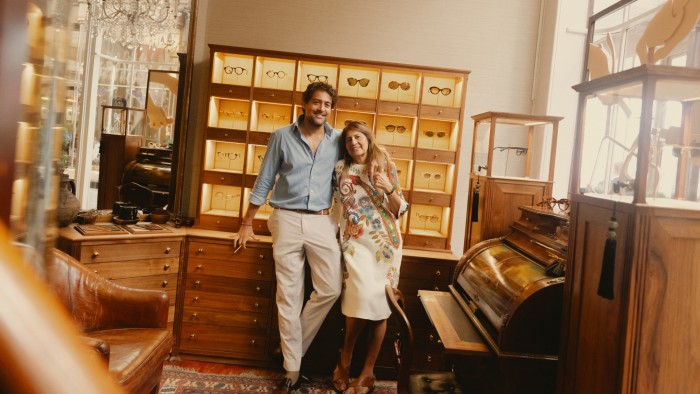
Linking the bustle of Old Bond Street to the relative calm of Albemarle Street, The Royal Arcade is the late 19th century’s equivalent of a luxury mini mall. To pass beneath the ornate stucco of either one of its arched entrances is to step into a version of West End retail as it might have been, had the glittering temples of big luxury never replaced the family businesses that once lined Bond Streets Old and New.
In this tangerine and white stucco tunnel, where pendant lamps augment the daylight, you will find shops with curved glass windows, narrow spiral staircases and dainty little iron balconies. Their occupants tend to be family-owned or independent businesses. Royal confectioner Charbonnel et Walker is at the Bond Street entrance, perfumer Ormonde Jayne at the arcade’s other end. Next to Watch Club, opposite shoemaker George Cleverley, you will find EB Meyrowitz.
The company was founded in 1875 and has been celebrating its 150th year. Its history includes making racing goggles for early aviators and daredevils such as Woolf Barnato, Sir Malcolm Campbell and Sir Henry Segrave. These days the character of this tiny shop with an outsized reputation comes from owner Sheel Davison-Lungley and, since 2012, her son Jamie.
Sheel began her career in optometry as an employee of Meyrowitz when the store was on Old Bond Street. “When I was studying, we all aspired to work at Meyrowitz because it had a reputation of being the very best,” she says in a soft voice. “But by the time I came in, it had slightly lost its way.” When the opportunity arose to buy it, she borrowed money from family and friends and acquired the business in 1993.
At which point Jamie, sitting across the table in the tiny first-floor office, interjects. “What my mother won’t tell you is that she completely transformed the place. Before her, it was respected but dusty. Now it’s respected and relevant.” She has restored the lustre of the brand by moving it into the arcade 26 years ago, taking the manufacture of frames in-house and building up a following for bespoke spectacles.
Sheel may seem to waft effortlessly around her business, but Jamie knows first hand how hard she worked. “She always used to say: ‘Do you want a mother who stays at home and looks after you? Or do you want one who goes to work?’” he recalls.
The question was rhetorical, of course, but that didn’t stop him asking, “Why can’t I come with you?” Such was his persistence that when he started school they reached a compromise. “During school holidays he was allowed to come into the shop and earn pocket money doing the filing,” says Sheel. Although he went on to study at LSE, where he achieved a master’s in finance and accounting, and then went into banking, he returned to Meyrowitz in his 20s. His mother was delighted, his grandfather, less so. “I felt quite bad about it,” says Sheel. “I asked Jamie, ‘Are you sure, because it’s a very different job to what you’re doing at the bank?’ And he said, ‘I’d like to develop our family firm.’ Do you remember?” She beams a proud maternal smile.
Even so, Sheel was a little anxious about working so closely with her son. “It is a small shop, and I had built up the business by being very understanding with people and doing my best to make what they wanted. I didn’t know how he would be with people. And I had to take him aside a couple of times.”
The bespoke side of Meyrowitz has attracted a desirable yet demanding clientele ranging from dukes to actors. The oldest client is 95; the youngest, an eight-year-old girl who asked for a pair of bespoke spectacles as a gift. Over the years, the Davison-Lungleys have found that Meyrowitz benefits from having two pairs of eyes. It allows them to see the same craft from different perspectives and explore more styles.
One of Jamie’s innovations was the introduction of eveningwear designs. “I prefer frames that are a little heavier and a little more barrelled,” he explains. “There’s a lot more curvature on the top line of the frame so light bounces off it. I think that makes for a really nice complement to an evening suit and patent-leather shoes.” Of his mother’s style, he adds: “She favours more matte finishes, with a more structured top. She likes to play with bridge shapes, so when you see acute bridge shapes, you know that it is one of her designs. We both have our different design styles and every month or so we chat about what we’ve designed, and why it works.”
“The biggest difference,” says Sheel, “is that I like drawing. I’ve always drawn with a pencil. I like things to look artistic. Jamie likes things to look precise, and he loves designing on his computer.”
“That’s because you never taught me to draw,” he ripostes. “Computer-generated design is almost foolproof,” he goes on. “There’s no guessing. There’s nothing left to interpretation, and that’s why I like it. I’ve been trying to get [my mother] to do computer design for the past six years.”
For Sheel, designing frames is all about interpretation. “I’d call this amber but for Sheel it will be caramel, honey, bright brown and sometimes golden syrup,” Jamie says, holding up a warm gold sheet of resin soon to become a pair of spectacles. “Being a little bit more pragmatic, I think that’s going to confuse our craftsmen, but she sees such subtle differences in tones. I think that’s amazing, but sometimes when I’m between her and the craftsman, it causes…” he pauses. “Logistical differences.” While Jamie will provide the drawing to their craftsmen and leave them alone until they have completed the work, Sheel will often visit the workshops in Hampton to discuss refinements to the works.
As well as designing, Jamie has taken on the role of brand director and developed the international trade that was missing when he arrived. “I started doing trunk shows about seven years ago, and after a couple of years began touring with bespoke shoemakers Gaziano & Girling, shirtmaker Budd and tailor Edward Sexton. That grew from about three clients on our first visit to San Francisco. Now we visit 11 cities in the US about twice a year and see between 75 and 100 people on each trip.” He has recently added the Middle and Far East to his itinerary, while forging a partnership with Savile Row tailor Huntsman. “We designed four pairs of sunglasses, and we can’t produce enough for them,” he says of the collaboration.
A couple of years ago, Sheel gave Jamie a free hand to redesign the shop. “I came at the end of the day, and I thought it looked amazing,” she says of his handiwork. Although the shop was completely transformed, it looked oddly familiar, but she could not say exactly why, until some time later she cast her mind to the time when, as a six-year-old, her son would come into the shop. “He would come round and sit with me and chat about the frames and the colours. While I worked, he would draw things. And he drew something similar to the cabinets he later made.”
“I had completely forgotten about that drawing,” Jamie says, “but my mother reminded me that it was a matrix of cubby holes. It was lovely to reconnect subconsciously with my six-year-old self. It has always been familial in the sense that I work with my mother, and enjoy her company.” In time, may there even be a third generation to join the business? Adds Jamie: “My partner works here too.”
Read the full article here