
NY Fed Consumer Survey Shows Steady Inflation, Despite Soaring Expectations For Medical Care Costs

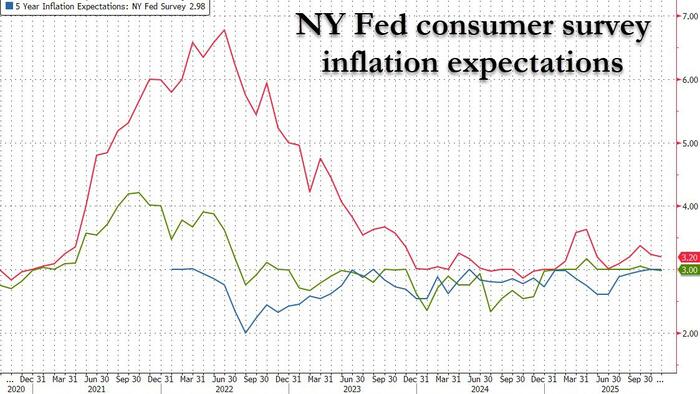
US consumer inflation expectations were stable in November while perceptions about households current financial situations deteriorated “notably” and perceptions about job prospects improved, according to the latest Survey of Consumer Expectations from the Federal Reserve Bank of New York.
Median inflation expectations a year ahead was little changed at 3.2% last month, down from 3.24% in November, while expected inflation three and five years ahead remained at 3%, according to responses in the New York Fed’s monthly Survey of Consumer Expectations, published Monday.
Median year-ahead commodity price change expectations increased by 0.2 percentage point for food (to 5.9%), 0.6 percentage point for gas (to 4.1%), 0.7 percentage point for the cost of medical care (to 10.1%), 0.2 percentage point for the cost of a college education (to 8.4%) and by 1.1 percentage points for rent (to 8.3%). Of note, the reading for the expected change in the cost of medical care is the highest since January 2014, shortly after the series began.
The survey showed consumers largely were more optimistic about the labor market in November than a month earlier, marking down the chances of a higher unemployment rate a year from now and reporting better odds of finding a job if they were to lose theirs.
The perceived probability of losing one’s job fell 0.2% to 13.8%, marking the lowest reading this year. At the same time, the mean probability of leaving one’s job voluntarily also slumped to 17.7%, the lowest since February.
Consumers are reduced the chances of a higher unemployment rate a year from now…
… and reporting better odds of finding a job if they were to lose theirs.
But with job prospects still worse than last year and inflation still elevated, a greater share of households reporting that their households were worse off compared to a year ago and a smaller share reporting they were better off. Expectations about year-ahead financial situations also deteriorated slightly, with a smaller share of respondents reporting that their households are expecting to be better off a year from now.
The percentage of respondents saying their current financial situation was worse than a year ago rose to 39%, the highest in two years.
Some more highlights from the report:
- Median one-year-ahead earnings growth expectations remained unchanged at 2.6% in November.
- Median nominal household spending growth expectations increased by 0.2 percentage point to 5.0%.
- Perceptions of credit access compared to a year ago deteriorated, with the net share of respondents expecting it will be easier versus harder to obtain credit a year from now decreasing, while expectations for future credit availability were largely unchanged.
- The average perceived probability of missing a minimum debt payment over the next three months increased by 0.6 percentage point to 13.7%, modestly above the trailing 12-month average of 13.3%.
- The median expectation regarding a year-ahead change in taxes at current income level increased by 0.9 percentage point to 4.1%, the highest reading since June 2024. The increase was broad-based across age, education, and income groups.
- Median year-ahead expected growth in government debt increased by 2.0 percentage points to 9.2%, the highest reading since July 2024.
- The mean perceived probability that the average interest rate on saving accounts will be higher in 12 months decreased by 0.8 percentage point to 24.1%.
- Perceptions about households’ current financial situations compared to a year ago deteriorated notably with a larger share of respondents reporting that their households were worse off compared to a year ago, and a smaller share reporting they were better off. Expectations about year-ahead financial situations also deteriorated slightly with a smaller share of respondents reporting that their households are expecting to be better off a year from now.
- The mean perceived probability that U.S. stock prices will be higher 12 months from now decreased by 1.0 percentage point to 37.9%.
More in the full report.
Loading recommendations…
Read the full article here