


Key takeaways:
-
Luke Judges states that technical strength alone cannot guarantee long-term competitiveness, suggesting that XRP could benefit from Solana’s pragmatism and execution speed.
-
Judges believes Solana’s market traction comes from practical engineering and a fast go-to-market strategy rather than protocol design alone.
-
David Schwartz takes the opposite position, arguing that XRPL’s reliability and stability are more valuable than pursuing high-throughput chains.
-
Judges highlights that developer onboarding, tooling and validator incentives are critical for sustaining growth and reducing centralization risks.
Luke Judges, global partner success lead and director of Ripple, shared observations about the evolving XRP Ledger ecosystem and its competitive landscape, highlighting a clear parallel to the operational successes of rival layer-1 network Solana. Drawing on his prior experience in the Solana network managing a substantial validator, Judges suggested that technical superiority alone is not enough to secure a network’s long-term relevance.
This article explores Ripple executives’ insights on operational lessons, focusing on technical advancements within the XRP Ledger (XRPL) and the strategic requirements for layer-1 competitiveness.
Operational lessons from Solana’s playbook
Judges’ perspective is unique and rooted in his experience operating two startups and running a Solana validator that managed more than $30 million in staked tokens through a full market cycle. He shared this detail on Nov. 30, 2025, on X, noting that he witnessed the network’s major price peak as well as its subsequent collapse and recovery.
This hands-on exposure led Judges to conclude that the success of layer-1 networks in a competitive cycle is often driven by factors distinct from core technology. He specifically credited Solana with having “pragmatism and speed,” which he views as essential for securing developer mindshare and driving adoption.
The core idea is that execution velocity and a practical approach to engineering and market entry can outweigh theoretical leadership in the race for ecosystem growth.
Nonetheless, Judges suggests that other chains could take note of how Solana runs its network, arguing there is “no point burying your head in the sand pretending you’re the only chain in town.” For the XRPL, these observations highlight potential blind spots, suggesting that technical milestones must be paired with a proactive go-to-market (GTM) strategy to translate into a true competitive edge.
Technical developments in the XRP Ledger
The call for strategic acceleration comes as the XRPL is actively pursuing significant technical expansion, including the launch of XRP Ledger Smart Contracts on AlphaNet. Historically optimized for fast, low-cost cross-border payments through its federated consensus mechanism, the XRPL is now focusing on increasing its programmability and utility in the decentralized finance (DeFi) space.
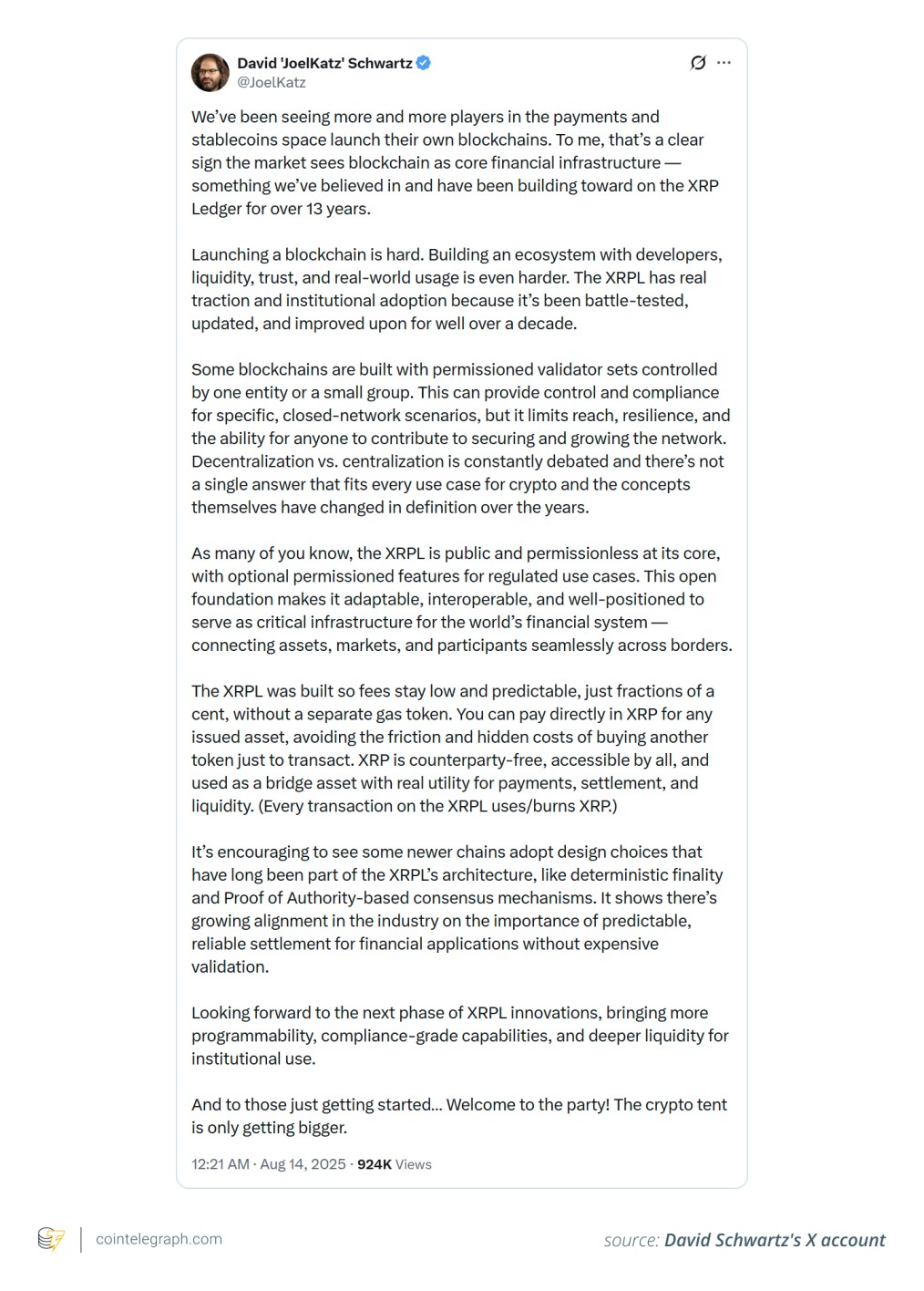
In direct contrast to Judges’ view, David Schwartz, chief technology officer of Ripple and the original architect of the XRP Ledger, emphasized that XRP’s design philosophy is centered on reliability, efficiency and institutional-grade performance. He argued that this positions the network as inherently superior to high-throughput chains like Solana without needing to overhaul its core strategy.
Schwartz critiques blockchains such as Solana for prioritizing raw speed at the expense of stability, pointing to its history of network outages as evidence that this approach is unsuitable for real-world financial applications.
For Schwartz, the XRPL’s consensus mechanism delivers consistent transaction finality and near-zero fees, offering superior uptime and predictability. He argues that this is a critical competitive edge that should be prioritized over mirroring the ecosystem structure that Judges praises for its “pragmatism and speed.”
Developer and ecosystem considerations
A key element of Judges’ assessment concerns developer experience and ecosystem support. Providing effective developer tools, clear documentation and structured onboarding processes can encourage builders to deploy applications and engage with the network.
Judges’ commentary highlights core challenges in maintaining a resilient layer-1 network, particularly the need for robust and sustainable validator economics. While acknowledging Solana’s success in attracting builders, he also noted that the network is facing the challenge of how “validator count is dropping fast right now,” which raises long-term concerns about decentralization and the sustainability of its incentive model.
For the XRPL, this serves as a preemptive caution against creating incentive structures that could lead to similar concentration risks, especially as the network explores native staking concepts.
The debate over validator economics highlights the two networks’ different design philosophies. The XRPL’s consensus is valued for its battle-tested stability, fast transaction finality and institutional-grade reliability. Its challenge is to develop new staking mechanisms that increase utility without compromising its core value proposition of predictable reliability, which stands in contrast to the instability seen in some high-throughput chains.
Did you know? In his X post, Judges notes that the Ethereum Foundation is becoming “much more focused in their GTM,” referring to its shift toward layer-2 solutions, or rollups. This move directly addressed user complaints about high fees and slow speeds on the main chain, issues that Solana was effectively using to attract users.
Market context and strategic execution
Judges’ overall message should not be interpreted as an existential threat to the XRPL but rather as a constructive mandate for strategic adaptation. It reflects a high-level recognition that the competitive landscape rewards execution over theoretical technological superiority.
In practical terms, Judges states that the XRPL’s strategic focus should center on three areas:
-
Improving the developer experience by making it faster and easier for programmers to build on the XRPL, borrowing Solana’s focus on practical, quick-to-use tools.
-
Sharpening the market strategy to quickly turn new technical features such as smart contracts into clear, unique and appealing benefits for partners and users.
-
Leveraging reliability for enterprise adoption, which is the XRPL’s main strength, while adopting the operational speed and flexibility seen in rival networks.
Judges’ takeaway can be interpreted as a reminder that capturing the next phase of blockchain adoption requires strategic adaptation to ensure the XRPL’s execution matches its technical innovation and established leadership in cross-border financial applications.
This article does not contain investment advice or recommendations. Every investment and trading move involves risk, and readers should conduct their own research when making a decision. While we strive to provide accurate and timely information, Cointelegraph does not guarantee the accuracy, completeness, or reliability of any information in this article. This article may contain forward-looking statements that are subject to risks and uncertainties. Cointelegraph will not be liable for any loss or damage arising from your reliance on this information.
Read the full article here