

Unlock the Editor’s Digest for free
Roula Khalaf, Editor of the FT, selects her favourite stories in this weekly newsletter.
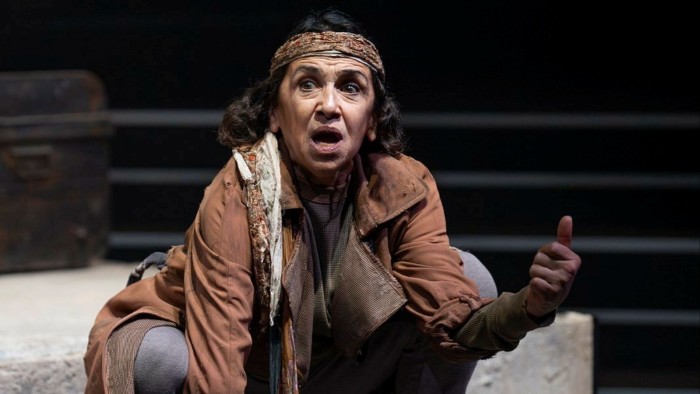
The tiger (Kathryn Hunter) sits at the front of the stage, exuding big cat boredom and effortless feline superiority. The lions, she tells us, dripping with scorn, escaped from the zoo two days ago and immediately got shot. “I mean, it’s the middle of a war. Use your head.”
Rajiv Joseph’s madly surreal, bleakly funny and quietly humane piece is based on a true event. In 2003, in the aftermath of the US-led invasion of Iraq, a starving Bengal tiger in Baghdad’s depleted zoo was shot by an American soldier after it mauled his colleague’s hand. For Joseph, this bizarre incident offers a dramatic route into the unhinged hellscape of war. In Bengal Tiger at the Baghdad Zoo, staged on Broadway in 2011 and only now receiving its European premiere, his tiger stays around, post-death, roving the burning city, haunting the soldier who killed her, looking for God and pondering the meaning of life.
It’s a wacky but clever device: a way of encapsulating a world turned upside down by brutality and exhaustion and a city full of ghosts. Director Omar Elerian responds with a production that spins on a dime between terrifying violence, quiet reflection and mordant humour.
Joining the spectral feline on the streets of Baghdad are soldiers Kev (Arinzé Kene) and Tom (Patrick Gibson), and a local man, Musa (Ammar Haj Ahmad) — each of them out of their depth and each on his own tormented path to the afterlife. Kev, who shot the tiger, is haunted by the beast and unravelling fast; Tom, who lost his hand, is obsessed with getting hold of a gold toilet seat belonging to Saddam Hussein’s sadistic son, Uday. Musa, once gardener to Uday, and now a deeply troubled interpreter for the Americans, is driven to despair — plagued by Tom’s increasingly deranged demands and visited by Uday’s vicious, cackling ghost (Sayyid Aki), who brandishes the severed head of his brother Qusay and boasts about his cruel exploits.
Musa, played with moving intensity by Ahmad, is at the heart of the play: a man who experienced first hand the murderous cruelty of the Husseins but is now sandwiched, impossibly, between his people and the occupying American forces, and who struggles to hold on to his humanity amid the destruction. “I am not the kind of person who does this,” he cries, after snapping and shooting someone. “It is not who I am.” He could be speaking for many, including the two soldiers losing their minds, played painfully well by Kene and Gibson.
The play gets over-entangled in its philosophising in places. But that’s offset by Hunter, who stepped into the role at the last minute to replace the unwell David Threlfall, and is quite superb. Dressed in a scruffy, tawny old coat and scuffed boots, she prowls the action, sardonic, stealthy, commenting on events with deadpan humour and grumbling at being forced into a sudden moral re-evaluation of her natural instincts — eating children and the like — by her posthumous existence. Her ethical musings, absurd as they may seem, underpin the play, contrasting with the madness of human atrocities. And she ends it with a quietly chilling warning: “Be conscious of the wind: where’s it coming from. Be still. Watch. Listen.”
★★★★☆
To January 31, youngvic.org
Read the full article here