

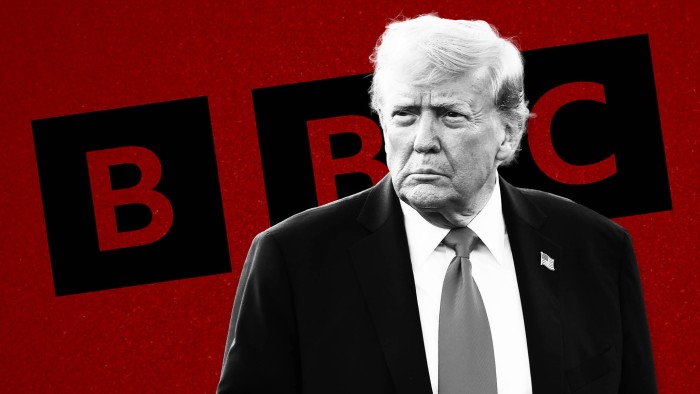
Donald Trump has followed through on a threat he made last month to sue the BBC, alleging the UK national broadcaster defamed him in a documentary.
The US president is claiming $10bn, saying the publicly funded corporation “intentionally and maliciously” sought to mislead viewers in a Panorama edit of a speech he gave in Washington on January 6 2021.
What has prompted the lawsuit?
The Panorama documentary, Trump: A Second Chance?, spliced together some of Trump’s comments in his Capitol Hill speech.
The programme suggested Trump had encouraged his supporters to storm the Capitol building as lawmakers ratified his loss to Joe Biden in the 2020 US presidential election.
In the programme, Trump was shown telling his supporters “we’re going to walk down to the Capitol” and that they would “fight like hell”, a comment he actually made in a different part of the speech.
In fact, he had followed up the remark about walking to the Capitol by saying his supporters would “cheer on our brave senators and congressmen and women”.
The documentary initially aired in October 2024, more than a year ago. But it sparked uproar only recently, following the leak of a critical memo sent to the BBC board by Michael Prescott, a former independent adviser to the corporation’s standards committee.
Prescott drew attention to the programme as he accused the BBC of wider failures in its coverage, not only of Trump but also the Israel-Hamas war and transgender rights. The ensuing dispute prompted the resignations of BBC director-general Tim Davie and Deborah Turness, its head of news.
Trump threatened to sue the following day. The broadcaster issued an apology, describing the programme’s edit as an “error of judgment”.
On what grounds has the claim been made?
In the lawsuit, filed this week in a federal court in the Southern District of Florida, lawyers for Trump have said the splicing of the speech created a false narrative. They contend that the edit falsely depicted him as issuing a direct call for violent action and rioting.
The case has been brought on two legal counts: the first is for defamation and the second is for violating the Florida Deceptive and Unfair Trade Practices Act (FDUTPA).
The defamation claim is based on the allegation that the BBC made false statements with “actual malice” — a concept in US libel law that means the publisher knew the depiction was false, or acted with reckless disregard for the truth.
“Contrary to the BBC’s claim that its splicing, manipulation, and distortion of the speech was an unintentional ‘editorial error’, substantial evidence suggests that this was an intentional and malicious effort,” the lawsuit states.
Trump’s lawyers claim the Panorama edit was part of a “long-standing pattern” to misrepresent Trump, citing other content, including a broadcast by its news programme Newsnight in 2022.
The second part of the legal claim relates to the corporation’s commercial behaviour. It contends the BBC is engaged in “trade and commerce” in Florida and that its supposed editorial manipulation constituted an “unconscionable” or “unfair” practice under FDUTPA.
Trump is seeking compensatory and punitive damages. The lawsuit contends he has suffered “massive economic damage to his brand value and significant damage and injury to his future financial prospects”.
Does the court have jurisdiction? Did people in Florida even watch the programme?
These questions are at the core of the case. “Jurisdiction is likely to be the central faultline on which this dispute is fought,” said Bambos Tsiattalou, founder of Stokoe Partnership Solicitors, a UK law firm.
BBC lawyers have already argued that there is no jurisdiction for the court in Florida to hear the case. The corporation has said that the documentary was not distributed in the US and that the broadcaster’s iPlayer streaming service was “geo-blocked” from viewers.
But Trump’s lawyers counter that the show was available in Florida to subscribers of BritBox, a subscription streaming service. They also argue that viewers may have used virtual private networks, which disguise an internet user’s location, to circumvent “geo-blocking” restrictions.
“They will have to evidence this use and that might prove difficult,” said Adelaide Lopez, a UK-US qualified litigator at Wiggin.
Trump’s lawsuit also states that filming took place at Mar-a-Lago in Florida and that the BBC maintains an office in the state.
A one-year statute of limitations for libel claims is likely to prevent Trump from suing in England and Wales. The limitation period for commencing a defamation claim in Florida is two years.
How strong is the case?
Several lawyers are sceptical about the prospects of a courtroom victory for Trump.
Jeffrey Smele, head of media and communications disputes at Simons Muirhead Burton, said the claim was “extravagant” and that the BBC had “some good grounds on which to fight”.
The president “is going to face a challenge establishing real damage”, Smele said, adding that Trump “wasn’t even aware of the edited clip at the time” and it “clearly didn’t interfere too much with the [2024] election because he won”.
However, Trump has had some success in securing settlements in separate legal actions against US media outlets. CBS owner Paramount has agreed to pay $16mn to settle the president’s defamation lawsuit over claims the broadcaster edited footage of an interview with Kamala Harris, his Democratic rival in the 2024 election, to make her appear more coherent.
Trump also sued ABC for defamation over on-air comments made by George Stephanopoulos, one of its star anchors. The network agreed to pay $15mn to settle the claim.
Iain Wilson, managing partner of Brett Wilson, which specialises in media law, said Trump was “no doubt hoping that pressure on the BBC both at home and abroad might result in a politically and personally favourable settlement”.
“The BBC will obviously be mindful of the cost and risk to the licence payer of defending a potentially long-running claim, even if it believes it has a good chance of defending the claim,” he added.
The BBC said on Tuesday: “As we have made clear previously, we will be defending this case. We are not going to make further comment on ongoing legal proceedings.”
Downing Street said it would “always defend the principle of a strong, independent BBC”, adding that “any legal action is a matter for the BBC itself”.
Dominic Crossley, head of dispute resolution at Payne Hicks Beach, said that “to a UK lawyer’s eye”, the claim seemed “ludicrously overstated and unlikely to withstand serious legal scrutiny”.
But he cautioned that the lawsuit meant the BBC was “being dragged to the unfamiliar, claimant-friendly jurisdiction of Florida, the backyard of their opponent”.
Crossley added: “Trump has achieved positive settlements from less promising starting points.”
Read the full article here