

Unlock the Editor’s Digest for free
Roula Khalaf, Editor of the FT, selects her favourite stories in this weekly newsletter.
In 1929, Julius Beer, co-owner of the Berson rubber company, bought a sizeable plot of land in the Viennese neighbourhood of Hietzing and began making plans for an ambitious new home. The Beers, a family of wealthy industrialists, weren’t out of place among the other residents in this affluent corner of the capital. But rather than plumping for one of its many art nouveau mansions, Beer envisioned a sleek modernist house that pushed the boundaries of contemporary architecture. For this, he turned to Josef Frank and Oskar Wlach.
The architects had worked mostly on social-housing projects and had only designed a handful of private homes – of which Villa Beer would be by far the largest. The house was completed just three years before the ascent of Nazism and an increasingly antisemitic climate forced Frank, who was Jewish, to emigrate to his wife’s native Sweden. It was in Scandinavia that the colourful textiles and furniture he designed for Svenskt Tenn, the Stockholm home-furnishings company, would secure his name as a leading figure in midcentury design. But in the early 20th century, Frank was known for his buildings: he had represented Austria at the first meeting of Le Corbusier’s International Congress of Modern Architecture in 1928.
Frank had very clear ideas about domestic architecture, and especially this project. “A well-organised house should be laid out like a city, with streets and paths that inevitably lead to squares from which traffic is excluded, so that one can rest there,” he wrote in 1931. Unlike Le Corbusier, who famously described the home as “a machine for living in”, Frank’s brand of modernism prioritised individual comfort over standardised functionality. Villa Beer encapsulated that philosophy, with sculptural staircases, cosy nooks tucked away within open-plan spaces and vast floor-to-ceiling windows that filled the house with natural light.
The Beers moved into their futuristic home in 1930, but didn’t stay long. Financial troubles meant Julius became unable to pay back the hefty loans he had taken out to fund the project. The family was forced to let the house after only 18 months, and in 1938 it was seized by the bank before passing into new hands.
Despite having grown up just around the corner from Villa Beer, Lothar Trierenberg knew nothing of its history. A tall, silver-haired man in his late 50s, he became intrigued by Josef Frank in 2020 when he moved into an office space in the designer’s former home. The next year, a serendipitous Google search revealed that Villa Beer, having stood empty for a decade, was on the market. But Trierenberg decided it should be made publicly accessible rather than be used as his own private home, and established a foundation from his family’s paper-making business for the purpose of maintaining the building, one of only a handful designed by Frank that was ever actually built.
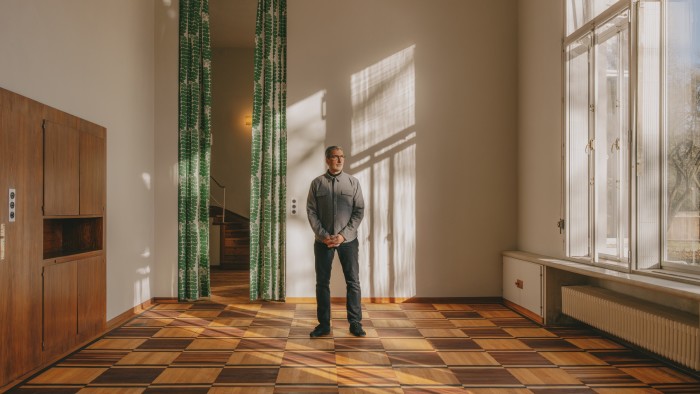
“Although there is a lot of historical substance in Vienna, unfortunately there is little from the modern era,” Trierenberg says, gazing admiringly at the stark concrete façade, bright white against the crisp blue November sky when we meet for a tour. He’s eagerly anticipating the delivery of two 60-year-old Robinia trees arriving from northern Germany – an event that will require the whole street to be closed off. Behind the monumental exterior is a surprisingly modest entranceway, with a series of low-ceilinged hallways and cloakrooms. Trierenberg strolls through them to the vast open-plan living space, taking a beat to admire the late autumn light that floods through the bay window across several floors and a striking grand staircase.
Trierenberg was no stranger to the design world. But without any prior experience in restoring historic buildings, he assembled a team of specialists. Local architect Christian Prasser was called in to lead the restoration work, while Katharina Egghart was recruited from Vienna’s Museum of Applied Arts as managing director of the newly established Villa Beer Foundation. In 2024, after three years of intensive research into the history and fabric of the building, the restoration process began.
From artisan woodworkers to dry-stone wallers, specialists from across Austria were called in to perform precise repair work. As we move through the house, Trierenberg points out details with wide-eyed enthusiasm: radiators sent to Poland to be repaired; new copper windowsills given a special patina so they would resemble the originals as closely as possible; marble slabs that have been returned to their position in front of the fireplace after being discovered in the garden, where they were used as paving stones.
Anything that could not be preserved has been remade with exacting precision. Window panes were produced in Germany using the same techniques from the 1930s; custom rubber flooring was manufactured in Italy to achieve the correct shade of green and offset Frank’s favoured white walls; and tiles for the bathroom and terrace were reproduced by small factories in rural Austria. Trierenberg takes particular delight in the light switches, which have been 3D-printed to match the originals. “Listen,” he says, flicking the switch. “The click sounds just like it would have in the 1930s.” It was important that traces of past inhabitants remained visible. The floorboards, for example, are pockmarked: “I told the carpenters to keep them because they tell the story of the house.” And modern elements have been introduced, namely proper insulation of the roof and basement, solar panels and a geothermal heating system. “It’s a historic building, so it’s important to keep things intact,” says Trierenberg. “But I wanted to improve things from a technical standpoint.”
From March next year, the house will be open to the public for guided tours that will explore not just the architectural significance of the space, but also the history of the Beer family. A small lecture theatre in the basement will host workshops and educational programmes. “It’s an opportunity to talk about the Jewish community, and why they were so important in Vienna during this period,” says Egghart. “Culturally, they really drove the city forward. Klimt and Schiele were supported by Jewish patrons, and they commissioned some of Vienna’s most interesting modernist buildings. They had an open-minded approach to art and architecture that allowed progressive works to develop.”
Music will also return to the house with the installation of a 1910 Bösendorfer grand piano, similar to the one Julius Beer’s wife Margarethe used to play. She trained as a pianist at Vienna’s conservatory, and Frank designed a special mezzanine nook for her practice. A residency programme is also in the works. The top floor of Villa Beer has been set up with bedrooms for a research and artists-in-residence programme, as well as for visitors. This floor has been furnished by Svenskt Tenn, with each room featuring furniture upholstered in a Frank fabric. “What’s funny is that Frank is now known as one of the fathers of Scandinavian design,” says Trierenberg. “But much of the furniture he designed for Svenskt Tenn was actually created here in Vienna.”
Frank’s early career has been largely eclipsed by his success as a furniture and textile creator. But the revival of Villa Beer shines a light on his architectural legacy. It’s a monument to his conviction that good design should serve the comfort and wellbeing of those who live with it. “That’s what really set him apart from other architects of the time,” says Trierenberg. “He believed that architecture is for people. He humanised modernism.”
Read the full article here