

By Anthony Paletta
Rudolph Schindler was a different sort of modernist architect. When most of his peers turned to steel with the currents of the International Style, he continued building largely with wood. He designed about 150 buildings — mostly houses — seeing each as a “different architectural problem”.
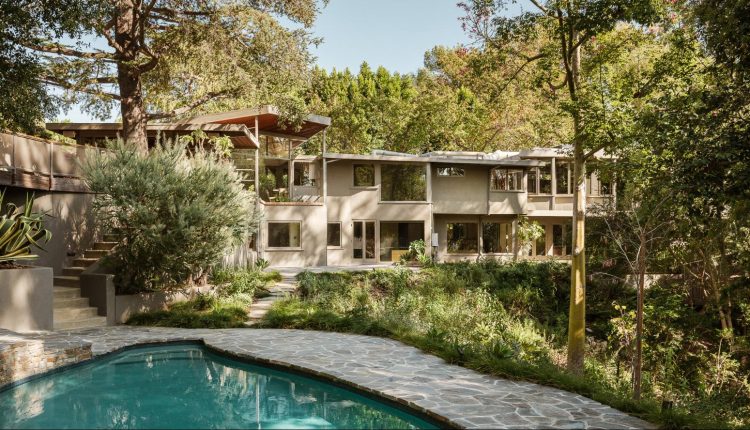
One of his unique creations, the Lechner House, is now on the market. Constructed in 1947, the four-bedroom home is one of the largest he built and is now designated a Los Angeles Historic-Cultural Monument.
Born in Vienna in 1887, Schindler emigrated to the United States in 1914. He worked for Frank Lloyd Wright in the 1920s, managing his office and carrying out design work on a number of projects, including the Hollyhock House in Los Angeles. He built his own home in LA at the same time, known as the Kings Road House (now a museum) and went on to design numerous buildings in the area.
The Lechner House was a product of his late career. Built for a doctor and his wife, he employed his Schindler Frame system — a rafter-less method of building designed to liberate walls from the need to provide much structural support.
The architectural merits of the building were more than slightly obscured by a sequence of nine owners before it was bought by Pam Shamshiri, co-founder of the design firm Studio Shamshiri, in 2008.
“When I bought the house there were Spanish tiles on the floor and a bar in every room,” says Shamshiri. “All of the wood had been covered up by plasterboard. The original fireplaces were covered in marble. It had lost its way.”
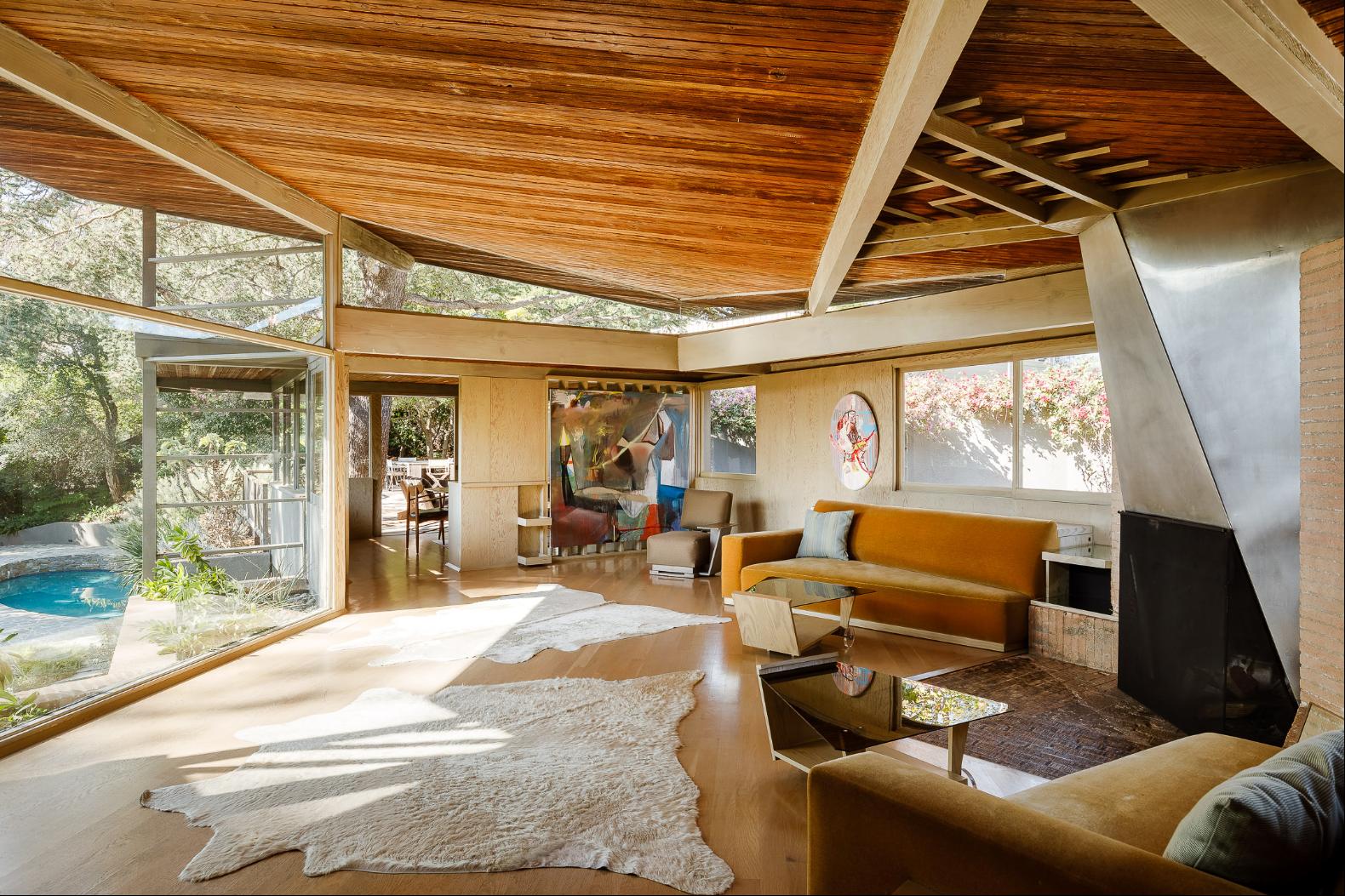
However, “the beauty was still there,” she says. In his book Nothing Permanent: Modern Architecture in California, art and architecture writer Todd Cronan describes the living room of the house as “perhaps the most dramatic and expressive of Schindler’s career”.
It is at the centre of the V-shaped house and has a roof that tilts upwards, revealing views of nature to the rear, with both floor-to-ceiling glass and clerestory windows providing abundant light. Shamshiri described the living room as “almost a spatial cave, with an extraordinary view of a canyon. I always felt like I was in a treehouse when I was there.”
There were a considerable number of later additions to remove from the house, starting with all of the marble and plasterboard and “seven or eight” layers of paint on the ceiling. Shamshiri was struck by the simplicity of the materials used in the house’s construction.
“In my day job I’m often dealing with exquisite materials, but on this project I was working with things that are relatively cheap,” she says. “He literally used construction-grade plywood. It was a very thoughtful, high level of design with really basic materials.”
Replacing some of these elements was not an easy task, though. “At the time it was built the construction-grade plywood was much nicer than what we have now; the grains were tighter.” Finding wood of that grade was tricky: “I drove to Arizona several times.”
Original Schindler furniture from the building had been sold. Shamshiri chose to rebuild it according to Schindler’s plans, including a pullout bar and table and asymmetrical built-in sofas in the living room.
Though she sought to follow his designs as closely as possible, sometimes there simply wasn’t a record of what decisions he’d taken on interior aspects of the house. Where specifications were lacking for furniture and custom architectural elements, she used other Schindler pieces from the era as a model. “Some were from two years earlier than this house or two later — it was a mixture of details.”
She described updates and tweaks as the most difficult intellectual challenge of the project. “The trickiest part was getting into Schindler’s head,” she says. Her task was “being a steward of something that is spectacular and part of history but taking liberties to make it your own.” Wood was re-stained with a pale green wash: “it’s almost like a watercolour over plywood.”
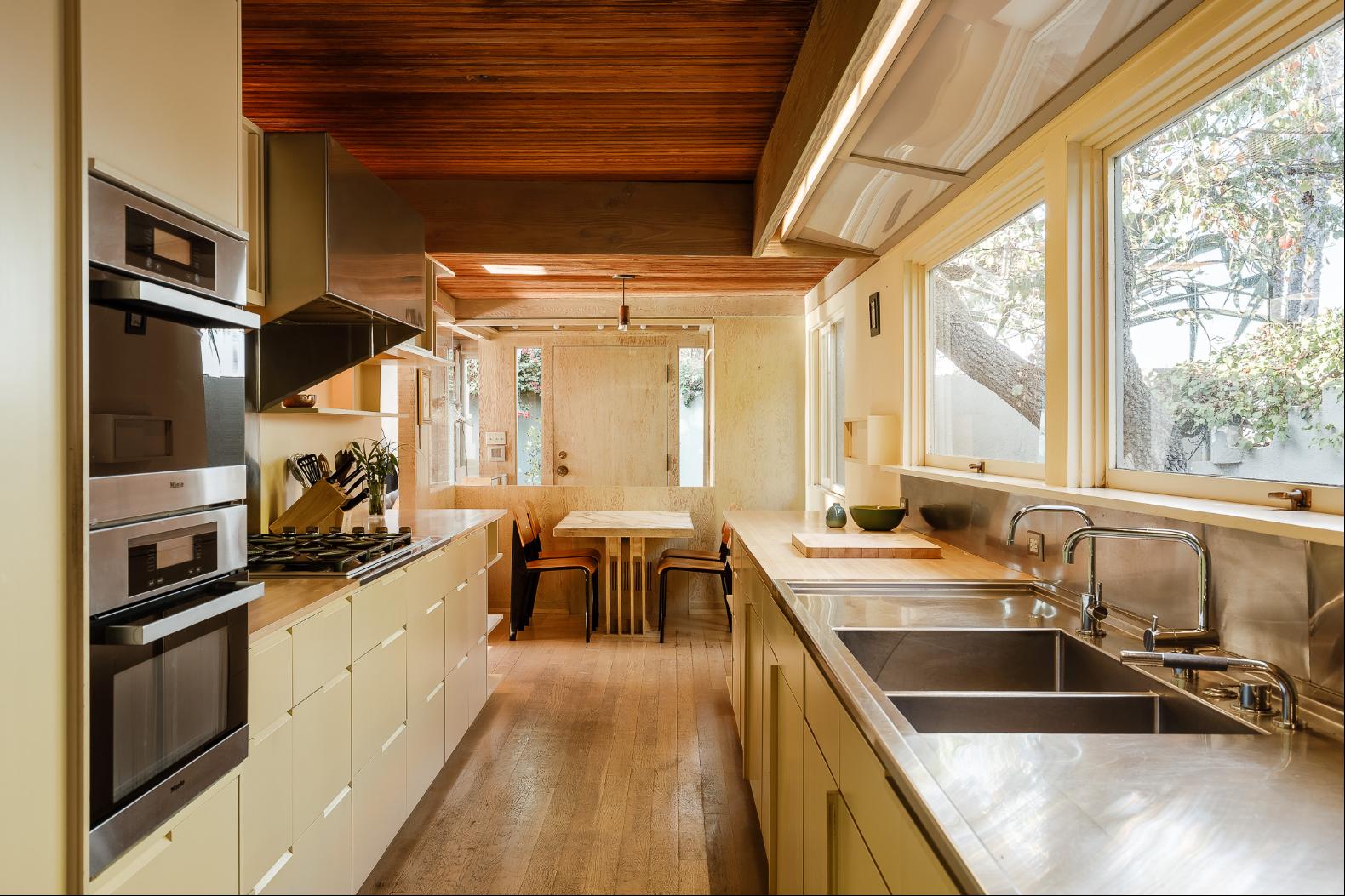
Shamshiri made a few changes, the most prominent being an expansion of the house’s original tiny kitchen. “The kitchen is three times as large as the original. I really wanted something that was open to the den and the living room.” She sought to stick to his vision even in this departure — the additional kitchen window she added was taken from an earlier plan for the house. The hood for the kitchen range was designed to mirror the diagonal living room fireplace hood.
She also redesigned the downstairs bathroom, with a cedar bathtub and custom cabinetry. Shamshiri sold the house in 2019 to artist Albert Oehlen and his wife Esther Freund Oehlen. They weren’t specifically seeking a Schindler house or one of its relative vintage “but when we saw it we wanted it. It is wonderful how all the rooms connect you with the nature outside.”
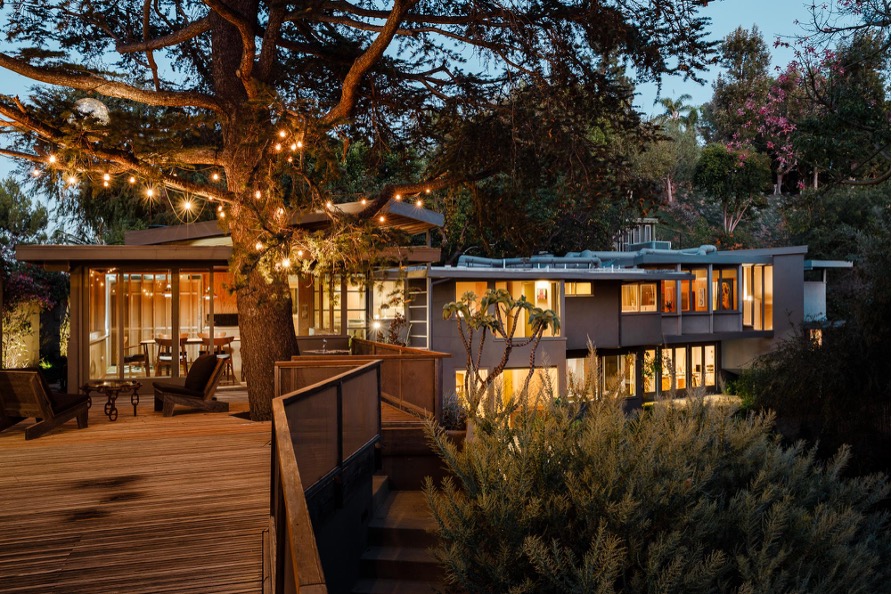
They enlisted landscape architects Terremoto to upgrade the gardens and refresh the original Schindler pool design, and commissioned a respectful revamp of the home’s exterior by architects Escher GuneWardena. The next owner will find a house returned to pristine condition.
The property is jointly listed by George Penner of Compass and Stefani Schmacker of Los Angeles Sotheby’s International Realty for $6.5mn.
Photography: Sterling Reed Photography
Read the full article here