

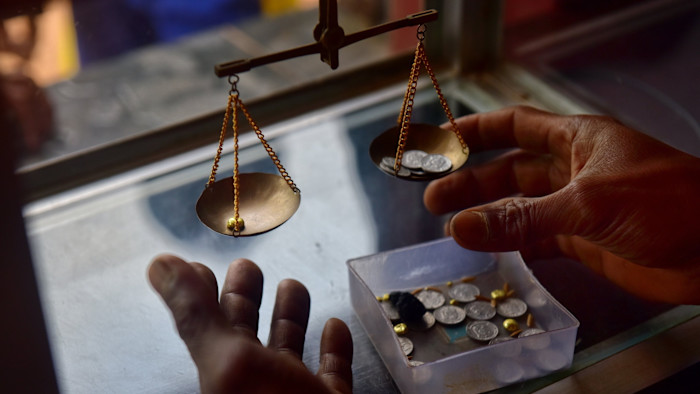
In the African island nation of Madagascar, central bank governor Aivo Andrianarivelo has an unusual mission: to end gold smuggling.
Madagascar produces as much as 20 tonnes of gold per year, he estimates, worth about $2.8bn at today’s prices, but almost all of that leaves the country illegally, robbing state coffers of tax revenues and foreign exchange.
“The criminal gangs, they have aircraft, helicopters, very sophisticated means of transportation,” said Andrianarivelo in an interview with the Financial Times. “Our strategy is to reduce the gold trafficking business in Madagascar.”
The island nation is one of a growing number of countries where central banks and finance ministries are starting to get more involved in domestic gold trading and to run local buying programmes, in an effort to disrupt illicit gold flows.
As the price of bullion has skyrocketed, surging more than 60 per cent to a record high above $4,300 per troy ounce, illegal gold mining and smuggling have boomed, making their task even more urgent.
The rally has caused huge problems in countries where gold is mined informally — leading to environmental devastation, polluted waterways, human trafficking and even funding wars and criminal gangs.
Many central banks — from Ecuador to the Philippines to Ghana — are turning to centralised buying programmes to better regulate the sector.
As much as 1,000 tonnes of gold is produced each year by artisanal and small-scale miners, and a lot of that is trafficked, said David Tait, chief executive of the World Gold Council, which represents gold miners.
“It’s anybody’s guess how much gold goes to bad actors, but even if you take a guess at 50 per cent, it is an enormous amount of money,” he said.
As gold prices increase, an unintended consequence is that criminal gangs enjoy more revenues and the environmental damage soars. “It could be apocalyptic, it really could — a law of unintended consequences of a gold rally to $10,000,” said Tait.
In Ghana, where the country set up a new central buying group, the “GoldBod”, in 2025, the mercury and water pollution resulting from artisanal mining has become a political crisis. More than 60 per cent of Ghana’s waterways are contaminated by gold mining activities.
In Ecuador, where drug gangs are turning to gold mining for cash, the government is expanding the domestic buying programme it started in 2016, and opening a buying station in the southern town of Zamora in January.
Diego Patricio Tapia Encalada, head of investments and international settlements at the Central Bank of Ecuador, says the buying programme attracts miners because it offers a good price and pays fast, within 48 hours.
“The price is important because then we incentivise the miner not to go to other channels,” he explained.
For a country like Madagascar, where most gold is produced in small artisanal mines, the price rally also raises the incentive for the government to exert control over a sector that has eluded it for years.
“One of the objectives is to make gold benefit Madagascar, and to legitimise the gold business, says Andrianarivelo. “That is the main goal, to make it more transparent.”
Madagascar’s central bank aimed to increase its own gold holdings from one tonne at present to four tonnes, he added, part of a trend of growing central bank gold holdings worldwide. Those plans had not changed since a new government took power in October, he said.
To achieve that, the central bank is expanding its domestic gold-buying programme, which purchases bullion from artisanal miners around the country, then ships the ore to a refiner overseas. The central bank can either sell the gold to gain foreign currency, or add the gold directly to its own reserves.
If it succeeds, the prize is big: so much bullion is smuggled out of Madagascar that on paper, gold does not officially show up among the country’s top exports, which include vanilla, cloves, clothing and nickel.
The mechanics of how central banks should buy gold, and from whom, are far from simple though. Several countries that have undertaken purchasing programmes have faltered, particularly due to the challenge of verifying the source of the ore brought to their buying stations.
“We have seen many issues and failures with these programmes,” said Marc Ummel, head of raw materials at the non-profit SwissAid. “Most of them do not have good due diligence and traceability mechanisms.”
If done wrong, central banks can end up buying gold that is mined illegally or linked to conflict, said Ummel. He pointed to examples including Sudan and Ethiopia, where the central bank has purchased illegal gold from the restive Tigray region.
But there are other positive examples as well. In Mongolia, where the central bank has been running a domestic buying programme for more than 30 years, the effort has helped to eradicate the use of mercury, a highly toxic metal, because buying stations can easily test for its presence.
Enkhjin Atarbaatar, director-general of financial markets at the Bank of Mongolia, said that when the purchasing programme was started in the 1990s, artisanal mining was quite prevalent. “Most of the gold mining is done by small or medium-sized companies now,” he said.
Selling gold was also a key source of foreign currency for the Bank of Mongolia, he added.
During a time of high gold prices, the challenge of regulating the sector and improving mining standards gets harder, said Diane Culillas, chief executive of Swiss Better Gold, a non-profit that works to improve artisanal mining standards with countries including Colombia, Peru and Ecuador.
“The gold always finds its way to market — all gold produced is still sold, legally or illegally, formally or informally. So motivating miners, for an initiative like ours . . . is not getting easier,” she said.
The technology to trace the origins of gold ore, still in its infancy, will enable buying stations to ensure integrity.
Ecuador is testing a new system that will allow buying stations to chemically identify ore using an isotope scanner, and other countries are following suit.
“If you do this now, in 10 years there’ll be only tiny amounts of gold going in the bad guys’ directions,” said Tait of the World Gold Council.
Read the full article here