

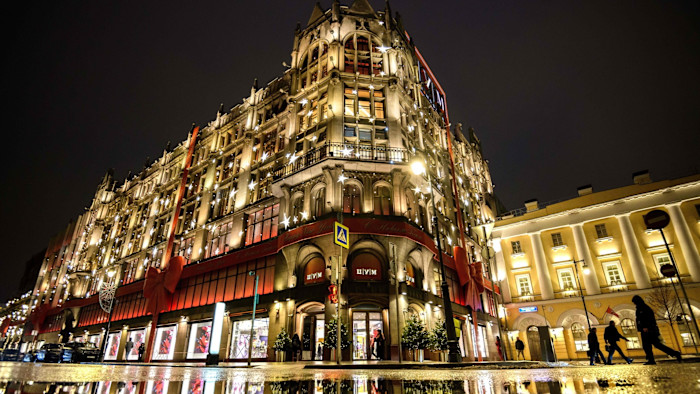
Moscow shoppers can still access a full range of high-end western fashion goods despite western sanctions on luxury items entering Russia — but only if they are willing to pay twice as much as shoppers in the EU.
The online catalogue for Tsum, a famous Moscow department store, shows significant selections of items from high-end marques such as Burberry, Kering-owned Gucci, Bottega Veneta and YSL, Valentino and Richemont-owned Chloe — in spite of a 2022 EU ban on exporting expensive luxury items with a wholesale cost of more than €300.
Tsum lists more than 4,000 separate items from Dolce & Gabbana, the Italian fashion company, as well as for Brunello Cucinelli, which suffered a steep decline in its stock price last year after Morpheus Research, a short seller, published research on its stores in Russia.
“This is something of an open secret. The goods are there to be seen not only by those who visit Russia, but by anyone who takes a peek on the internet,” said one luxury chief executive in Milan speaking on condition of anonymity.
Large volumes of European luxury goods are re-exported into Russia after first being sold to buyers in Turkey, the United Arab Emirates and China.
These goods, however, are sold in Russia at a significant premium to outlets in other countries.
To work out the Moscow mark-up, the Financial Times built a sample of about 600 European luxury-brand items sold by Tsum for which it was able to find matching items at retailers in Italy or France. This group of high-end goods cost an average of €1,229 in the EU but the equivalent of €2,626 in Moscow. Tsum did not respond to a request for comment.
The matches were made using artificial intelligence assistance and were based both on images posted on the Tsum website as well as text descriptions. All matches were then checked manually. The FT sample focused on a group of celebrated EU brands including Dolce & Gabbana, Valentino, Bottega Veneta and Burberry.
The data suggests high-end watches are being sold at about double their western prices: €33,100 in Moscow for watches costing €17,700 in the west.
The most extreme mark-ups in the sample were for handbags. The average bag for which the FT was able to find prices, matching both text descriptions and images, cost €1,900 in Europe but €5,200 in Moscow.
EU legislation bans the sale of any luxury goods costing more than €300 per item “to any natural or legal person, entity or body in Russia or for use in Russia”.
The law contains a list of goods, and includes items such as truffles, caviar, purebred horses, champagne, sporting goods as well as clothing and luggage.
The €300 limit on the value of goods refers to the value disclosed in the export declaration, which will usually be close to the wholesale price.
This can translate into a retail price of about €1,000 to €1,200 for luxury goods, according to industry experts. Luxury goods can, however, legally be sold to intermediaries in third countries who can then choose to sell the items into Russia.
In September, Brunello Cucinelli’s chief executive Luca Lisandroni told the FT that the company continued to supply department stores in Moscow but shipped “items of our collections within the price caps fixed by the EU”.
Russian customs returns confirm that Brunello Cucinelli goods shipped directly from the EU are overwhelmingly below the €300 limit. More expensive pieces, however, do continue to enter the country via third parties — with Turkey acting as the key conduit for Brunello Cucinelli.
Brunello Cucinelli did not respond to a request for comment.
Similarly, customs records show Mercury Fashion, the company that runs Tsum among other retail brands, only buys cheaper goods directly from suppliers in the EU. Mercury did not respond to a request for comment.
For example, customs data shows the company bought $6.7mn of Dolce & Gabbana goods in the first quarter of 2025, but none of the shipment documents implied a price-per-item in excess of the €300 limit, even though it stocks items from the brand priced well above that threshold.
While Dolce & Gabbana appears not to have shipped goods over the sanctions limit directly into Russia, its website refers customers to Tsum as an official retailer of its goods. There they can buy goods that EU sanctions have sought to keep off the Russian market. The company also continues to run a store in Moscow.
Dolce & Gabbana did not respond to a request for comment.
Circumvention of sanctions has created a Russian domestic logistics industry that routes large volumes of more expensive European goods via third countries. For example, Global Style Import, a Moscow logistics operator, advertises that it helps with “access to the latest styles and trends from around the world”.
In the first quarter of 2025, the company imported about $1.7mn of Dolce & Gabbana goods originating in Italy via Turkey and the UAE. The prices being paid by Global Style, however, were routinely significantly higher than the €300 limit. The most expensive, a silk dress, was listed at $1,300 per item.
Mercury was founded by Leonid Fridlyand and Leonid Strunin in 1993, importing western luxury goods to Moscow at the height of Russia’s roaring nineties. It went on to become the largest luxury goods distributor in the country, buying Tsum, a historic department store, in 2016. Mercury also owns the auction house Phillips.
Read the full article here