

Authored by Sean Tseng via The Epoch Times (emphasis ours),
U.S. forces stormed into Venezuela before dawn on Jan. 3 and captured Venezuelan leader Nicolás Maduro and his wife, Cilia Flores, in a lightning operation that punched in and out of Caracas before its air defenses could mount an effective response.
The operation resulted in no U.S. fatalities and no loss of U.S. military equipment, U.S. officials said.
The U.S. mission—code-named Operation Absolute Resolve—has quickly become more than a political shockwave. Analysts have said it was also a real-world test of U.S. military power against a country that has spent years buying Chinese- and Russian-made air-defense systems and showcasing them as proof that it could deter Washington.
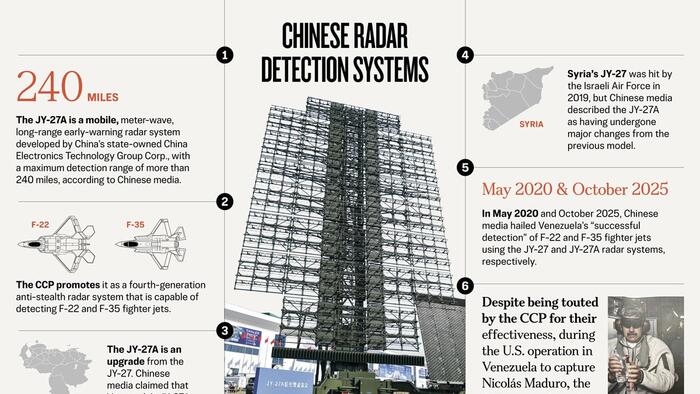
The raid raised uncomfortable questions for Beijing about the limits of the Chinese-supplied systems that Venezuela has leaned on—especially “anti-stealth” radar that China advertised as capable of spotting and stopping U.S. stealth aircraft, a military analyst said.
The analyst told The Epoch Times that the most damaging takeaway for China isn’t the failure of a single piece of equipment—it’s what the operation suggested about deeper weaknesses: corruption in China’s defense industry and lack of reliability of the technology and command structure meant to tie those systems together.
“A system built to look modern on paper and intimidating in propaganda falls apart under the demands of real combat,” said Yu Tsung-chi, a retired major general from Taiwan and former president of the Political Warfare College at Taiwan’s National Defense University.
He said Beijing’s performance claims often lean more on messaging than combat validation.
China condemned the capture of Maduro and accused Washington of acting as a “world judge,” in a blunt response that underscored how closely Beijing saw the fallout tied to its influence and credibility in Latin America.
Operation Measured in Hours
President Donald Trump ordered the operation at 10:46 p.m. ET on Jan. 2, Chairman of the Joint Chiefs of Staff Gen. Dan Caine said.
Aircraft launched from about 20 land and sea bases across the Western Hemisphere, and the helicopter force approached Venezuela at roughly 100 feet above the water to maintain the element of surprise.
Within five hours, by 3:29 a.m. ET, U.S. forces had Maduro and Flores aboard the USS Iwo Jima, an amphibious assault ship. They were then flown to the United States.
U.S. officials said the operation involved more than 150 aircraft along with integrated electronic attack and nonkinetic effects from U.S. Cyber Command, Space Command, and other assets to suppress Venezuelan defenses and clear a path for the helicopters.
Briefings described a layered effects approach: bombers, fighters, surveillance and reconnaissance aircraft, electronic warfare jets, and drones overhead; space and cyber support to disrupt Venezuelan systems; and strikes intended to dismantle and disable air defenses as helicopters closed on Caracas.
According to officials, aircraft used in the operation included B-1B bombers, F-22 Raptors, F-35 Lightning II fighters, EA-18G Growler electronic attack jets, E-2 Hawkeye early warning aircraft, and numerous drones alongside transport and helicopter assets.
China’s Systems
For years, Venezuela has spent heavily on Chinese and Russian equipment while claiming that it was building one of the region’s most modern defense systems.
In recent months, reports have highlighted Venezuela’s installation of Chinese-made JY-27A radar units, marketed as able to detect “low-observable” aircraft—exactly the kind of system meant to complicate U.S. operations involving stealth platforms.
That promise did not hold on Jan. 3.
Yu said neither Chinese nor Russian air-defense systems “made the slightest bit of difference” once the United States brought real-time intelligence, electronic warfare, and precision weapons to bear.
The real contest, he said, wasn’t just radar range or missile specs, but a fast chain of detection, communications, decision-making, and joint execution—exactly where weaker militaries tend to break.
Beyond radar, Venezuela has also displayed and fielded Chinese-made ground systems that Beijing has marketed abroad—from VN-16 amphibious assault vehicles and VN-18 infantry fighting vehicles to Chinese rocket artillery systems.
Venezuelan parades in recent years have showcased those platforms as symbols of a growing partnership and a tougher military posture.
But Yu said glossy displays don’t matter much if the wider network—sensors, communications, command, training, and logistics—can’t hold up under pressure.
Parades Versus Combat Reality
Yu said the U.S. raid on Caracas exposed the limits of China’s propaganda-first military culture—one that rewards polished demonstrations more than hard, repeated combat validation.
He said the People’s Liberation Army (PLA) has not fought a major war since 1979, and it studies foreign conflicts in part because it lacks large-scale, recent battlefield feedback of its own.
“You can look perfectly aligned and advanced on a parade ground,” Yu said, “but without real combat to back it up, it’s all just stage effects.”
Read the rest here…
Loading recommendations…
Read the full article here