

“Comfort” is what otherworldly helpmate Jill “Doll” Blaine seeks to offer the people in her care as they reach the end of their mortal existences and prepare to cross the threshold between life and death in George Saunders’ new novel, Vigil.
While Buddhist and Catholic thought are the main sources of the novel’s idiosyncratic cosmology, the significance Saunders assigns to “comfort” brings to mind a literary precedent: As I Lay Dying. William Faulkner’s 1930 novel is about a poor, dysfunctional family on a journey to fulfil their late mother’s dying wish, that she be buried with her original family. The family patriarch, Anse Bundren, agrees out of self-interest: “now I can get them teeth. That will be a comfort.”
Selfish and egotistical, Anse seeks and gets his own comfort, at the expense of others. Selfless and humble, Jill Blaine offers comfort to others, and it’s worked 342 times in a row. Her latest charge, 87-year-old oil tycoon KJ Boone, however, is self-satisfied and fully comforted by the heroic American story he tells of himself. Saunders’ Boone makes Faulkner’s Anse, long one of the most despicable characters in American literature, seem relatively likeable (well, almost).
Faulkner and Saunders also share, in their respective eras, a literary national standing seemingly at odds with the difficult features of their work. Nobel laureate Faulkner wrote dense modernist fiction about human experience in early modern Mississippi, emphasising historical traumas and failed efforts at evasion; prizewinning and bestselling Saunders writes experimental postmodernist fiction about human experience across an array of American times and spaces, attentive to the interplay of both individual and large-scale suffering and succour.
Moreover, despite the darkness and heaviness of what they write about, both Faulkner and Saunders can be moving, weird and funny. Indeed, these features have always been strongly evident in Saunders’ acclaimed collections of short stories. The title work of his first, CivilWarLand in Bad Decline (1996), is set in a failing American civil war theme park peopled by sad-sack employees and actual ghosts of the conflict. Tenth of December (2013) includes a story that takes aim at both American consumerism and human trafficking, tracing a debt-ridden suburban dad’s efforts to ensure his daughter feels as cool as her peers, who accessorise themselves with poor women from the global south. If your response to the premises of these stories involves shudder and cackle, empathy and curiosity, you’re in excellent company: Saunders’ loyal readership includes Barack Obama, who has listed Saunders’ books among his annual favourites.
Saunders came to international prominence in 2017 when he won the Booker Prize for his debut novel, Lincoln in the Bardo, a metaphysical historical fiction set in Washington in the early stages of the civil war. The novel’s main characters are a grieving Abraham Lincoln and his young son Willie, who dies and then finds himself consigned to a realm (the “Bardo”) in between life and death, surrounded by a talkative collection of others.
At the novel’s climax, Lincoln’s body is inhabited by these unquiet souls, calling to mind the great American poet Walt Whitman’s declaration, “I contain multitudes.” So too does Saunders’ Lincoln — men and women, Black and white, enslaved and free, rich and poor, kindly and jerky — and at last at peace over his son’s death, he’s made ready to lead a divided, warring nation.
Saunders is earnest without being saccharine, moral and political without being didactic or self-righteous, owing in part to the strange premises he adopts for his stories. As much is immediately evident in Vigil, which begins with Jill, its narrator, falling to Earth and landing in front of a mansion in contemporary America. “I made for the front door and, not yet walking competently, collapsed to the earth like a just-unstrung puppet, then leapt to my feet and moved on relentlessly to my work.” This work involves accompanying dying people to the next phase of existence by helping them reckon with the failings and wrongdoing of their time on Earth.
In Saunders’ fashioning, this experience takes place somewhere along a continuum between the Buddhist concept of release from suffering and the Catholic concept of the expiation of one’s sins. Saunders has described Catholicism as formative to his sense of human purpose and the world itself, while he later left his childhood faith to become a practising Buddhist.
A very American update to Dante’s famous otherworldly accompanists, Beatrice and Virgil, Jill is a small-town Indiana-born girl who died young and newly married in 1976. She was behind the wheel of a “‘lime-green’ Chevelle” rigged to explode and kill her heart-throb husband by a self-loathing antagonist named Paul, who figures recurringly in Jill’s own story in the novel.
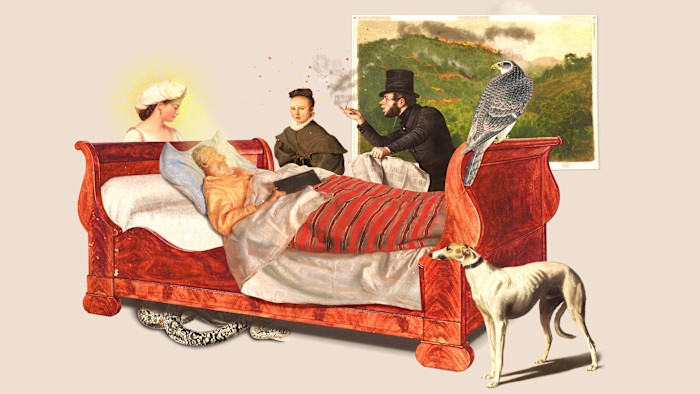
Separate from that, she enters into conversation with a “tiny, crimped fellow in an immense mahogany bed”: Boone, a late American petro-potentate who is initially convinced that Jill is a figment of his medication-addled imagination. She persists and begins to learn his life story, and it’s here that Saunders brings together both archetypal features of American experience — Citizen Kane comes immediately to mind — and a very current-feeling set of moral and political concerns associated with the intersection of human and planetary health and wellbeing.
As with Ian McEwan’s books, it sometimes feels like Saunders is pandering to an assuredly adoring audience with his set-ups and themes, and yet, as happened to me with McEwan’s recent What We Can Know, with Vigil the strength of the storytelling overcame my resistance.
Boone was born to a poor, hardworking family in remote Wyoming; a boyhood encounter with power and wealth, while caddying for rich men on a golf course, shows him the possibilities for life beyond his family’s dire straits. He pursues these relentlessly, entering the oil business and, in the mid-1990s, delivering a life — and history — changing speech in defence of fossil fuels at a meeting in Aarhus, Denmark. In turn, the US pulls away from any environmentally conscious policies, and Boone becomes immensely wealthy and influential while poor people, flora and fauna the world over suffer terrible degradations. But Boone has a different reading of his accomplishments:
“Against heavy odds, he’d lived an extraordinary life, full of tremendous accomplishment, and had always done his best and, in sum, had done nothing wrong, not a goddamn thing, and was leaving behind no lasting harm, zero, nada, none at all: a world better for having him in it, period, full stop.”
The tycoon doth protest too much, methinks. But not the very patient Jill, who stays with Boone despite his rudely rejecting her and also while he remembers earlier, warmer times in his otherwise coldly calculated life.
Jill is also present as Boone encounters a host of human (and animal) spirits who try to convince him to move beyond his infallible sense of himself, including his plain-spoken father and a gentle man from India whose family and village were destroyed by the unrestrained industrial capitalism Boone unleashed on the world. He had helpers in this, two of whom also visit him as he’s dying. These caustic, cynical ghosts of the anti-green present, both named Mel, are gleeful collectors of fellow unrepentant American alpha businessmen and they compete with Jill to influence Boone’s self-reckoning.
Such is Saunders’ skill and empathetic imagination that the questions raised by his concocted otherworld — why are Jill and others here past death, what keeps them vital, what will release them and to what next? — generally prove more mysterious than mystifying, until a moving revelation, involving Jill and her inadvertent killer, near the novel’s end.
Meanwhile, we want Boone to see the error of his ways, purged of his pride, and punished for the terrible endings his fossil fuel triumphs have delivered to the natural world and its inhabitants, which he’s about to leave behind. “He was like a deflated balloon in which, despite all external appearances, there remained one last bit of air”: what will he do with it? Vigil holds out the possibility that either undeserved comfort or deserved suffering comes to a once-powerful, now-dying man, in and beyond his final breath.
Vigil by George Saunders Bloomsbury £18.99/Random House $28, 192 pages
Randy Boyagoda is a novelist and professor of English at the University of Toronto. His new novel, ‘Lords of Serendipity’, will be published this autumn
Join our online book group on Facebook at FT Books Café and follow FT Weekend on Instagram, Bluesky and X
Read the full article here