

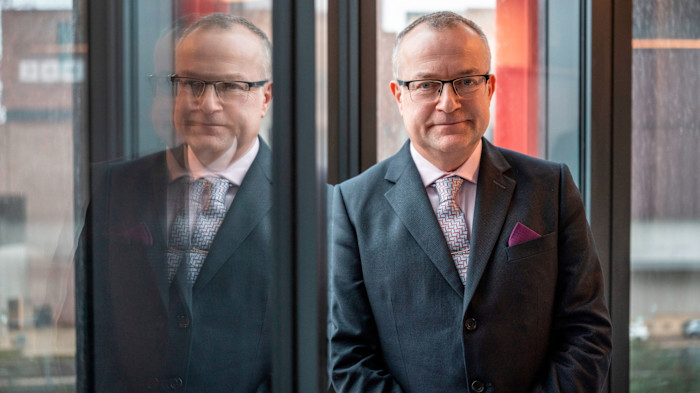
NHS drug costs should not be increased for years to come and giving in to President Donald Trump’s demands for higher payments would be a “huge backward step”, the new head of England’s medicines watchdog has warned.
Jonathan Benger told the FT there would be a “diminishing return” from more rises in the cost at which drugs were considered to be cost effective and that, for the UK, there were better ways to boost life sciences investment.
Ministers have agreed to lift UK health service spending on new medicines by 25 per cent as part of a deal with the US to avoid tariffs threatened by Trump, and have told the National Institute for Health and Care Excellence (Nice) to change its rules to achieve the terms of this agreement.
About 9 per cent of UK healthcare spending is on medicines, down from 11 per cent a decade ago and a lower proportion than in other European countries. Branded medicines costs reached £15bn in 2023-24.
However, Benger, in his first interview since becoming chief executive of Nice last month, said the government would either need to increase taxes or cut other public spending to fund this increase in expenditure on drugs.
“If they choose to spend money on defence, they’ve got to pay for that somehow, either by raising taxes or removing money from somewhere else. If they choose to spend money more on medicines, similarly, that has to be paid for,” he said.
The approval body ensured “the UK taxpayer gets medicines at a very good price and I think to dismantle that system would be problematic”, he added, warning of a “huge backward step” if Prime Minister Sir Keir Starmer gave in to US pressure and weakened Nice’s ability to make independent decisions.
Nice at present approves medicines that cost less than a maximum of £20,000-£30,000 for each year of good-quality life they provide — a metric known as “quality-adjusted life year” (QALY).
Under the deal between London and Washington, this threshold will rise to £25,000-£35,000 alongside other technical changes to assessment methods, the first time the QALY metric has increased since Nice was set up in 1999.
Benger played down the impact of the rise, saying it would result in only “a few more medicines being approved every year that would otherwise not have been approved. Maybe three or four or five.”
However, the pharmaceutical industry hopes the change has set a precedent for further increases to Nice’s threshold and has pressed for it to rise with inflation, warning that the UK is becoming a less competitive investment destination.
“It would be problematic if we keep moving the QALY threshold, and I don’t think there’s a strong argument for index linking,” he said. “There is a diminishing return if you go up and up.”
Those wanting to boost the UK life sciences sector “would get more value out of looking at the whole, wider system”, from regulation to research funding and clinical trials, added Benger, who was previously chief medical officer at the watchdog.
Although Nice has consistently approved nine in 10 medicines it assesses, pharma companies have said an increasing number of drugs are not being launched in Britain because of low prices.
Meanwhile, Trump has also accused European countries, where medicine costs are typically far lower than in the US, of “freeloading” off US innovation and demanded that other health systems pay more.
Benger said there was a “small gap” between the number of new drugs launched in Britain and in countries such as France and Germany, adding: “Trying to close a small gap is probably not always the right place to focus when there are other bigger things that need to be addressed.”
Nice had “approved some monstrously expensive medicines” where they were shown to be cost-effective, he said, pointing to a gene therapy for the blood disorder beta-thalassaemia that gave “decades of high-quality life”.
With the threshold changes due to take effect in April, Benger said “maybe five” of the 66 medicines Nice was in the process of assessing might be rejected under the current rules but approved under the new ones.
Companies would be able to “pause” assessments until the change took effect and resubmit previously rejected medicines, said Benger, who is an A&E doctor and formerly held roles at NHS England.
Nice has been under pressure from ministers and patient groups to recommend Enhertu, a breakthrough breast cancer treatment developed by Anglo-Swedish company AstraZeneca and Japanese group Daiichi Sankyo.
The watchdog, an arm’s-length body of the Department of Health and Social Care, rejected the drug for use in the NHS in 2024.
Enhertu is approved in Scotland, which has a different recommendation agency, and more than 20 European countries.
Benger said Nice had “already reached out to” the makers of Enhertu to ask if they wanted to submit fresh evidence.
“If they were prepared to revise their commercial offer, I think there’s every possibility that we would be able to reconsider that particular medicine,” he added.
Read the full article here