

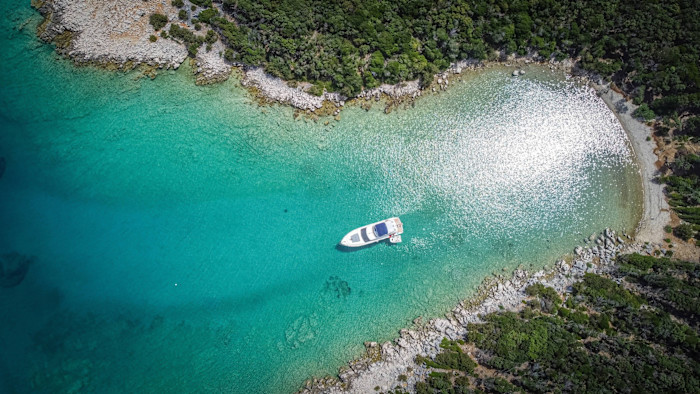
Toby Maclaurin understands how difficult it is to differentiate his firm, Ocean Independence, from every other high-end yacht broker in the world. “In our market, we can charter you any yacht in the world, and so can all our competitors — the identical yacht. That’s the way our business works.”
The way to make a difference, he says, is in the quality of their service: the standard of the chefs they provide, for example, or how efficiently they revictual (restock with provisions) at a given stop.
But, from this summer, he’s happy to offer a new bonus: guaranteed great weather, or your money back.
Even in midsummer, conditions on the Med can turn choppy: a rainy day on a hoped-for beach afternoon near Sardinia, perhaps, or gusts of wind in the Cyclades in August, which can upend an itinerary. Some clients, especially those new to charter, are uneasy at the risks inherent in such six-figure-plus outlays and express their concerns readily to Maclaurin.
Thanks to a new partnership with weather prediction start-up Poncho, it’s a topic that Maclaurin will no longer be wary of tackling. “This encourages us to have a conversation with the client that at the moment we try not to have,” he says. For between 2 and 15 per cent of the charter hire, up to a maximum of $250,000, his guests can now insure against Mother Nature’s whims — and receive automatic rebates when the weather goes awry.
Poncho is not the only start-up in this space, but rather one of a number of companies offering similar, data-driven underwriting against rainy days ruining a long-planned trip. Sensible Weather was founded by climate scientist turned hedge fund quant turned entrepreneur Nick Cavanaugh, who describes it as “a climate change buffer for travel”.
Such anxieties are a prime market to tap: 58 per cent of Americans say they fear bad weather will ruin their holiday plans, according to Talker Research. Poncho claims its own data shows that 48 per cent of customers are more likely to book when a guarantee of this ilk is offered — though there is no outside study to corroborate this.
Zurich-based Omar Jerrari founded Poncho in October 2024, after struggling to decide if the weather would make it worth splurging on a ski weekend away with his wife. The alumnus of insurer Axa wondered why there was no way for travellers to insure against that problem; Poncho was his response. It scrapes publicly available weather data and combines it with input from paid experts in climate science to generate prediction models that underwrite its service. Jerrari partners with companies such as Maclaurin’s Ocean Independence to offer the service to consumers.
Poncho will monitor the weather on any covered trip, and send customers a daily email recap. “If there was two hours of bad weather, and we promised you wouldn’t get more than one hour, for example, this day would be counted as a bad weather day,” says Jerrari. If so, a daily refund is triggered, and the reimbursement is with a customer in two days or less.
It is a commission model, with revenue split with partners such as Ocean Independence — Jerrari says he has signed five deals so far, with more discussions under way. He declines to share exact numbers but says some of the companies forgo any revenue from his service, considering it instead a bonus sweetener to close a booking.
Travel services company Paisly has been working with a Poncho competitor, Weather Promise, for a year or so, and its president, Jamie Perry, is pleased with both the incremental revenue and bookings it has driven. Paisly is a wholly owned subsidiary of JetBlue which handles its package holidays and other upsells beyond flights.
The weather guarantee helps clinch bookings from nervy travellers, says Perry, often those more value-driven customers booking, perhaps, a multigenerational getaway in the Caribbean during hurricane season when prices are lower — and the weather less co-operative. “Traditional travel insurance comes in when someone has already purchased something and is thinking about protecting it. This is about giving people peace of mind to make a booking in the first place,” he says.
Paisly has integrated the offer into the confirmation page for that reason, he says, and is pleased with its uptake though he declines to cite specific numbers. The seamlessness of claims is crucial, Perry points out, as monies are automatically rebated into a traveller’s bank account according to government rainfall figures.
Sensible Weather, the other major player in this nascent sector, is both more transparent and broader in its reach than these firms — it’s the only one of the trio, for example, to offer a consumer app, dubbed Sunshine, which existing customers can use to book a standalone guarantee that isn’t hosted by a travel provider.
Founder Cavanaugh has just signed a deal with booking engine SynXis, which means that 1,400 hotels can now offer his insurance. The six-year-old company also has deals with NBC’s GolfNow holiday booking site, among others.
He is also happy to discuss details of how his company makes money. When it insures a hotel stay, travellers typically pay about 6 per cent of the total stay in premiums, while a ski ticket or outdoor event will be insured at 9 per cent of the overall cost; partners take 20 to 30 per cent of that fee, depending on volume of sales. The predictive weather forecast isn’t flawless, so the company can’t enjoy pure profit: 9 per cent of policies will see some form of payout triggered, he says.
Still, there are shortcomings and drawbacks to these services, especially for luxury travellers, says Julie Danziger, founder and managing partner at Embark Beyond. Her firm is one of New York’s leading luxury travel agencies, and she was initially intrigued by the premise of Weather Promise, inviting the team to present to 30 or more of her firm’s agents.
One of them persuaded a client to sign up and saw a seamless rebate when the weather turned, but Danziger says it hasn’t become a staple of her business. Sensible Weather offers a trip-by-trip programme, rather than an annual membership, as something such as medical insurer MedJet provides. Advisers, then, must continually promote it during calls with time-poor customers. “And they can make more [commission] from talking about an amazing hotel,” she says.
It’s also hard to scale without corporate partnerships, as Poncho founder Jerrari admits. If an offer for such safeguards comes after the booking is concluded, rather than during the sales process, it is far less likely to be accepted. “If once you’ve booked you receive an email saying ‘Hey, want to cover this trip against bad weather?’, the conversion rates are 10 times lower compared to when it’s fully integrated,” he says.
There are also regulatory hurdles around insurance products, especially within the EU — hence providers prefer to be described as warranties on a service, rather than conventional insurers. This isn’t the first attempt to offer such guarantees, either, as Jerrari explains; the first product of this ilk was launched in 2012, but he says changes since then set him up to succeed. Those pioneers failed because predictions were both too expensive and less reliable than today, with both processing power and data storage much cheaper than even a decade ago.
Perhaps the strangest constraint on such efforts, though, is the skewed focus on what constitutes bad weather: rain. In a climate change-upended world, of course, where Spain in midsummer can hit the mid-forties Celsius, as it did in June this year, heat can be as disrupting as a rain shower, if not more so. Poncho only covers wind and precipitation in any form. “We had to make a choice which variable we’d start with, and we felt like those were the ones that would worry most people,” says Jerrari. Though he plans to provide snowfall coverage for ski locations this year, he does not offer it currently.
Weather Promise also defines bad weather by much the same parameters. Only climate change scientist Cavanaugh is the outlier here. “The vast majority of what we sell — we call them perils, internally — is rain, but we do have a high temperature weather [insurance] today for places like Arizona or Palm Springs in summer,” he says.
The biggest hurdle is that flagged by Ocean Independence’s Maclaurin: believability. Consumers are, understandably, cynical about whether such insurance will work. “Our job is to convince people this is real,” he says, “We’ve spent years going ‘Terribly sorry, the weather is the weather’ but now we can help — we’re changing our tune.”
Read the full article here