

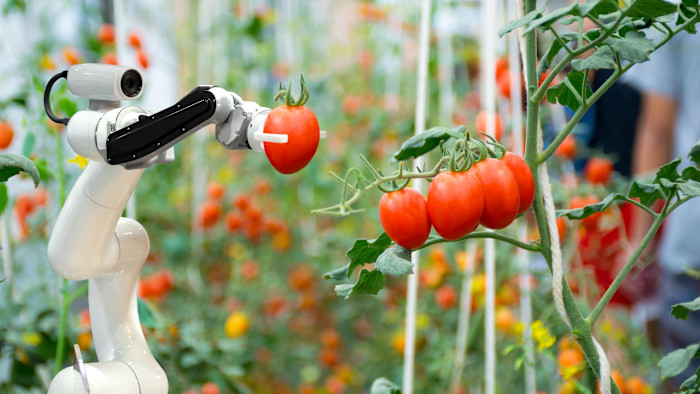
The universe of artificial intelligence is moving quickly. The latest frontier for industry is where physical devices meet AI – a union that offers hugely more scope for commercial applications than the humanoid robots in corny old films.
More than 4.7mn industrial robots were in operation in 2024, according to the International Federation of Robotics. This figure is rising by over 500,000 a year, twice the rate of ten years ago.
Physical AI takes robots to a new level. They can now combine autonomy with hardware that moves objects in the physical world – the robot itself, instruments or materials – using sensors to perceive their surroundings. This marks the next step in the evolution of robots from deterministic machines, which perform the same precise task over and again, to those that can complete varied, complex tasks and which respond to changing circumstances.
Robots can learn from seeing people perform tasks and even from watching videos of people doing a particular job. They perfect their actions through trial and error, either in the real world or, increasingly, in a simulated environment. So-called one-shot learning algorithms require only a single demonstration for a robot to learn a task. These however are newer and more difficult to design. They require extensive training and are not yet widely available.
Robots’ utility is no longer limited to carmakers’ production lines. The World Economic Forum says robots are moving from “high-volume, low-variation” environments to those that are “high-variation, low-volume”, which include changing circumstances or locations. As a result, the deployment of skilled robots is now more viable in small-scale and dynamic operations.
The advantages of using robots range from reducing the danger in physical jobs to improving efficiency and productivity by filling gaps in the workforce. That said, the technology is so young that data is limited.
Stephan Schlauss, the global head of manufacturing at Siemens, the German engineering company, gave an indication of the technology’s effectiveness in a WEF report last summer. He wrote: “AI-enabled robots that pick and place different parts and materials in our assembly lines reduce automation costs by 90 per cent. Manual workers are also empowered with AI-guided systems, enhancing productivity and quality.”
Why now?
Robots are not new but, similar to AI agents, different strands are being woven together to make them more sophisticated.
Advances in soft materials, precision motors and training methods have combined to allow the creation of machines which perform tasks that humans consider simple, such as tightening a screw or holding an irregularly shaped or fragile object. Cameras and sensors enable vision while haptic sensors provide feedback on touch. Together they allow enhanced decision-making that helps robots to adapt to different circumstances and new fields of application.
At the same time, cutting-edge technologies are more accessible. The availability of increased processing power combined with cloud computing has reduced the need to invest in fixed hardware stacks. This has put newer technologies within reach of companies with smaller budgets.
Deployment has become easier with more intuitive interfaces such as natural language communication. With AI increasingly able to carry out more tasks and AI-enabled robots more accessible, the WEF says it is critical that companies know how to redesign workflows for maximum advantage.
Skills will need to change, too, as we highlighted in our October 2025 report on AI and the worker. Factory and warehouse staff will have fewer manual, repetitive or laborious tasks to carry out. Instead they will work alongside robots and should be shown how to run them and carry out simple maintenance.
From machine to (not quite) man
Industrial robots have evolved from a fixed position “robot in a cage” that has no spatial or relative awareness, such as a welding machine. Now there are robots that can weld on different surfaces and respond to input from their surroundings.
Experiments by Angelo Cangelosi, the professor of machine learning and robotics at Manchester university, take this interaction to a new level and involve robots standing beside humans to carry out tasks together.
“Of course, you need a robot that is safe and can sense proximity so it can stop,” but more important, when working side by side, the robot must also understand the intention of its coworker and whose turn it is to take an action.
This technology, which would enable robots to work in a collaborative fashion in a structured environment, is in the research phase. Robots that can perform many unspecified tasks in real-world environments are even further away.
The WEF classifies robotic developments as rule-based, training-based or context-based.
Old-style rule-based robots are trained on inputs such as “if x, then y”. They perform static, unchanging tasks and their output is based on input: there is no learning and no flexibility. This works in situations such as production-line assembly, which requires limited dexterity.
Training-based systems are built on models that replicate specific behaviours or patterns. They can perform more complex or fiddly tasks than their forebears but the scope of operations is restricted to structured environments.
While these systems can use probability theory or probability distributions to complete tasks, their behaviour is constrained by training data, model architecture and hardware, and outcomes are limited in scope.
They often rely on sensors, cameras and maps loaded into their software to navigate and operate effectively. They only rarely support natural language prompts; zero-shot execution, which is performing tasks without training, is minimal. For example, a robot trained to sort two types of fruit will struggle with a third type unless it is retrained. Conversely, a robot with broader training and sufficiently dexterous hardware might be able to handle a wider assortment.
Training can be through imitation learning, where a robot mimics human demonstrations and is then fine-tuned, allowing improvement through trial and error.
In teaching a robot how to insert a screw, for instance, the first data input might be based on imitation, and reinforcement learning will ensure that the angle, pressure and torque are perfected. Systems can be trained in a simulated environment, both to minimise damage to real equipment and to access sufficient data (on which more below). After a system has learnt how to perform the task in a simulated environment, the education can be transferred into the programming for the physical robot.
The input of context-based robots is more general and their output is more flexible. The robots’ software might include generalist foundation models trained on large, diverse datasets. This enables them to interpret varied inputs and generate adaptive responses.
Imitation learning can be overlaid to add behaviour for human interactions or real-time decision-making. Robots can then use probabilistic inference, which enables responses that reflect environmental cues and instructions rather than rigidly replicating training examples.
By combining this generalist training with real-time inputs, from cameras, microphones, tactile sensors and natural language prompts, context-based robots are more capable of undertaking tasks without explicit training.
Zero-shot tasks can include sorting items by weight if a robot understands both sorting and weighing, or folding and sorting differently-coloured laundry if it is shown how to fold as well. However, for entirely novel tasks, such as folding laundry without training, it might require additional input.
The data dilemma
The process of training is neither simple nor swift. Edward Johns, an associate professor at Imperial College London and the founder of the Robot Learning Lab, says: “We need robots to be much quicker at learning [new tasks] because the rate at which they learn at the moment is very slow, which is expensive.”
A limiting factor is the paucity of data and the cost of collecting what is available, Johns says. In imitation learning, for instance, hundreds of hours of demonstrations can be required for a robot to learn a task. Although reinforcement learning is theoretically easier in terms of human input, simply requiring a score for the robot’s performance, in practice it takes longer because more data is needed. Consequently, it is cheaper to pay humans to give demonstrations than to give rewards – and for the latter task, humans can be replaced by a reward system written into the training programme.
Large language models can ingest everything on the internet to educate themselves but data connected to real-world environments is harder to come by. It would be risky to allow a robot to wander around a warehouse while it learnt the layout, and it would be impossible to ensure it encountered all variables. Ethics considerations can also make data hard to collect, for instance in surgical procedures.
As with all forms of AI, there is no shortcut: good data is the key to strong performance. If data is insufficient, it is more likely that a robot will struggle to carry out a task accurately.
Consider cutting an onion, says Stephan Hotz, the chief product officer of Wandelbots, a Berlin company which provides a software platform that can operate any robot.
“One thousand people have now cut an onion – and now you have enough data to teach a model what it means to cut an onion. That means you can transfer that model information.” Virtual simulations can be used to create more data but the original dataset must have a degree of diversity. Data from simulations is known as synthetic data.
Hotz says: “If you have only one person cutting an onion and you take that as a basis to create a ton of synthetic data, the risk is higher [that you] go off in weird directions – which happens. [For instance] you see in all the videos on YouTube where they just go crazy.” If you start by generating synthetic data from a larger sample that effect can be mitigated.
This simulation approach is more straightforward for trained robots in structured environments than for context-based robots expected to respond to live situations. This is because simulating all real-world possibilities is a challenge.
Companies can also use data from deterministically programmed robots that are already deployed in their facilities to improve operations or to train new robots — and old robots can be retrained with new data, upgrading them to handle new materials.
Wandelbots helped Schaeffler, the German precision equipment maker, to deploy existing hardware reconfigured to handle flexible rubber rings. The robots would originally have been programmed to close their gripper to a specified width — an unreliable approach given the material’s behaviour.
Retrained and operating on a modern software stack, and integrated with a vision system, the robot can work with flexible material in a more responsive manner. “So you can make the system more intelligent by bringing in . . . trained models, or very specific pieces of instruction that are AI-backed, to react to new situations,” Hotz says.
Integrating legacy robot platforms and operating systems into new, agnostic software and AI-ready platforms is not a quick process. According to Hotz it can take up to nine months to integrate a branded robot and its software system with that of Wandelbots to the point of full production readiness, which is why not many companies offer such a service.
Besides the benefit of being able to enhance the robots with AI, there can be other advantages to reprogramming older robots. As physical AI becomes more sophisticated, coordinating several machines to work together in more complex manoeuvres — such as that shown by RoboBallet, the project by Google subsidiaries working with UCL in London — becomes feasible for robots on a uniform platform.
What lies beneath
Besides data, several technology layers go into the systems that train physical AI. Hardware includes computing chips and operating modules that can run simulation software, which has to be underpinned by systems that can apply the laws of physics.
An increasing range of chips is available for AI development. Nvidia remains the supplier with the highest profile but others are striving to catch up, including AMD, Intel and Qualcomm, as well as the lesser known Cerebras. Chips are optimised for different functions, for instance model training, simulation or inference.
The software behind physical AI training is also proliferating. Physics engines include Nvidia’s PhysX while hardware-agnostic open-source software comes from names such as Bullet, MuJoCo or ODE. These enable physical simulation, robotics control or reinforcement learning.
Simulator programmes are the next overlay, optimised for the creation of environments such as digital twins. These include Webots, Gazebo and CoppeliaSim, which are fully or partially open source and hardware-agnostic, while Nvidia’s Isaac Sim open-source framework works on an Nvidia GPU and is integrated into its programming system.
Operation of robots and any inference or processing at the edge — meaning at device or data source level rather than the server level — rely on further layers of hardware and software.
Applications
Training-based AI-enabled robots have opened up new applications in structured contexts, factories.
Nvidia says that Foxconn, the Taiwanese electronics maker and assembler which counts Apple as a client, used its AI learning processes in digital twins to train equipment to tighten screws and thread cables, tasks that were previously too fiddly for robots.
Danikor, a maker of intelligent tightening systems, says robots produce more consistent results than people. Feedback systems can save data to refine torque for optimum results, while alarms for abnormal occurrences help to ensure quality control.
In environments that are less predictable – such as industrial facilities where robots and humans interact in real-world delivery, open-field agriculture or maintenance situations where things could go wrong – context-based robots are more useful. These can react to circumstances using input from sensors and cameras.
Amazon uses over 1mn robots in its more than 300 fulfilment centres, and AI capabilities enable far more flexibility. For instance, autonomous mobile robots can use sensors to navigate around moving obstacles such as people, while robotic sorting arms can identify and handle millions of different items.
Vulcan, one of Amazon’s more recent picking and stowing robots, is the company’s first with feedback sensors that enable it to choose an appropriate force for the object it is handling. It can pick and stow three-quarters of the items Amazon stores at fulfilment centres, from socks to toothpaste to electronics. It continues to learn as it operates how items behave when handled.
Amazon is among a handful of companies that have pilot programmes to deliver items to remote locations using autonomous drones, trained both via simulation and in real-world environments. Human intervention is still commonplace for safety.
Sectoral application
Ten years ago the electronics and automotive sectors accounted for 64 per cent of the installed base of robots, according to IFR data. The use of robots is broadening from these two domains. General industry has adopted robot technology more quickly at the margins, and by 2024 it accounted for 53 per cent of the installed base.
Geographically, Asia has been ramping up its use of robots, led to a large degree by China. In 2024, China was responsible for 54 per cent of all new robots installed — more than six times as many as Japan, the second-biggest buyer.
While still a small proportion of the whole, in the past five to seven years the growth in the installation of collaborative robots has accelerated.
Healthcare has shown some of the strongest sectoral growth, with nearly twice as many new robots installed in 2024 than the previous year. Rehabilitation and physiotherapy treatments use smart exoskeletons, while medicine delivery, diagnostics and older people’s care deploy robots that respond to human input.
While not yet offering autonomous surgery, the latest model of Intuitive’s Da Vinci system uses AI to analyse surgical performance data in real time and relay it to the surgeon, improving performance on highly-technical operations.
Inspection drones can be deployed in many areas, from infrastructure monitoring and fault detection to environmental hazard assessment and for monitoring endangered species. Agriculture yields are being improved by the use of AI-enabled drones and farm equipment that monitors soil, crops and livestock. Autonomous fruit-harvesting systems are already in use in countries including Australia, Japan and the UK.
Other sectors with more limited deployment include retail and hospitality, education and search and rescue.
Such systems use a combination of robotic arms, mobile robots, unmanned aerial vehicles (UAVs), robot swarms, dog-like caninoids and smart vehicles to perform tasks in response to inputs from sensors or voice commands.
Sustainability
Although AI itself is resource-hungry, intelligent systems can also contribute to sustainability. AI can enhance robot efficiency in manufacturing and industrial facilities: robots can be designed via simulations with specified parameters, such as an instruction to ensure that movements are maximally efficient. This will reduce wear and tear on equipment and/or ensure less energy is used. Taken together, this saves on materials both in the design and operation phases.
Benefits also accrue from improved consistency of output, reducing wastage at the point of production, while post-production quality control can highlight problems early on. This optimises the use of materials at each step. Amazon, for instance, uses AI-enabled systems to decide which packaging to use for an order and how to size, cut and fold it for minimal waste.
As well as controlling the physical aspects of production and materials usage, intelligent systems can optimise the use of water and energy. They can manage schedules to use resources for maximum efficiency in terms of reduced usage or working at cheaper times. They also identify when production lines are not functioning as they should, prompting maintenance ahead of time. This saves resources both through reduced downtime and fewer sudden breakages.
Moving parts
The sector is constantly changing as companies worldwide invest heavily or become partners to develop new systems. According to data provider Corum Group, 381 deals were transacted in the first quarter of 2025, a fifth more than in the same period in 2024 (when 1,277 deals were struck in the full year). The disclosed value, which given the private nature of many of the transactions accounts for only 15 per cent of the deals, was $21.6bn.
As recently as October, Softbank, the listed Japanese investor, agreed to buy the robotics arm of ABB, the Swiss engineering group, for $5.4bn. The acquisition, which Softbank said would strengthen its AI robotics business, cements a more industry-focused approach to intelligent robots after the launch of Pepper, its popular but ultimately unsuccessful humanoid, 11 years ago.
Nvidia and Fujitsu have announced a tie-up to create AI robots with agentic capabilities, meaning the machines can act independently and improve themselves over time. These systems will power intelligent robots and automation across sectors from manufacturing to healthcare, “next-generation computing” and consumer services.
Fujitsu believes the key to progress lies in goal-driven AI agents that can learn, adapt and evolve without human intervention. This could be a significant step towards self-improving robotics, where AI agents at the operating level can simulate, plan and execute tasks and improve autonomously.
Challenges
There are a variety of challenges in developing and adopting AI, ranging from technical and developmental issues to those around deployment and ethics.
Funding
Despite access to technology being generally cheaper, funding can still be a challenge. Physical AI development requires a lot of money, so small companies especially may be better off looking for appropriate partners.
Materials and form factors
While Hotz believes we are “only three to five years” from humanoid robots, he says their capabilities are limited by form. To perform all the tasks a human does, they might need 10 “sets of hands” in different styles for different tasks, making them impractical and expensive.
This area is Johns’s specialism. He has spent years training rudimentary, pincer-like hands to perform a variety of tasks. Despite their seeming awkwardness, he says: “There’s an awful lot you can do with very simple grippers.”
Part of his new research aims to simultaneously develop hardware and software to create the optimal hand for any given task, one that can carry out as many general tasks as possible.
He says that AI itself may eventually design a generalist hand that is not even humanoid: “It could have seven fingers” or “a completely different mechanism in the wrist.”
Caninoids – mechanised robot dogs – illustrate that the most useful form factors might not be as we imagine. Four-legged robots are more stable than bipeds and can cope with problems such as unsteady terrain and surfaces. AI is improving these capabilities, using machine-learning simulations to cope with challenges such as slippery floors.
Model limitations
It is unlikely that the humanoids portrayed in art and films, those that have artificial general intelligence, will be with us soon, if ever. Likewise, computer systems that surpass human capabilities.
Unlike industrial robots that can be uploaded with foundational data and models, Cangelosi teaches robot brains from zero up, followed by layers of learning, as one might teach a child. This process can be accelerated so that a robot can be “two” well within two years but he says that there is no way to give a robot the same extent of knowledge and context to be able to perform all tasks with the same flexibility as a human.
Safety
This is another impediment to the rapid creation of humanoids, Hotz says. If an industrial robot malfunctions, it can simply shut down and no one is injured. “A humanoid robot, when it runs out of battery, it keels over and might fall on your infant or your cat. That of course, is a huge problem that has to be solved before they can be deployed en masse.”
In any event, for the more structured industrial context he does not see a case for early adoption. “Most tasks can be solved more reliably and cheaply with traditional form factors, like arms or mobile robots”.
Catastrophic forgetting
AI models can occasionally forget how to perform trained tasks, a phenomenon that occurs when new data overwrites old data.
“Catastrophic forgetting” is more likely in devices that are constantly called on to learn from and respond to their surroundings rather than in industrial robots in structured environments. It is particularly a risk when systems learn new tasks that are similar to old ones. There are ways to mitigate this, for instance by adopting slower or interwoven learning or through rehearsal, when old data is replayed along with new data. The problem has still to be overcome: its incidence is unpredictable.
Adopt for success
Concerns that robots could take over jobs in a wholesale way are so far unfounded. In some instances, robots have filled gaps where humans cannot or will not work: in factory jobs that are dangerous or demanding or in markets such as Japan, where the workforce is shrinking.
It is undoubtedly the case that jobs will change, if they have not already. Not all aspects of this will be bad: robots can prevent injury by assisting human co-workers with heavy loads or awkward tasks.
The nature and distribution of jobs will change with different needs. In many industrial environments, human jobs are likely to become more technical: rather than carrying out operational tasks, workers will maintain and operate robot workers. Some manual jobs might disappear – repetitive assembly-line work, for instance – while intricate trades such as electrics and plumbing will still be difficult for robots to carry out. Huang of Nvidia says plumbers and electricians will still be needed by the hundreds of thousands.
Enterprises in general should consider robot deployment strategically because physical AI is not solely concerned with cost-cutting but also reimagining workflows for resilience.
Enterprises that adopt physical AI should look at using it to help employees work more effectively. As highlighted by the Tech for Growth Forum’s report on AI and the worker, the most successful AI adoption will be achieved by companies that involve their people in envisaging fresh workflows to take advantage of new tools.
Read the full article here