

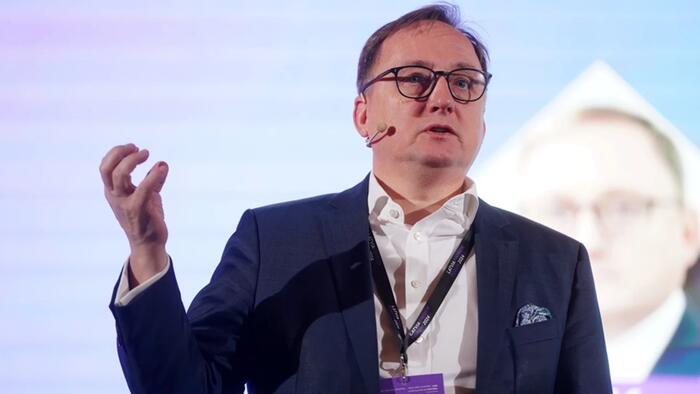
Latvia’s central bank governor, Martins Kazaks, has warned European leaders against downplaying the danger posed by Russia, describing in a fresh interview the European Union is already “at war” with Moscow and must be ready for further escalation, particularly in its financial systems.
This is raising eyebrows at the Kremlin, but many Russian officials might actually agree with this grim assessment: “It’s naive to think that we are not at war” with Russia, Kazaks told the Financial Times.
He cited as examples of an active war situation the ongoing cyberattacks on Europe, alleged acts of sabotage targeting infrastructure in the Baltic Sea, as well as drone violations of Danish and other EU airspace – the latter which has involved plenty of speculation and accusations leveled among EU officials, but no final or clear proof of links to Russia or its intelligence services.
Kazaks acknowledged that as of yet, the conflict connected to Ukraine is not being fought directly on EU soil, but he stressed “we need to be resilient to deal with that.”
In response, Latvia’s central bank has intensified contingency planning in recent years, prioritizing uninterrupted access to cash and digital payments during emergencies and the ability to carry out offline card transactions for essential purchases. On this Kazāks emphasized, “We are in many cases best in the class.”
He further cautioned that an armed conflict involving a eurozone member could trigger “financial stability issues” – but ironically he claimed that more and constant European/NATO support to Kiev would make these risks “marginal”, also as the EU has newly sought to greatly bolster its own defensive capabilities.
This is in line with his own government’s consistently hawkish anti-Moscow stance, along with the other tiny (but loud) Baltic and former Soviet satellite states.
We can say at the very least that Russia-NATO proxy war has been in full swing for quite a while now. As a reminder, the world just reached the following tragic milestone:
Russia’s full-fledged war against Ukraine has already lasted longer than the Soviet fight against Nazi Germany in World War II—as discussed in Steve Gutterman’s RFE/RL. “None of the conditions for a final resolution of the conflict are in place,” Ruth Deyermond of King’s College London told Gutterman for his analysis entitled “Will Russia’s War Against Ukraine End In 2026?” Deyermond believes neither Ukraine nor Russia are “in a position to achieve a conclusive victory on the battlefield” or to collapse under pressure. According to Deyermond, the main obstacle to peace is Moscow’s stance: “Russia… seems to have no interest in an end to the fighting, let alone the war,” she says, while CSIS analyst Mark Cancian argues the Russians’ “stated goals are totally unacceptable” and their intransigence “stems from their belief that they are winning.” At best, a cease-fire or “temporarily frozen conflict” is possible so long as Putin’s presidency remains tied to the war, according to Crisis Group’s Olga Oliker.
But the above doesn’t address the other pressing question: can Ukraine and its dwindling and fatigued armed forces last? While the West believes it is weakening Russia, there is little doubt that Ukraine is being fast drained and weakened to the brink of collapse. It is being propped up by the Western powers, financially, militarily, and really on almost every level.
For example, on the pressing issue of the country’s collapsing power infrastructure, regional media warns amid rolling blackouts, power outages could begin to last over 16 hours a day under newly proposed emergency schedules. The country can’t get parts fast enough to replace damaged substations, and this is an area where no amount of external support can keep up, ultimately.
Loading recommendations…
Read the full article here