

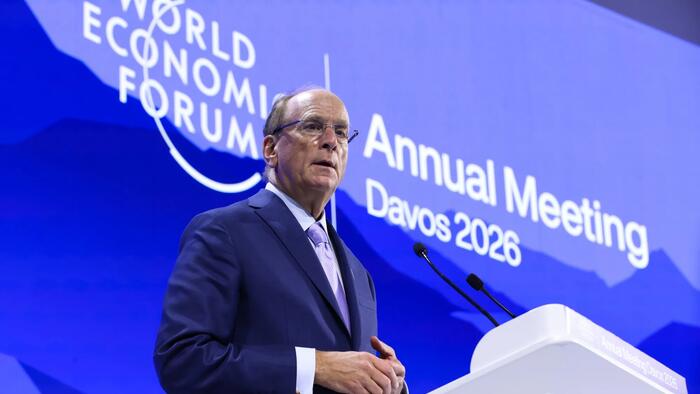
BlackRock Chief Executive Larry Fink – the new “mayor of Davos” after founder Klaus Schwab resigned last April – used the opening of the World Economic Forum this week to deliver an unusually stark warning to the global elite: Artificial intelligence, if left on its current trajectory, risks deepening inequality, hollowing out the professional class and becoming the next great failure of modern capitalism.
Speaking Tuesday to thousands of executives, policymakers and financiers gathered in Davos, Fink – who spearheaded the ESG scam – argued that the extraordinary wealth created since the end of the Cold War has been distributed too narrowly to sustain social stability – an imbalance he said the AI revolution threatens to accelerate.
“This forum can’t remain an echo chamber,” Fink said. “And we shouldn’t want panels where everyone agrees 95% of the time. Because the world doesn’t.”
“Since the fall of the Berlin Wall, more wealth has been created than in any time prior in human history, but in advanced economies, that wealth has accrued to a far narrower share of people than any healthy society can ultimately sustain,” Mr. Fink said, adding “Most of the people affected by what we talk about here will never come to his conference. That’s the central tension of this forum: Davos is an elite gathering trying to shape a world that belongs to everyone.”
The billionaire head of the world’s largest asset manager warned that the early rewards of AI are flowing almost exclusively to those who own the technology’s foundations – models, data and infrastructure – while wage earners risk being left behind. He drew a direct parallel between the impact of AI on white-collar workers and the disruption globalization inflicted on manufacturing jobs in previous decades.
“The open question: What happens to everyone else if AI does to white-collar workers what globalization did to blue-collar workers?” Mr. Fink said. “We need to confront that today directly. It is not about the future. The future is now.”
A Familiar Critique, Sharpened by AI
Fink has long positioned himself as an internal critic of modern capitalism, using his annual letters to investors and his prominence at Davos to argue that markets must better serve society at large. He was a leading proponent of environmental, social and governance investing and has championed “stakeholder capitalism,” a framework that calls on companies to balance shareholder returns with responsibilities to workers, customers and communities.
As RCP noted a few days ago, Stakeholder capitalism is a concept invented by Schwab. Schwab’s argued for years that capitalism governed by shareholders would be vastly improved by systematically elevating the inputs of other stakeholders, like employees, supply chains, community values and the environment. ESG investing is the analytic framework upon which stakeholder capitalism largely depends. ESG rating agents use non-financial metrics to identify the “best” and “worst” companies to overweight, underweight or exclude in investment portfolios. Stakeholder capitalists broadly embraced the net-zero energy paradigm, aka “Paris +1.5°C by 2050 at all costs”. Net-zero commitments led many European countries to spend trillions on wind and solar investments at the expense of more reliable, more resilient and considerably cheaper energy alternatives, including fossil fuels. WEF’s acolytes have cheered them on as they did.
Except, whoopsie – looks like even Larry admits that’s not gonna work:
Even BlackRock CEO Larry Fink now admits that “transitioning” to solar and wind will cause a global power shortage—after spending years pressuring companies to do exactly that.
The “transition” he advanced has already sabotaged our power supply and raised our electricity bills. pic.twitter.com/wggLJ78xzP
— Alex Epstein (@AlexEpstein) January 18, 2026
In a 2022 letter to investors, published ahead of that year’s Davos summit, Fink urged companies to recognize that their mandate extended beyond profits alone. While BlackRock rolled back many of its diversity, equity and inclusion goals in early 2025, His remarks this week signaled a renewed effort to reshape the debate – this time around AI.
Concerns about AI’s impact on labor extend beyond wealth distribution. Geoffrey Hinton, a Nobel laureate often described as a pioneer of artificial intelligence, has warned that the technology could displace large numbers of white-collar workers while concentrating profits at the top.
“What’s actually going to happen is rich people are going to use AI to replace workers,” Mr. Hinton said last year. “It’s going to create massive unemployment and a huge rise in profits.”
Larry Fink has become an outright socialist. He built his fortune on capitalism and is now rigging the system against future generations.
Capitalism didn’t fail—it was sabotaged by the WEF global elite through cronyism, endless money printing, overregulation, and zero… https://t.co/Oc8FNLrRjS
— Desiree Fixler (@desireefixler) January 19, 2026
The warning comes amid an unprecedented surge in AI-related wealth. Morningstar analysts found that a group of 34 AI-linked stocks – including Amazon, Alphabet and Microsoft – rose more than 50% in 2025. According to the Bloomberg Billionaires Index, the median net-worth increase among the 50 wealthiest Americans last year was nearly $10 billion.
Federal Reserve data show that the bottom half of Americans own about 1% of stock-market wealth, while the top 1% control nearly half of corporate equity. In effect, Fink said, the AI boom is reinforcing a K-shaped economy – one path of rapid wealth accumulation for asset owners, another of stagnation for everyone else.
Palantir CEO Alex Karp chimed in on AI as well at Davos, saying that it will displace so many jobs that it will eliminate the need for mass immigration.
“There will be more than enough jobs for the citizens of your nation, especially those with vocational training,: said Karp during a WEF panel. “I do think these trends really do make it hard to imagine why we should have large-scale immigration unless you have a very specialized skill.”
Karp suggested that vocational workers will be more valuable, “if not irreplaceable,” criticizing the notion that higher education is the ultimate benchmark of a person’s talents and ability to hold a job.
That said, he also notes that many believe we’re in an AI bubble.
🚨BREAKING: Palantir CEO Alex Karp says many believe we are in an AI bubble because much of AI simply does not work out of the box.
Karp says off the shelf LLMs are not precise enough for regulated tasks like underwriting, arguing real value only comes from building a software… pic.twitter.com/seuMLxrFpq
— AI Scientist (@AIScientist) January 21, 2026
Blockchain Everything?
Fink also promoted financial tokenization and called digital currency “necessary” – while envisioning all assets sharing a single blockchain to ‘reduce corruption.’
BlackRock CEO Larry Fink speaks on reducing corruption via tokenization of stocks and bonds, while sitting next to Citadel’s Ken Griffin.. pic.twitter.com/vDxPfcJEsi
— Reese Politics (@ReesePolitics) January 21, 2026
Loading recommendations…
Read the full article here