

Good morning and welcome back to FirstFT Asia. In today’s newsletter:
-
Trump drops tariff threat over Greenland
-
Takaichi vs the bond markets
-
A Gen-Zer’s year without a smartphone
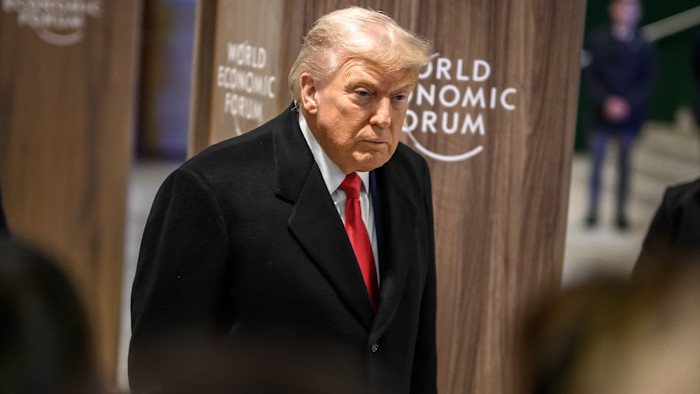
We begin in Davos, where President Donald Trump said he was dropping his threat to hit European countries with new tariffs after striking “the framework of a future deal” over Greenland in talks with Nato’s secretary-general Mark Rutte.
What to know: The US president said he had held a “very productive” meeting with Rutte and would hold future talks and find a solution that “if consummated” would be a “great one” for the US and Nato members. In a later interview with CNBC, Trump said he withdrew his threat to impose tariffs on European countries opposed to a US takeover of Greenland because “we had pretty much the concept of a deal”. He added that the framework agreement could involve Greenland’s natural resources.
The US president’s comments marked another reversal of a tariff threat and a significant softening of his stance on Greenland. They came hours after he told an audience at the World Economic Forum in Davos that he would not use force to acquire the territory from Denmark — but told Europe to back his plan.
Market reaction: The US president’s move to withdraw his tariff threat offers a sudden reprieve to global markets, and will ease fears of a breakdown in the transatlantic relationship. Wall Street stocks recoiled on Tuesday, with the blue-chip S&P 500 share index posting its worst day since October. Stocks rallied yesterday after Trump dropped the threat of new levies, with the S&P 500 jumping 1.2 per cent. Read the full story.
-
Instant Insight: Trump may be climbing down on Greenland but American allies will not forget the episode, writes Gideon Rachman.
-
More from the WEF: US commerce secretary Howard Lutnick was heckled at a World Economic Forum dinner in Davos, with European Central Bank president Christine Lagarde walking out during his speech.
-
No more Davos? Senior executives at the World Economic Forum are weighing whether the organisation’s flagship annual meeting needs to change location.
Join FT Live all week at Davos for exclusive interviews, high-level briefings, webinars and more. Register for free.
Here’s what else we’re keeping tabs on today:
-
Economic data: South Korea publishes fourth-quarter GDP, Japan releases December trade data and Hong Kong reports monthly inflation figures.
-
Monetary policy: The Bank of Japan begins its two-day policy meeting, where the central bank is expected to keep rates on hold after raising them to a 30-year high last month. (Reuters)
Five more top stories
1. US Supreme Court justices appeared sceptical of Trump’s efforts to sack Federal Reserve governor Lisa Cook, as they heard arguments in a case with sweeping implications for the independence of the world’s most important central bank. Trump’s attempt to fire Cook in August was the first time a US president had tried to remove a Fed governor.
2. Indonesia has revoked the permits of 28 resources companies, including a subsidiary of Jardine Matheson, as part of a probe into whether their operations played a role in the deadly floods that killed more than 1,000 people late last year. Here’s what we know about the companies losing their permits.
3. Israel’s Prime Minister Benjamin Netanyahu will join Trump’s “Board of Peace”, a contentious new organisation that the US president has suggested could replace the UN. However, the Israeli premier’s office did not say whether his country would pay the $1bn fee that guarantees permanent membership.
4. US uranium group Energy Fuels will acquire Australian Strategic Materials to create a “mines-to-metal” champion in the race to build a non-Chinese supply chain for rare earths. The deal is the latest sign that US companies are looking to Australia for critical minerals development.
5. Logical Intelligence, a start-up that claims to have made a breakthrough in developing a more advanced AI model, has appointed Yann LeCun to its board as it seeks funding at a $1bn-plus valuation. The appointment of LeCun, Meta’s former chief AI scientist, came as the Silicon Valley-based firm unveiled a new “energy based” reasoning model called Kona.
The Big Read
Drones have emerged as the most decisive weapon in the Russian war on Ukraine, causing three-quarters of recent casualties. Both sides are scrambling to source the vital components from China, which are often produced in the same factories. Here’s how Chinese suppliers could decide the drone war in Ukraine.
We’re also reading . . .
-
Takaichi vs the bond markets: If Japan’s prime minister fails to persuade bond markets that she can afford her cost-cutting plans the tremors will be global.
-
Declining superpower: Even under normal leadership, a status-anxious US would be lashing out, writes Janan Ganesh.
-
Australian fires: As temperatures rise, some fear that 2026 could prove to be one of the worst fire seasons since the deadly “Black Summer” blazes of 2019.
Map of the day
Trump once told a journalist about his desire to acquire Greenland: “I love maps. And I always said, ‘Look at the size of this. It’s massive, and that should be part of the United States.’” But as the FT’s visual journalists point out, the Arctic island is not as big as it seems.
Take a break from the news . . .
All Harvey Nriapia ever knew was his iPhone. But after feeling ashamed of his screen time, the FT Gen-Zer swapped his Apple device for a flip phone. A year on, he shares what he’s learned about life without a smartphone — and whether he’ll ever go back.
Read the full article here