

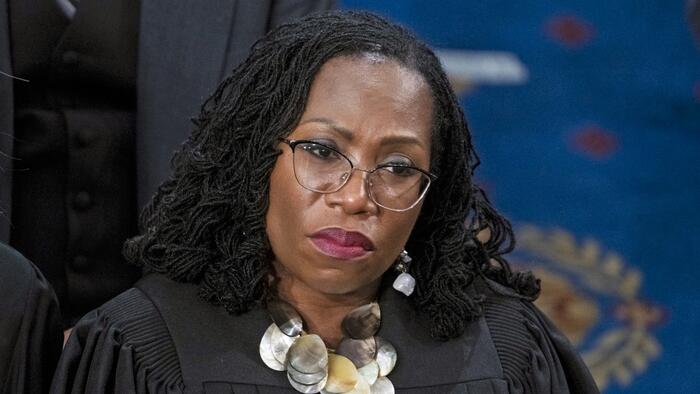
During oral arguments in Wolford v. Lopez, Supreme Court Justice Ketanji Brown Jackson suggested that the post-Civil War “Black Codes” – a set of openly racist laws enacted in the Democrat-controlled South to strip newly freed Black Americans of basic rights, including the right to possess firearms – could serve as legitimate historical precedent under the Supreme Court’s Bruen test. That test evaluates modern gun laws by asking whether similar restrictions were accepted in the nation’s historical tradition. The case concerns a Hawaii law that bars licensed gun owners from carrying firearms onto privately owned property open to the public. Jackson relying on the Black Codes for constitutional guidance is hilarious, as those laws were explicitly designed to deny civil rights to Black Americans in defiance of emancipation.
The exchange unfolded as Justice Jackson pressed U.S. Principal Deputy Solicitor General Sarah Harris on why post–Civil War Black Codes should be excluded from consideration when courts examine modern-day gun control laws. Hawaii relied on a 1865 Louisiana statute as historical support for its law, a statute even Neal Katyal, the lawyer representing Hawaii, admitted was “undoubtedly a relic of a shameful portion of American history.”
“So, I guess I really don’t understand your response to Justice Gorsuch on the Black Codes,” Jackson began. She explained that, under Bruen, courts are required to look to history and tradition to assess constitutionality. “The fact that the Black Codes were, at some later point, determined themselves to be unconstitutional doesn’t seem to me to be relevant to the assessment that Bruen is asking us to make.”
Harris responded by emphasizing the fundamentally racist purpose of those laws. “Black Codes were unconstitutional from the moment of their inception because they are pretextual laws that are designed to ensure that newly freed slaves are returned to a condition of sharecropping.”
Justice Jackson, a black woman, immediately pushed back. “Okay, let me stop you there. They were not deemed unconstitutional at the time that they were enacted,” she said. “They were part of the history and tradition of the country, and when we have a test now that’s asking us to look at what people were doing back then, I don’t understand why they should be excluded.”
Harris reiterated that point. “Because they are outliers. They are, by definition, unconstitutional. They have always been unconstitutional.”
Jackson bizarrely remained unconvinced. “Found later, afterwards, not at the time,” she said, returning to the Bruen framework. “And if the test says what’s happening at the time tells us what’s constitutional for this purpose, why aren’t they in?”
Harris responded by insisting the laws should be disregarded because they were aberrations and unconstitutional from their inception.
But Jackson rejected that framing. She argued that their unconstitutionality was determined later, not contemporaneously, making it a legitimate precedent. And, according to Jackson, if the test looks to historical practice at the time of enactment, she asked, why should those laws be left out?
Harris attempted to explain how a law could be unconstitutional from inception, while still accounting for historical analysis. Jackson claimed that Harris’s position effectively dismissed history altogether. When Harris denied that implication, Jackson underscored the contradiction by noting that history either matters under Bruen or it does not.
Harris then stressed that historical inquiry remains essential, though not indiscriminate. “We should deeply care about the history,” she said, adding that Bruen requires courts to identify a genuine national tradition by excluding aberrations. She described the Black Codes as precisely that — laws enacted “for the purpose of trying to reduce newly freed slaves back to conditions of servitude,” including measures that criminalized carrying arms on private property. “Those are obvious outliers which should not count under the whole point of Bruen.”
Things I didn’t have on my bingo card today: Justice Jackson defending the racist Black Codes as precedent for what we should consider constitutional. pic.twitter.com/I9yxcMsDrf
— Carrie Severino (@JCNSeverino) January 20, 2026
Justice Jackson has never distinguished herself on the bench for her bright legal mind, but it was frankly remarkable to see her treating some of the most overtly racist laws in American history as potentially valid reference points for modern gun control.
Loading recommendations…
Read the full article here