

Hello from New York.
All eyes are on Davos, where US President Donald Trump has confirmed he won’t attack a Nato ally.
“I don’t have to use force. I don’t want to use force. I won’t use force,” he said, in reference to his desire to acquire Greenland.
This is a walk back, since he previously refused to rule out force and told Norway’s prime minister that his lack of a Nobel Peace Prize had made him less inclined “to think purely of peace”.
But don’t forget, he totally could if he wanted to!
“We probably won’t get anything unless I decide to use excessive strength and force, where we would be, frankly, unstoppable,” Trump said.
“But I won’t do that.”
The president also met yesterday with business leaders from Schneider Electric, Siemens Energy, TotalEnergies and Aramco.
In other energy news, US shale companies are seeking opportunities in Venezuela, the Middle East and Australia as domestic output plateaus.
And the EU is straining to wean itself off Russian uranium, but US companies are buying up new supplies from Urenco and Orano, the leading western producers of uranium.
In today’s newsletter we look at Trump’s crusade against offshore wind, which suffered court defeats last week. Plus, my colleague Jamie Smyth examines whether Europe’s growing reliance on US gas is becoming a problem amid transatlantic tensions. — Martha
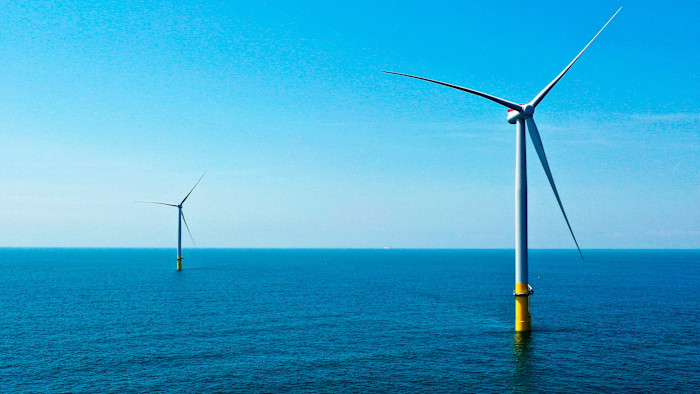
US offshore wind projects win legal reprieve
Offshore wind scored a hat trick, or for our American readers, went 3 and 0, last week.
Donald Trump’s administration in December suspended the leases of five offshore wind projects, citing national security concerns such as the risk of radar interference.
Ørsted, Equinor and Dominion Energy immediately sued on behalf of their projects, strenuously denying that they pose any risk and pointing to their advanced construction status.
Three judges cleared the way for construction to continue, notching a blow to the White House’s crusade against offshore wind.
Judges Royce Lamberth and Carl Nichols (a Trump appointee) said separately that Ørsted and Equinor had demonstrated “irreparable harm” to their projects, while Judge Jamar Walker said the government’s case was “too broad” to apply to Dominion’s project.
The stakes were high for the companies, which have sunk billions of dollars into the wind farms. Ørsted’s Revolution Wind project has cost $6.2bn, and the president’s attacks on offshore wind forced the company to raise $9bn in a rights issue in October. Equinor’s Empire Wind has cost $5bn and Dominion’s Coastal Virginia Offshore Wind is the most expensive at $11.2bn.
They could also provide electrons critical to powering the AI boom. CVOW will power up to 660,000 homes upon completion and is located near “data centre alley”, the world’s largest hub for internet traffic. Electricity bills in Virginia have risen nearly 11 per cent over the past year — putting CVOW at the centre of vital questions about how to power data centres and keep utility bills affordable.
Its targeting marks an escalation in the war on offshore wind. CVOW had avoided the wrath of the Trump administration during the tenure of Virginia’s Republican former governor, Glenn Youngkin.
But the election of Democrat Abigail Spanberger last November seems to have lumped CVOW in with other blue-state projects, which have had stop-work orders levied at them.
The companies have the green light to keep building. But never trust Trump to let a grudge go. The underlying lawsuits continue, and at a recent meeting with oil executives, he warned “my goal is to not let any windmills be built”. A White House spokesperson said the administration “looks forward to ultimate victory on the issue”.
One potential rub for the offshore wind developers was hinted at in Empire and CVOW’s hearings, where Judges Nichols and Walker noted the government’s concerns relate to the wind farms’ operations, not construction.
The government’s argument — that building a nuclear bomb could be harmful even if it’s never detonated — didn’t fly. But the caveat suggests room for the government to make the claim that up-and-running wind farms do pose a danger in the future. (Martha Muir)
Is Europe too reliant on US gas?
Four years ago, the EU was plunged into an energy crisis when its reliance on Russian pipeline gas was brutally exposed following Moscow’s full-scale invasion of Ukraine.
It was a harsh lesson for Brussels, which had failed to diversify gas supplies following the interruption of imports during an earlier dispute between Moscow and Kyiv in 2006.
Once bitten, twice shy, as the saying goes, and since February 2022 the EU has diversified away from Russian gas — mainly by buying liquefied natural gas from an ally, the US.
The US share of EU gas imports has risen from 5 per cent in 2021 to 23 per cent in 2025, and is projected to rise to 30 per cent this year as LNG replaces Russian flows, according to a new report by Oxford Economics, a consultancy.
The arrangement has been good for both parties and in December Brussels made a commitment to phase out Russian gas permanently by late 2027.
US LNG exports have reduced energy price volatility and played an important role in lowering inflation. The availability of flexible LNG cargoes has weakened the traditional relationship between heating demand, gas storage levels and price.
“Despite cold weather and low storage levels, the European Dutch TTF Benchmark was 20 per cent lower year-on-year in Q4 2025,” according to the Oxford Economics report.
The transatlantic LNG trade has boosted US industry, which is building capacity at breakneck speed along the Gulf Coast in spite of warnings of a looming supply glut.
Trump has been a strong advocate for the industry, extracting a pledge from EU member states to buy $750mn of US energy over three years as part of a trade deal agreed in July.
Though he has backed off his threats to invade Greenland and impose tariffs on EU member states, Trump’s recent rhetoric is sure to cause European policymakers to question just how much they should tie their future energy security to US LNG.
“The Trump administration has demonstrated a willingness to use economic dependencies,” said Jack Reid, graduate economist at Oxford Economics. “Given the lack of alternative suppliers, even an increase in the market’s perceived risk of disruption would put upward pressure on European gas prices.”
Reid said unilateral action from the US to limit gas to the EU remains a tail risk and is not part of the firm’s baseline view. It would impose economic costs and legal blowback from the LNG export industry, which Trump has sought to champion.
But in such a volatile geopolitical environment — and with three years of Trump’s presidency remaining — it would be a brave politician who does not prepare for the previously unthinkable.
Asked for its response to whether Europe would start to debate its reliance on US LNG in the wake of Trump’s comments, the Center for LNG, a US industry group, said the sector was in a “unique position to meet the energy needs of the EU as they look to completely phase out Russian energy by 2027”.
“The flexibility of US contracts, security of supply and market-driven participants enable a dynamic relationship that benefits parties on both sides of the Atlantic. As the transatlantic energy co-operation between the US and EU continues to grow, driven by the surge in commercial activity in 2025 in advance of the 2027 deadline, we expect to see more US LNG arrive to replace Russian energy.” (Jamie Smyth)
Power Points
-
Indonesia has revoked the permits of 28 resources companies as part of a probe into whether their operations played a role in the deadly floods last year.
-
The UK is poised to extend the life of the Sizewell B nuclear power plant.
-
Can Delcy Rodríguez stay true to her socialist roots and meet Trump’s demands?
Energy Source is written and edited by Jamie Smyth, Martha Muir, Alexandra White, Rachel Millard, Malcolm Moore and Ryohtaroh Satoh, with support from the FT’s global team of reporters. Reach us at [email protected] and follow us on X at @FTEnergy. Catch up on past editions of the newsletter here.
Read the full article here