

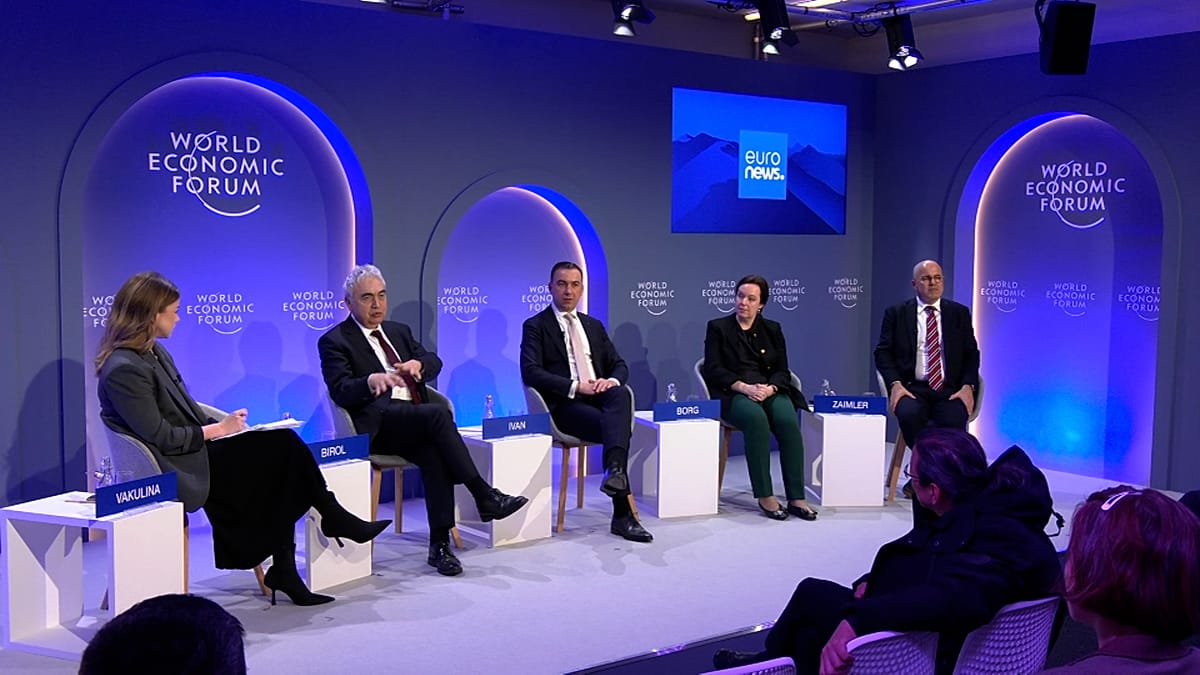
Europe must electrify “everything” in the coming years, Fatih Birol, Executive Director of the International Energy Agency (IEA), said during a Euronews panel at the World Economic Forum in Davos, sharing a vision of a continent powered by clean power rather than fossil fuels.
“When we look at energy security in Europe, and Europe’s goals, such as reaching our climate goals, but also at the same time being affordable, I see one future for Europe,” Birol said. “Electrify everything, as much as you can, electrify everything. Transportation, industry and so on.”
The IEA chief suggested a two-fold strategy to this end. The first is to massively invest in grid infrastructure, and the second is to lower energy prices.
“One is grids, grids, grids,” Birol said, emphasising the importance of revamping the power grids in Europe.
He noted that there are significant bottlenecks, as permits remain difficult to obtain, undermining the development of the vast, interconnected networks that deliver power to homes, businesses, and factories. Birol called this “the main barrier to the electrification of the European economy”.
“I will give one shocking number. Last year in Europe, we installed a record 80 gigawatts of renewable capacity. More than 400 gigawatts of renewable capacity were ready. But we couldn’t connect it to the grid. And it didn’t go to the households or the factories. This is completely crazy. Economically, it doesn’t make sense at all.”
Birol compared this push for green energy to developing the necessary infrastructure to build a fancy, efficient car, while forgetting to build roads.
Grid failures were also tied to the Iberian Peninsula blackout that left 60 million people without power in April 2025.
EU ‘Grids Package’
The ageing European grid was highlighted in a study by energy think tank Ember published this week, which found that the EU doesn’t have an issue generating green power — wind and solar generated more EU electricity than fossil fuels for the first time in 2025 — but that its “outdated” grid means it has a problem moving that power around.
In light of these issues, the European Commission unveiled a “Grids Package” at the end of last year to revamp the bloc’s obsolete electricity grid to increase electricity transmission across the EU27.
This move was lauded by Birol, who said he hoped this package would see the light of day, as this could “unblock many of the problems” faced by Europe.
Kıvanç Zaimler, CEO of Sabancı Holding, a leading Turkish investment holding company, who joined the panel, echoed that grid investment is “a must” but stated this must be an in-depth transformation using another car-themed analogy.
“We also have to think about efficiency through digitalisation. It’s like managing (road) traffic. You not only need additional roads, but you also need to solve traffic problems with navigation systems,” he said.
Tackling high energy costs
Another key issue in Europe, Birol said, is the high cost of electricity, which represents a major challenge for the competitiveness of European industry.
“Electricity prices in Europe are very high compared to, I don’t know, the competitors such as the US, such as China. They are three to four times higher here than in those countries,” he told Euronews.
Romanian Energy Minister Bogdan Ivan said the solution to high energy prices was to double energy resources in Europe.
“We (in Romania) are paying (among) the highest energy prices adjusted for people’s income,” Bogdan said.
He said this should be done by diversifying resources. “I want to use EU resources to finance nuclear power,” Ivan said. “That’s one of the best ways to bring cheap and baseline energy.” He argued that if the EU put too much emphasis on investing solely in wind and solar, it would “definitely have an issue”.
EU energy ministers have pledged to level energy prices across member states and prevent discrepancies between countries during their last official meeting in December.
Sweden’s Vattenfall President and CEO Anna Borg, who was also a panelist, agreed that diversification is key, also putting forward nuclear as a key component.
“We will need all the fossil-free technologies that we get our hands on. But it is important to understand that the European economy can, in the long run, only be competitive if we phase out fossil fuels.”
Challenging regulations
Reviewing regulations is central to addressing all the underlying challenges delaying European energy sovereignty, the panellists agreed, especially in lowering prices.
Borg argued that overlapping legislation should be addressed, as it often impedes the swift development of key projects.
“Sometimes when we want to build something, we first have to get approval according to one regulation and then another. And they are overlapping in looking at the same thing, but you can get different results,” she said, calling for a more holistic approach.
The Vattenfall representative said what is really needed are “stable regulatory and policy frameworks” that are long-term: “(Energy) investments are made to be there for many decades. And the best thing that we can do from a European perspective is to keep an alignment between the countries so that policies don’t differ too much within the EU.”
She argued that a lack of such frameworks and the back-and-forth on regulations creates uncertainty, risking market investments.
Zaimler agreed that companies find Europe’s regulatory processes tedious. “Europe has the longest permission or process time from zero to build a new renewable plant in terms of permissions.”
He compared the process to that of the US, which he claims is more focused on awarding permits. “I see more motivation in the US to speed up (these processes) compared to Europe.” This issue is also expected to be targeted by the EU’s Grid Package presented in December.
Read the full article here