

Unlock the Editor’s Digest for free
Roula Khalaf, Editor of the FT, selects her favourite stories in this weekly newsletter.
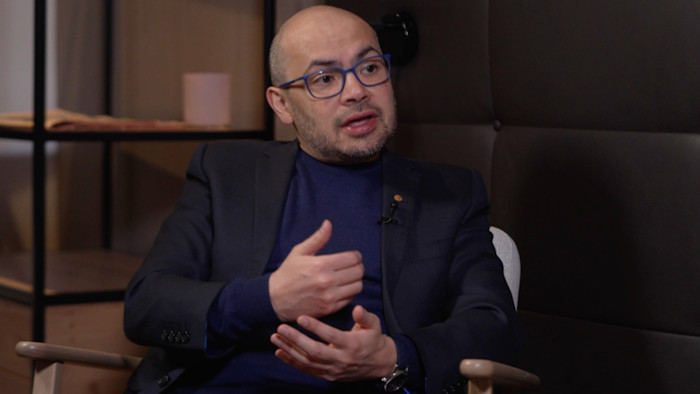
Google DeepMind chief Sir Demis Hassabis has warned that exuberance in parts of the AI industry looks increasingly “bubble-like”, while arguing that its scale and technology leave the Big Tech group well placed for any potential reckoning.
The British Nobel laureate told the FT that the level of investment in some parts of the tech industry had become detached from commercial realities.
“Multibillion-dollar seed rounds in new start-ups that don’t have a product or technology or anything yet do seem a little bit unsustainable,” he said at the World Economic Forum in Davos this week, adding this may lead to “corrections in some parts of the market”.
The comment comes as other tech leaders in Davos, such as Nvidia’s Jensen Huang and Microsoft’s Satya Nadella, batted off concerns of over-investment in the sector.
Venture capitalists have rushed to buy into groups such as former OpenAI executive Mira Murati’s Thinking Machine Lab, which was valued at $10bn just six months after it was founded and despite giving few details on what it is building.
The start-up recently lost a number of key staff, raising doubts about its long-term prospects. There have also been investor concerns over the multibillion-dollar race to build AI infrastructure, including a series of debt-fuelled deals that rely on usage of the technology to keep growing.
Hassabis said demand for AI across Google’s products, such as its latest Gemini 3 model, was stronger than ever, insisting it would prove to be “the most transformative technology probably ever invented”.
“If the bubble bursts we will be fine,” he said. “We’ve got an amazing business that we can add AI features to and get more productivity out of.”
Last year, Google rebounded from a difficult period since the release of OpenAI’s ChatGPT in 2022. Its AI models now surpass the performance of its smaller rival and the search giant is closing the gap in chatbot users.
The momentum has driven parent company Alphabet’s valuation past $4tn, making it the second-largest company in the world after chipmaker Nvidia.
Hassabis also argued western companies still have a lead against China on AI development.
About a year ago Chinese group DeepSeek surprised Silicon Valley by developing a powerful and free-to-access AI model for a fraction of the price of its American competitors. The release also shook US public markets, where there is a heavy concentration of capital in Big Tech stocks.
Hassabis said there had been “overreaction in the west” to DeepSeek, arguing “the Chinese labs haven’t proven they can innovate beyond the frontier yet”. He said US tech companies still had a lead of “six months or so”.
However, in the past year, China has invested heavily in developing leading models that can be freely used by developers in applications, leapfrogging American rivals in “open” AI development.
Hassabis admitted Chinese companies were “more focused on the near-term applications”, in the hunt for immediate revenues “rather than maybe these more research-heavy frontier capabilities” required to achieve artificial general intelligence — or machines that can surpass human abilities. That remains the lofty goal of US-backed groups such as DeepMind, OpenAI and Anthropic.
Debate at Davos also centred on the growing risks and harms around AI.
In recent months, OpenAI was hit by lawsuits over claims its chatbot had encouraged young people to commit suicide. Elon Musk’s xAI was heavily criticised after it emerged its Grok chatbot had been used to generate sexualised images of women and children.
Hassabis said it was imperative to focus on safe and responsible AI development, and for the AI industry to show the general public what AI’s benefits are.
“For us, that’s doubling down on our AI for science and AI for medicine work and things like that, which are kind of unequivocal goods in the world,” he said.
The DeepMind co-founder also said Google’s AI models could help the Big Tech group realise its long-held vision of smart glasses. The company first introduced smart glasses over a decade ago, but the devices were widely derided and failed to catch on with consumers.
Last year, Google announced partnerships with fashion groups such as Warby Parker seeking to introduce new AI-infused spectacles for consumers.
“Maybe we were a bit too ahead of our time when we first started this 10-plus years ago at Google with the devices,” Hassabis admitted. “What was missing was a killer app for that. I think a universal digital assistant that helps you in your everyday life could well be that killer app.”
Hassabis is widely seen as central to Google’s future plans, having gained more control and responsibility over its AI operations in recent years. However, he dismissed speculation that he would, in future, step up to succeed Alphabet chief Sundar Pichai.
“No, I’m very happy with what I’m doing. I love being close to the science and the research,” he said, adding, “there’s only so much one can do in the day and still leave enough time for serious thinking”.
Read the full article here