

Unlock the Editor’s Digest for free
Roula Khalaf, Editor of the FT, selects her favourite stories in this weekly newsletter.
I’ve often wondered why there are not more thrillers set in or shaped by the Bosnian war. I reported on that conflict in the 1990s and it had all the necessary ingredients: superpower intrigue; a legion of spies; and savage, warring militias, as well as the terrible cost of ethnic cleansing as Yugoslavia collapsed.
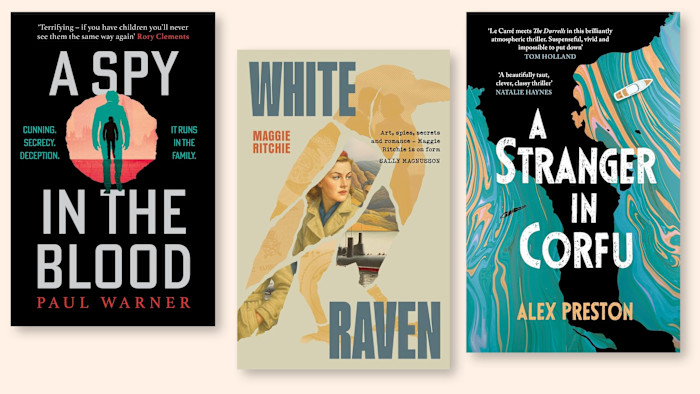
In Alex Preston’s beautifully crafted A Stranger in Corfu (Canongate, £18.99) Nina Woolf, a former British intelligence officer, is haunted by her time in Srebrenica, where in July 1995 Bosnian Serbs massacred more than 8,000 Muslim men and boys. There she had attempted to escape with two children, Amir and Samijia, from the Skorpions, a murderous Serbian militia, as they rained down bullets on them. The children vanished. Nina was shot, taken prisoner and repeatedly raped until she escaped.
Now she lives on the Greek island of Vidos, a semi-prisoner among other former spies traumatised by what they have done, experienced or seen in MI6’s service. Nina swims out to sea each morning, always returning to a gathering of “lost, abject souls, knowing too much to be allowed to mix freely in the wider world”.
There are echoes here of Mick Herron’s Slow Horses collection, about failed MI5 officers put out to grass. But Preston, an award-winning author of literary fiction, brings new layers of accomplishment to the growing genre of “sidelined spy lit”. Nina’s trauma and back story, and those of her colleagues, are woven into a haunting tapestry of grief and loss. Nor is Vidos safe. Preston adds plenty of danger and intrigue to make an electrifying, original read that asks profound questions about the human cost of patriotic service. As Nina wonders, “That was the question for any spy, she supposed: whether it was ever worth it.”
Lupine surnames, it seems, are having a moment. In A Spy in the Blood (Zaffre, £16.99), the first volume of his new Mark Wolfe series, Paul Warner brings the highest possible stake for a father’s mission: to find and rescue his daughter. Wolfe, a senior MI6 officer once known as the greatest spy of his generation, has also been sidelined. He still works for MI6 but has been moved from field work to recruitment and personnel.
But espionage runs in the family. Even as a child his daughter Jody excelled at spy games and so waltzes into the service. But when she goes missing in Afghanistan, Wolfe, a richly drawn protagonist, launches a perilous off-the-books one-man rescue mission. Kabul and its grim surrounds are vividly portrayed, radiating danger, populated by skeletal donkeys, forlorn men and “women shuffling like tired chess pieces in bright blue burqas”. Warner steadily cranks up the tension as the story accelerates to a shocking climax. This is an impressive launch for what promises to be an exciting new series.
In Spies and other Gods (Baskerville £16.99/published in the US in April, Atlantic $27) James Wolff takes a deep dive into the inner workings of MI6. This Wolff is a former British intelligence officer writing under a pseudonym. The story moves between Sir William Rentoul, the soon-to-retire head of MI6, and Aphra McQueen, who is investigating a complaint about a sensitive operation around an Iranian assassin and a trail of corpses across Europe.
Needless to say, McQueen’s enquiries are not welcomed. Rentoul, though, has faith in the service’s “decades upon decades of experience in frustrating outsiders intent on getting to the bottom of things”. Wolff deploys his insider knowledge as the intelligence establishment smoothly closes ranks. But McQueen’s low-key initial approach belies her insubordinate determination to find out what really happened. She shows daring as the story moves from London to Birmingham, Paris and Switzerland, taking her further into danger. She is a welcome addition to a genre often still dominated by male protagonists.
Finally, to Scotland for two engaging thrillers. Maggie Ritchie’s White Raven (Scotland Street Press, £16.99) was inspired by a real-life Scottish woman who served as a code-breaker at Bletchley Park. The story unfolds in 1956 at the height of the cold war as the west descends into paranoia and nuclear submarines are deployed off the Scottish coast. Rosie Anderson, a former code-breaker, takes a summer job teaching art at the intelligence services’ languages school. But she is soon taking a crash-course in espionage tradecraft as she turns spy-hunter — and proves a skilled student.
Gilly Macmillan’s The Burning Library (Baskerville, £18.99/William Morrow, $30) features Dr Anya Brown, an academic at St Andrews university, and Detective Constable Clio Spicer, of Scotland Yard’s Art and Antiques squad. The somewhat fantastical plot revolves around two shadowy women’s organisations, the Order of St Katherine and the Fellowship of the Larks, who are both hunting a secret medieval manuscript. Danger looms as Brown is drawn deep into ancient mysteries while Spicer is on the trail of one of Brown’s colleagues, who has vanished. There are obvious echoes of Dan Brown but Macmillan, a best-selling author, skilfully weaves the two protagonists’ storylines together with plenty of surprises in this highly readable, twisty tale.
Adam LeBor is the author of ‘The Last Days of Budapest: Spies, Nazis, Rescuers and Resistance, 1940-1945’
Join our online book group on Facebook at FT Books Café and follow FT Weekend on Instagram, Bluesky and X
Read the full article here