

Submitted by Thomas Kolbe
Donald Trump’s appearance at the World Economic Forum was portrayed by the German media as the very embodiment of evil against the pristine white backdrop of Davos’ snow. To cast politicians like von der Leyen, Merz, and Macron as the “good” counterparts only exposes this media spectacle for what it is: farce.
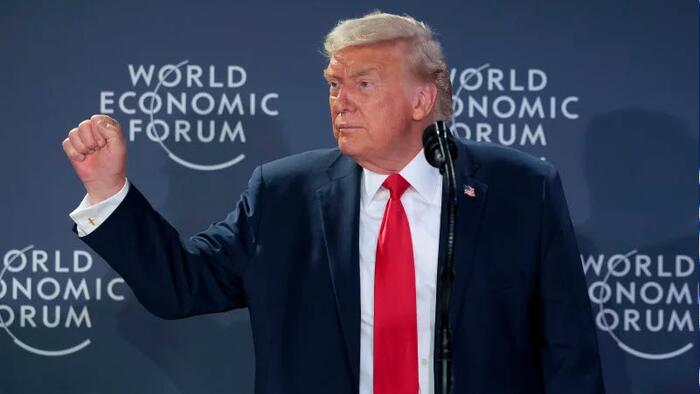
A love-hate relationship has developed between U.S. President Donald Trump and the German press. Almost every time he appears in public—which, in fact, happens daily—the bureaucrats in newsrooms react with a Pavlovian reflex. Even his Davos speech on Wednesday at the World Economic Forum, delivered without rancor despite Europe’s noticeably skeptical stance toward the U.S., provoked a maximal defensive reaction.
Establishing the Contrast
Der Stern portrays Trump as the West’s isolator, a power politician who “ate humble pie” in Davos, and labels his speech simultaneously as a declaration of NATO’s bankruptcy. As if to keep the German fight against Trump alive at all costs, the Frankfurter Rundschau warned not to be lulled by the U.S. President’s moderate tone. The headline reads martial—Trump reliably sells well.
It also irritates the German media that Trump regularly exposes European leaders like Emmanuel Macron to public ridicule. Naturally, even Tagesschau dispatches its fact-checkers against him. His speech was reportedly riddled with inaccuracies and falsehoods.
If only they were as precise and attentive when Macron, Merz, and von der Leyen stack lie upon lie—whether regarding their domestic policies, the state of the economy, the Ukraine conflict, or the failed energy transition now driving Europe into a spiral of poverty.
Even the fact that an Orwellian surveillance state is rising before our eyes, heavily supported by Germany, does not trouble German journalists. In short: we are the good, the evil sits in the White House. And we, the good, are merely protecting Europe’s docile lambs from the toxic poison of patriotic spirit that Americans are eager to inject with their virile obsession with “can-do” governance.
They despise healthy patriotism, a lean state, the ostentatious fight for free speech, and the dismantling of the NGO behemoth—all these achievements of a mature civilization that Brussels-style centralism seeks to dissolve in the European hyper- and control-state for the “common good.”
Together with politics, the German media has established a Manichaean worldview. Every over-the-top appearance by the U.S. President, perhaps difficult for European tastes to digest, only eases the camouflage. The Americans’ power-political interests—shaped by domestic pressure, externally funded protest waves, the fentanyl crisis, and the costly Pax Americana quietly accepted by Europe—play no role in the German media’s strategic considerations.
They side with the presumed good—those exploiting climate apocalypse, Euro-protectionism, and the systematic dismantling of civil liberties. Simply emphasize it long enough, project the public’s anger at the country’s growing crises onto a figure of hate, and the media can distract from its own failures. That figure is Donald Trump.
Growing Distance
Must one not, in view of Europe’s migration crisis and disastrous energy transition, concede Trump is right on the issues? The German commentary’s arrogant condescension only reflects the detachment of its political caste. From the perspective of a German-driven Euro-socialism, the American spirit, the supposed cowboy mentality, and spontaneity are ridiculed. Listening to each other is no longer desired; the American stance is deemed antagonistic, and within the woke zeitgeist, morally reprehensible.
A reflex so foolish it is almost physically painful to follow such journalism. Shouldn’t the media’s task be to explain Europe’s true geopolitical situation and the challenges arising from energy scarcity and resource constraints?
European nations would do well to align with the Americans, make peace with Russia, and return to political reason. For the Westdeutsche Zeitung, however, Trump’s Davos speech was merely self-praise. He reportedly spread lies and slanders about the old continent.
Hovering above all is the hope that in three years a pro-European, globalist president will succeed Trump—a figure in the style of Barack Obama, picking up the red thread of climate socialism and protecting Europeans from their peculiar isolationism and its consequences.
If the EU’s climate-socialist project collapses in the foreseeable future, a strong, autonomous U.S. would be the destination for a panicked flight of capital—a potential end to the Brussels central apparatus. Returning to the climate-socialist fold would only succeed via digital currency controls and capital movement restrictions, which explains Europe’s attacks on Trump’s presidency. The fact that former Bank of England Governor Mark Carney, now a Canadian Prime Minister, has devoted himself to European politics adds particular gravity to the U.S. attempt to politically control its hemisphere.
Trump’s patriotic project’s failure is precisely in the Euro-socialists’ interest. German media have, for a decade, cultivated the image of an erratic, irrational, intellectually limited chauvinist with great success. The constant repetition of identical interpretations of his actions, their moral appraisal, and the dramatic escalation under the mantra of a rules-based world order have created a narrative leaving no room for ambiguity—purely Manichaean.
On one side: Trump, the personification of evil, pushing European humanists into a corner with his tariffs, now even flirting with an aggressive land grab in Greenland. He is Lucifer in the White House. On the other: light, good—the EU, the great peace project, originally just a bulwark against the Soviet Union, now reimagined over decades as the climate savior and moral last instance of the West.
False Game
It is precisely this power that has for four years kept the disastrous war of attrition in Donbass alive. And it is not Trump, but European politicians who instill the specter of an imminent Russian invasion into the minds and souls of citizens via increasingly shrill tones across all media. Day by day, week by week, a scenario of maximum threat is conjured, morally discrediting any deviation and painting negotiation readiness as weakness—or even betrayal.
The mass deaths in Ukraine reveal Europe’s ethical decay without mercy. Beyond that, escalation against a nuclear power is militarily hopeless, economically a suicide mission, and ethically reprehensible. Macron, Merz, and von der Leyen have long known this war is unwinnable—regardless of funds sent to Ukraine.
It is now only about delaying Ukraine’s bankruptcy in hopes of a military miracle—one only the Americans could force. And that requires, as mentioned, a new pro-European U.S. president.
States and European banks are heavily invested in Ukraine. An uncontrolled collapse could shake Europe’s financial system so violently that even the great debt crisis 15 years ago would appear as mere prelude.
Trump still seeks a negotiated solution in this conflict, which would end Europe’s dream of regime change in Moscow and a controlled exploitation of Russian resources, crucial to recapitalizing European states and banks.
The manichean media effect against American policy becomes even more dangerous amid Europe’s growing censorship apparatus. Many fail to realize that Trump’s failure would politically eliminate the last influential advocate for free speech, free markets, and rational deregulation.
It was Americans—Vice President J. D. Vance and Secretary of State Marco Rubio—who repeatedly intervened in Brussels in recent months when digital freedom on platforms like X, Telegram, and Meta was acutely threatened.
The list of European defenders of freedom has, by contrast, become alarmingly short.
Loading recommendations…
Read the full article here