
‘This is what sanctions look like’: the film showing Saddam’s Iraq through children’s eyes

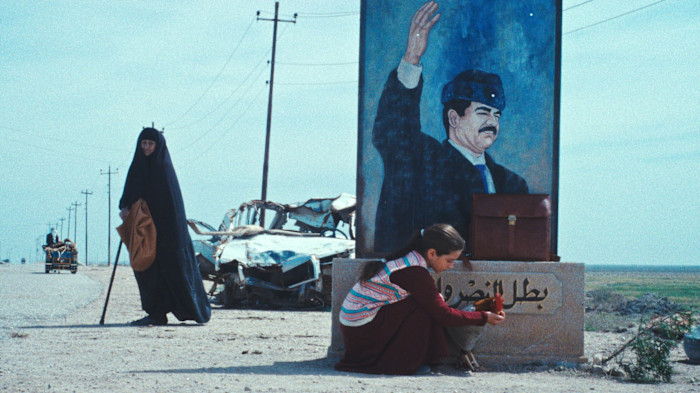
A film whose ingredients include eggs, flour, sugar and economic sanctions sounds improbable, but The President’s Cake takes those materials to confect a universal story of childhood and survival. Shot on a shoestring budget with non-professional actors, Hasan Hadi’s debut feature last year became the first Iraqi movie ever to premiere at the Cannes Film Festival, showing in the Directors’ Fortnight section. There it won the Caméra d’Or prize for Best First Feature as well as an Audience Award and went on to sweep through other international film festivals with a quiet force.
Set in the 1990s following Iraq’s invasion of Kuwait, and under the shadow of punitive measures by the US and UK against Saddam Hussein’s regime, it follows nine-year-olds Lamia and Saeed (and their pet rooster) as they embark on a gruelling mission to bake a cake — as requested by the teacher at their military-run school — in honour of the authoritarian leader’s birthday. Leaving their peaceful but meagre huts on the marshy banks of the Euphrates, the two children set out in search of scarce ingredients across a bustling Baghdad. What they find, however, is the best and worst of humanity.
For Hadi, who grew up in 1990s Iraq, the truth-based film is deeply personal. While he didn’t bake such a cake himself, he attended one of many schools where this happened. The film is driven by a desire to show a side of his country seldom seen.
“I wanted to tell a story about everyday people, not just soldiers and generals,” he says. “Usually people [in the west] see the numbers of the dead in Iraq in the news, and they don’t know that these numbers belong to people that had names, dreams and ambitions.”
He emphasises that his film is about love, friendship and sacrifice, not just Saddam and the west. Nonetheless, he uses the political backdrop to give a microhistory and child’s eye view of life under dictatorship and western sanctions. The President’s Cake deploys the absurdity of its premise to both satirical and shocking effect.
Hadi points to the long years of sanctions that followed the first Gulf war and the estimated 500,000-1mn children who died as a result of them, noting: “So few people know about these horrific events . . . [I hope that] the next time they see a headline about sanctions, they’ll remember that their governments are not just depriving kids of KitKats, but of dignity itself.”
Hadi recalls how family, friends and neighbours were forced to sell everything they owned. “Their TVs, wedding suits, shoes . . . I saw people pulling out their door frames in the hopes of making some cash. This is what the violence of sanctions looks like. It’s not the sanitised ‘diplomatic’ tool in western people’s minds.”
For Iraqi audiences, The President’s Cake is profoundly moving. “At our first screening in London, Iraqi viewers were crying,” Hadi says. “For them, this was a black-hole period — there were no stories, no films from that time. So for people to see their childhoods reflected on was incredibly powerful.”
The film had a limited run in Iraq last year, with a wider release planned for after Ramadan. But it has had an impact far beyond Iraq, Hadi says, highlighting how difficult it can be for films from the Middle East to be seen internationally. “I’m proud the film is breaking ignorance and stigmas. Festivals like Cannes matter because they make Iraqi narratives visible to the west and show that our stories are, of course, worthy of being told.”
This attention has already rippled outward, with France’s National Centre of Cinema (CNC) last year signing a deal with Iraq’s ministry of culture to support the country’s cinema. “I can’t say that happened only because of our film, but their head came to our screening in Cannes. CNC’s decision to invest will open a door for a new generation of Iraqi filmmakers.”
The President’s Cake has also been lauded for the sumptuous camera work of cinematographer Tudor Vladimir Panduru, who contrasts the peaceful shimmer of the Euphrates with Baghdad’s tense and dusty streets. The film lingers on characters’ faces, adding to the unspoken understanding between the children. In this and other ways, The President’s Cake subtly showcases how history’s unsung heroes emerge from small, quiet acts of survival.
Key to this was the unwavering commitment to on-location shooting. “We were offered full financing twice, on condition that we film in Morocco,” Hadi recalls. “There was just no way we were going to do that.”
Shooting in Iraq was non-negotiable both from a creative and “authenticity standpoint”, but also for the sake of the Iraqi community. “People saw Hasan doing something in his hometown and that mattered,” producer Leah Chen Baker says. “It also meant we could shoot in real historic locations that no studio could replicate.”
But filming in Baghdad, Al-Chibayish and Nasiriyah came at a price, Hadi adds. “Being there meant facing challenges you just don’t have elsewhere, in terms of equipment, technicians and availability of locations to rent. In Iraq we don’t have acting schools or casting directors, which meant me and the crew had to go out and find people ourselves.”
That hands-on approach helped shape the film’s realism, leading Hadi to rely heavily on street casting. “We used child actors who came from poor families, many of which were hesitant to film with us at first. Lamia’s parents were unsure, so we invited them in to talk and explain how we could support one another. Some of our actors couldn’t read or write, so we enrolled them in school and have helped them beyond the film itself.”
Among its most unexpected stars is the rooster, a constant companion to Lamia throughout the story. “We had four or five roosters acting for us, but one of them, Andy, was a superstar,” Hadi laughs. “He always did the right thing. In Iraqi culture, roosters are majestic beings that crow when they see a devil or an angel. Every time Andy crows in the film, something bad happens.”
Such details — tender and steeped in local symbolism — give The President’s Cake its authentic but fable-like quality: equal parts tragedy, comedy and political allegory. In doing so, it restores dignity and colour to a generation of Iraqis long forgotten or ignored in the west.
‘The President’s Cake’ is in UK cinemas from February 13 and on general release in US cinemas from February 27
Find out about our latest stories first — follow FT Weekend on Instagram, Bluesky and X, and sign up to receive the FT Weekend newsletter every Saturday morning
Read the full article here