

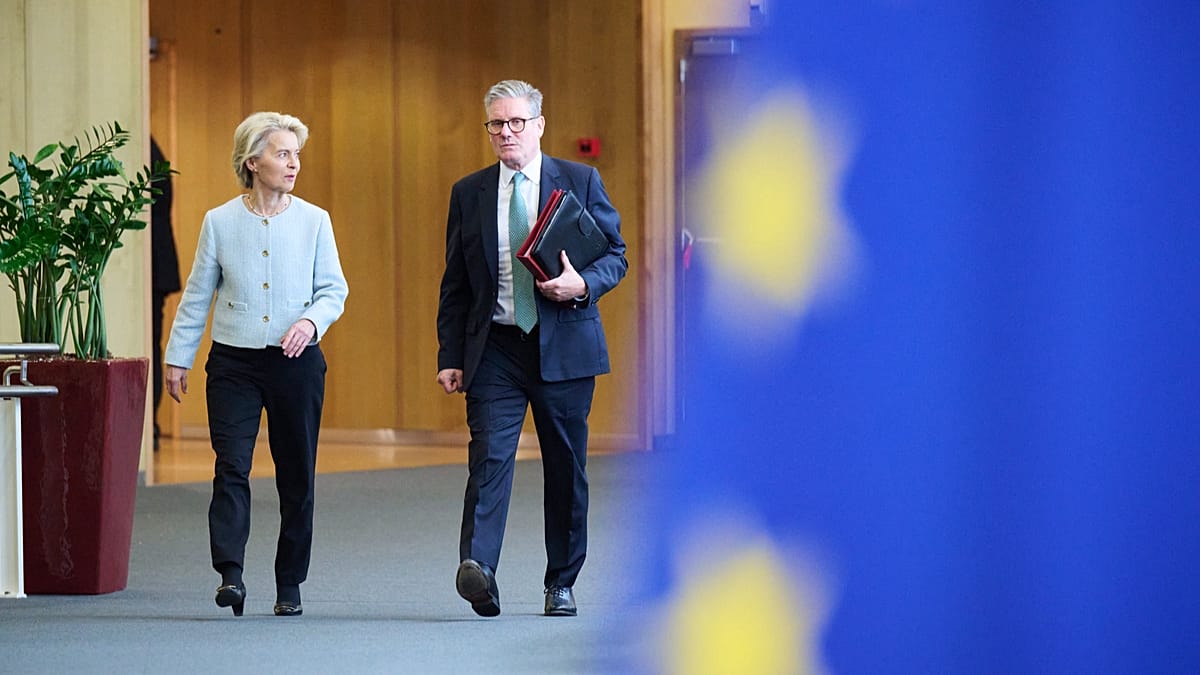
With the 10th anniversary of the referendum that took the UK out of the EU approaching, and after years of acrimonious rhetoric, a rapprochement between London and Brussels now seems well and truly underway.
Talks on deeper trade, customs and defence integration are accelerating, with a steady stream of positive signals issued on both sides of the Channel in recent days. Perhaps officials at both ends are taking a leaf from the 2016 nostalgia trend that has been taking social media by storm, where users embrace the “simpler time” of a decade ago.
But more likely, it’s a response to mounting pressure on the UK’s governing Labour party, which is consistently polling several points behind the right-wing populist Reform UK led by arch-Brexiteer Nigel Farage, as well as an increasingly hostile geopolitical environment that’s upending the global order.
The momentum started building in 2024 when newly elected Prime Minister Keir Starmer sought a “reset” in the UK’s trade and economic ties with the EU. He has recently signalled an eagerness for alignment with the bloc’s Single Market in hopes of boosting the UK’s ailing economy and shoring up its defences against global trading volatility.
Talks on slashing checks and barriers on trade are expected to intensify after a meeting between UK Chancellor Rachel Reeves and the EU’s trade and economy chiefs, Maroš Šefčovič and Valdis Dombrovskis, in Downing Street on Monday.
Dombrovskis told the BBC after the talks that the EU is “ready to engage” in negotiations on re-integrating the UK into a customs union – a notion that Starmer initially ruled out, but which he is now under mounting pressure to reconsider from several cabinet colleagues.
Brussels has always been clear that the UK cannot pick and choose privileged access to the Single Market without accepting the EU’s “four freedoms”: the full freedom of movement of goods, services, capital and people.
And full reintegration into the bloc’s Single Market remains politically sensitive for Starmer, as accepting the free movement of people across the EU-UK border would feed into Reform UK’s anti-immigration platform.
The EU is reportedly negotiating a “Farage clause” to be included in a future EU-UK pact, which would allow the bloc to be adequately compensated should Reform UK come to power and pull out of the Labour-negotiated deal.
While a general election in the UK may not be held until the summer of 2029, Reform UK is currently topping the polls.
‘A new way of working together’
Spain’s Prime Minister Pedro Sánchez told the New Statesman earlier this week that he supported the UK re-joining the EU, saying there’s “a clear need to have the UK on board again.”
A deal struck between the Sánchez government and the UK last June on Gibraltar, the overseas British territory that had been left in limbo after the 2020 Brexit deal, cleared a major hurdle to a broader EU-UK arrangement. The agreement thawed long-running tensions between Madrid and London, and provided free rein for Brussels officials to take the lead on negotiating a broader “reset” in post-Brexit ties with the UK.
On Tuesday, European Parliament President Roberta Metsola called for renewed momentum in those negotiations in a speech before the Spanish Senate in Madrid.
“Ten years on from Brexit, it’s been 10 years, and in a world that has changed so profoundly, Europe and the UK need a new way of working together, on trade, customs, research, mobility, and on security and defence. This is about looking forward, and doing what makes sense for Europe and for the UK today,” the Maltese politician said.
“It is time to exorcise the ghosts of the past, reset our partnership, and find solutions together. That’s realistic pragmatism, anchored in values, that will see us all move forward together.”
Stronger defence
Brussels and London are also hoping that they will find a compromise to deepen defence cooperation and ensure Ukraine can buy the military equipment it needs using the EU’s recently agreed €90 billion loan, two-thirds of which is earmarked for military assistance – including British-made systems.
Talks between the two sides to allow the UK’s full participation in the EU’s €150-billion loan for defence scheme (SAFE) collapsed last November when they failed to find a compromise over how much London would have to contribute financially.
Euronews understands that those talks fell apart over a major gap between the two sides: whereas the final offer on the table from the EU was around €2 billion, the UK estimated it ought to contribute just over €100 million.
Starmer told reporters over the weekend during a visit to China that the EU and UK should “work more closely together” when it comes to defence.
“Whether it’s SAFE or other initiatives, it makes good sense for Europe in the widest sense of the word – which is the EU plus other European countries – to work more closely together,” he said. “That’s what I’ve been advocating and I hope to make some progress on that.”
EU officials are currently wrestling with how to involve third countries, including the UK, in the bloc’s shared €90 billion loan for Ukraine.
An EU diplomat told Euronews that the legal text governing the loan is expected to be approved by member states this week. It will include a so-called “European preference”, with a majority of 15 member states also backing a proposal for third countries participating in the scheme to make a financial contribution.
This has been championed in particular by France.
“France has never been against the UK taking part in the Ukraine loan,” a French diplomat said. “Our only point is that third countries should also contribute financially, otherwise they would be in a better situation than EU member States themselves, which would be unfair.”
The EU will raise the money on the markets and shoulder the repayments, including interest. Contributions from third countries would go towards repaying that interest, which is estimated to be around €2-3 billion per year.
Currently, these costs are meant to be repaid by only 24 of the EU’s 27 member states – Hungary, Slovakia, and the Czech Republic secured an opt-out – with individual contributions likely to be calculated based on GDP.
A similar arrangement applying to third countries is likely to be a lot more palatable to London than the one envisaged for SAFE.
Read the full article here