

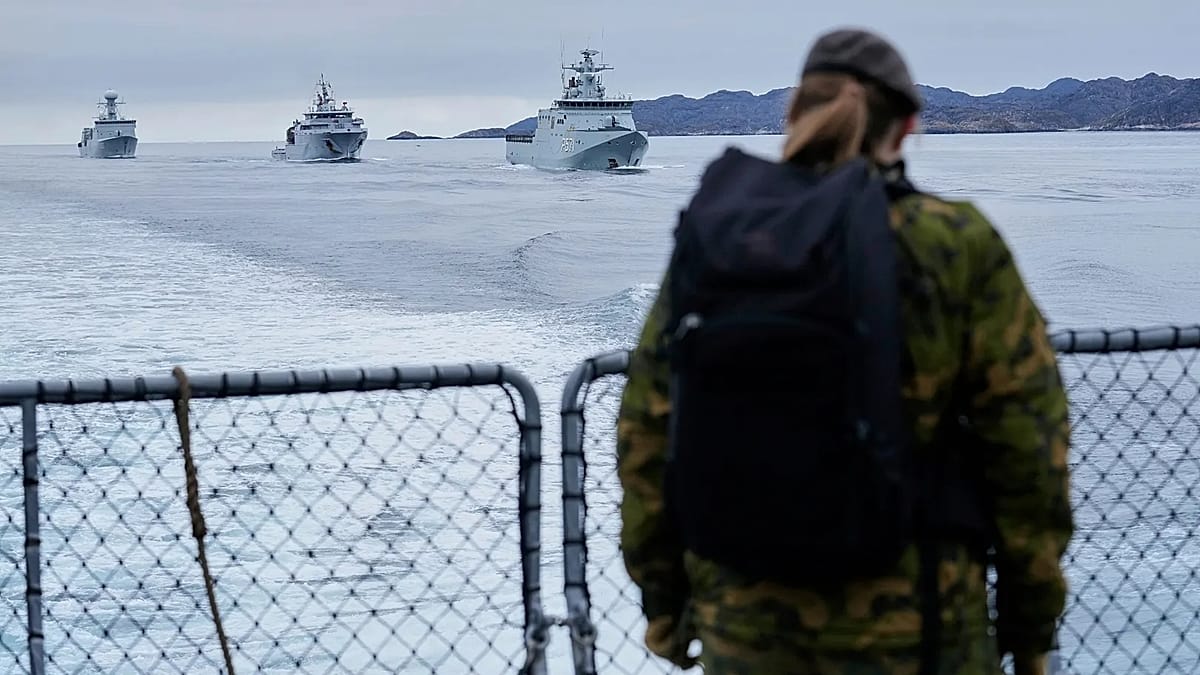
As Arctic ice retreats and geopolitical tensions harden, NATO’s northern flank is emerging as one of the alliance’s most consequential and neglected theatres, and Europe is now confronting a hard truth: it is strategically underprepared to play a role in a region that is set to become a key military and economic corridor.
Most European allies might have disagreed with United States President Donald Trump’s aggressive Arctic policy, but most seem to agree with the substance of his message: the Arctic needs special attention, and it needs it fast. Their problem: they’re missing both the doctrines and the military capabilities necessary to enforce them.
At the military level, the Arctic is crucial to the defence of the North Atlantic, especially given Russia’s northern fleet outnumbers NATO’s capabilities.
“When we talk about the defence of the UK, the Greenland-Iceland-UK gap in particular is very, very important,” Anthony Heron, a research associate at the Arctic Institute, told Euronews. “Any adversarial forces or military that will approach the United Kingdom will very likely come from the Arctic region.”
Monitoring that space, he added, depends on sustained domain awareness across a region that is vast, sparsely populated and environmentally hostile.
That awareness is not only about military action. Beneath the ice lies the infrastructure that underpins modern economies: subsea cables and power lines that carry enormous volumes of data between Europe and North America, which are attractive targets for espionage and sabotage.
Other Arctic cable projects in the pipeline include the Far North Fiber, which aims to link Japan to Europe through the Northwest Passage, and Polar Connect, which plans to provide secure and resilient connectivity through the Arctic to Asia and North America.
“Domain awareness and the ability to track submarines in the Arctic are key to ensuring that these subsea cables and power lines are secure,” Heron said. “If they were to cut such lines, it would be catastrophic for the economy.”
Climate change is also creating new shipping routes through the Arctic, which would significantly shorten transit times compared to the Suez and Panama canals. But they also introduce a new layer of strategic competition.
Russia, Heron said, is likely to expand its military presence to protect these lanes, raising the stakes for NATO if it fails to respond.
“If we sit back and miss out,” he said, “it really will cause economic turmoil.”
The capability problem
Yet despite the region’s growing importance, NATO’s Arctic posture remains uneven and heavily reliant on the US – and Greenland is a case in point.
“When we speak of Greenland, it’s mainly a US presence in terms of satellites,” Heron said, even though the island is “very, very well placed in terms of domain awareness and early threat detection”, particularly for tracking Russian movements through the GIUK gap.
That reliance reinforces a broader structural problem.
While Denmark, Sweden and Norway have long invested in cold-weather forces – NATO’s Supreme Allied Commander Europe last month described their capabilities as “tremendous” and “uniquely positioned to strengthen NATO’s northern flank and Arctic security” – other European allies are lagging behind.
“Neighbouring Arctic states, and that includes the United Kingdom and France, lack a specific Arctic doctrine,” Heron said.
More fundamentally, decades of underinvestment from NATO allies mean that there are currently few modern capabilities deployed to the Arctic, and simply redeploying assets and resources there from other theatres is not possible due to the harsh conditions.
And while NATO doesn’t maintain a year-round presence in the Arctic, Russia has around 30-40 specialised bases and improved airfields dotted around its Arctic territory.
“Not every capability that you have elsewhere could be simply transposed to the Arctic and function there,” Verineia Codrean, chief of strategy at Euroatlast, told Euronews. Her company, which has contracts with multiple European governments, manufactures advanced autonomous underwater vehicles with endurance of up to 16 weeks.
That’s because the Arctic’s extreme cold, ice cover and remoteness all degrade systems that work well in more temperate environments, from drones and sensors to communications equipment and basic navigation.
The investment problem
The Arctic, which covers roughly 4% of the Earth’s surface, imposes serious technical constraints.
“If you look at an area like Greenland or the North Pole, there is no fixed infrastructure,” James Campion, CEO and co-founder of the Swedish 6G deeptech company TERASi, told Euronews. “Any defence force operating in the area needs to bring all of that equipment with them.”
Even establishing communications can become a major logistical undertaking. Traditional military radio towers used by the military can take hours to assemble and require large teams to deploy in harsh conditions.
Campion’s company provides a system that combines lightweight radio hardware with drone platforms that would require only one person to deploy – although it remains experimental and with limited range. It will be first deployed in March with the aim to then ramp up the system’s range.
Cold weather also shortens endurance. Frost can immobilise drones within minutes, batteries drain rapidly, and even cables can become brittle and snap.
The alternative would be using satellite-based services which can offer reach, but they bring their own vulnerabilities. “These systems start to come under threat,” Campion said, “and they’re also under the control of third parties who may or may not be aligned with our interests.”
But that is just the tip of the iceberg. The challenges become even more acute for capabilities that are needed under the ice cap. Navigation near the magnetic pole is difficult, communication is intermittent, and resurfacing may be impossible for long periods due to ice cover, Codrean said.
“In the Arctic, 24 hours doesn’t get you that far,” she said.
Systems that are considered long-range elsewhere barely scratch the surface of what is needed in the Arctic. That’s because drones typically need to go back to the surface or past sensors to transfer the data they collected.
“If that asset is not able to go very far and it needs to be recharged every two days, then you have to recall it back. And where would you recall it back if there is ice all around you? If you need to recall back to your starting point, it can’t go that far.”
New platforms, such as autonomous underwater vehicles powered by hydrogen fuel cells, can operate for weeks or even months beneath the ice, but these capabilities are still in their inception.
And it’s probably below the ice that new capabilities are most needed, according to Codrean, because the new cables to be laid will require basic mapping of the seabed.
“The future of Arctic security will be decided under the water, not in the air or on the ice,” she told Euronews. European strategic autonomy, she said, “will not be built through diplomacy alone, but through persistent subsea capabilities”.
There are signs that European governments are beginning to look at the region much more strategically. France, for example, published an Arctic defence strategy last year, reflecting a growing recognition that the Arctic offers long-term military and economic advantages.
But doing so will require difficult trade-offs.
“The brutal reality is that it will take significant investment,” Heron said. “That will obviously naturally pull funding away from other areas that NATO publics might be unhappy with.”
Read the full article here