

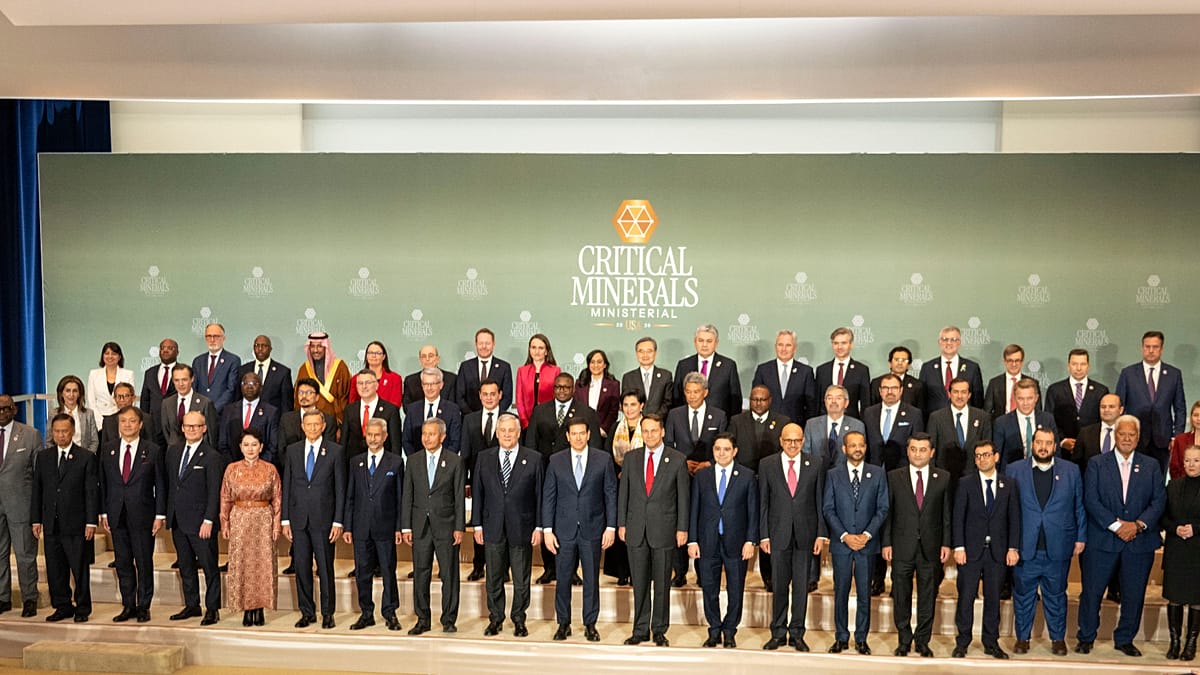
The European Union is one step closer to agreeing on joint efforts with the United States and Japan to “increase economic security and national security” by securing the supply of critical raw materials, according to a statement.
Within the coming 30 days, the EU and the two nations are expected to sign a memorandum of understandingto boost critical minerals supply chain security, in a rare and surprising display of trade conciliation by the US under President Donald Trump.
The planned partnership will “identify areas of cooperation to stimulate demand and diversify supply for both participants by identifying and supporting projects in mining, refining, processing, and recycling”, according to the press statement.
It will also include a discussion of measures to prevent supply chain disruptions, promote research and innovation, and facilitate information exchange on stockpiling.
The EU has so far signed 14 major new trade deals to diversify its supply of critical raw materials, as the race for these minerals is key to the bloc’s climate ambitions to achieve carbon neutrality by 2050 and leverage the Union’s defence capabilities by 2030.
Minerals like arsenic, baryte, gallium, graphite, tungsten and all permanent magnets are crucial to develop both clean technologies and weaponry.
“We stand ready”
Stéphane Séjourné, the EU’s industry chief, is representing the EU27 in discussions hosted by US Secretary of State Marco Rubio a few days after a damning EU audit found that the bloc is far from meeting its 2030 supply goals for these minerals, exposing a heavy dependence on China.
On Wednesday, Rubio hosted the first “Critical Minerals Ministerial” at the State Department in Washington, DC, where more than 50 countries were invited to “advance collective efforts to strengthen and diversify critical minerals supply chains”, according to the US State Department.
“We stand ready and intend to work with each country here today to find a specialised role that you can play,” Rubio said. “If you don’t have minerals, you can help refine them, and the countries gathered here include the largest consumers of critical mineral products who, together, have the buying power to build a more resilient and diverse global market.”
The gathering seeks to build momentum for collaboration to secure these critical components and avoid bids being submitted to the same suppliers – and where they are, for countries to find ways to complement each other’s business ventures.
US Vice President J.D. Vance, also present in the meeting, said Washington will establish a system to set price floors for critical raw materials. Vance said the United States was proposing a trading bloc for these minerals, and that many countries had already signed on to the plan.
“Let’s make the prices more predictable and less erratic so that we can support the domestic supply chains and the investment that makes those supply chains possible,” Vance said, stressing “how much our economies depend on these critical minerals”.
“Supply chains remain brittle and exceptionally concentrated. Asset and commodity prices are persistently depressed, driven downward by forces beyond any individual country’s control.”
Vance called for a “trading bloc among allies and partners” that guarantees American access while “also expanding production across the entire zone.”
US Interior Secretary Doug Burgum, meanwhile, told a press conference on Tuesday that some 30 countries want to join a club of allies and partners to trade critical minerals and reduce dependence on China.
“Typically the United States, we’re free market folks, we don’t like messing with markets,” Burgum said. “But if you have someone who is dominant, who can flood the market with particular material, they have the ability to essentially destroy the economic value of a company or a country’s production.”
A meeting between US Secretary of Commerce Howard Lutnick and Commissioner Séjourné is scheduled for Thursday.
Italy and Germany join forces
Meanwhile, in Europe, Italy and Germany sent a document on critical raw materials to the European Commission on Tuesday, reiterating Europe’s renewed commitment to the sector and aiming to mitigate strategic dependencies and build secure supply chains for European companies.
Rome and Berlin’s joint plea to the EU executive follows the pledges made by the two foreign ministers, Adolfo Urso and Katherina Reiche, at the Italy-Germany Summit of January 23 on critical raw materials.
“Italy and Germany will closely coordinate their positions in various international forums, expressing their full support for the European Union’s negotiations to establish a partnership with the United States on critical minerals in the coming weeks,” reads an official statement from the Italian Foreign Affairs Ministry.
Robin Roels, Policy Officer for Raw Materials at the NGO European Environmental Bureau, told Euronews he regretted how quickly the EU abandoned pledges for strategic autonomy once the US applied pressure.
“Only a few weeks after the EU pushed back against Donald Trump’s coercive threats and saber-rattling over Greenland, Stéphane Séjourné flying to Washington to discuss a future Raw Materials MoU looks like crawling back to ‘daddy’,” Roels said.
Real autonomy means boosting our circularity to mitigate demand spikes, Roels said, investing seriously in recycling and substitution, and breaking with the linear dig-use-dump model that created today’s crises in the first place.
Read the full article here