

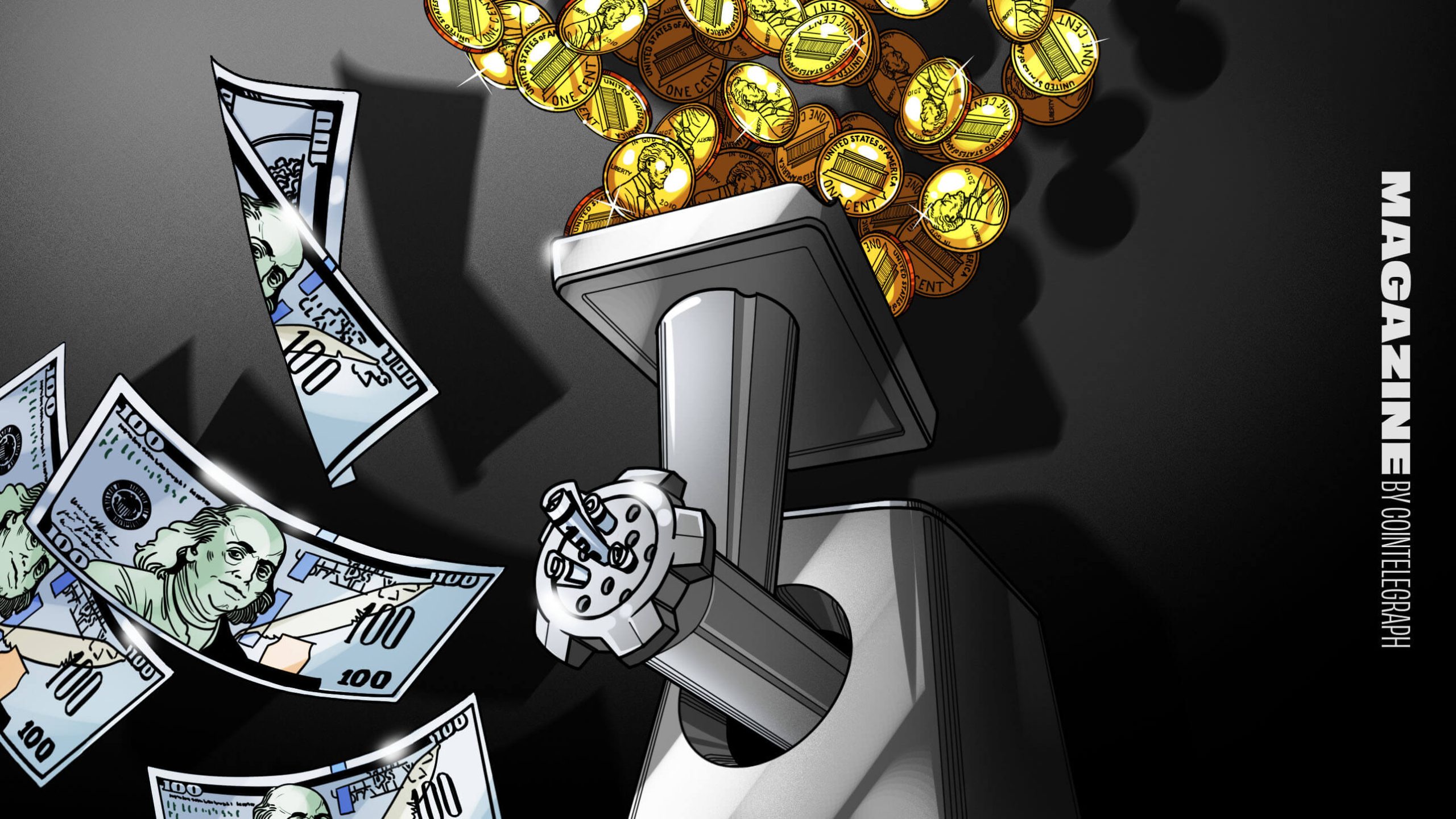
Watch out Bitcoin, there’s a new inflation hedge in town.
It’s no secret that when governments debase currencies, investors run to scarce, hard assets like gold, silver, real estate and Bitcoin.
But investors occasionally share the idea online there’s an even harder money out there: the American five-cent coin, or at least, the metal that it’s made out of.
The idea is pretty simple. The alloy used to create a ‘nickel’ — cupronickel, which is made of 75% copper and 25% nickel — currently exceeds the face value of the coin.
Melting it down and selling it, then using the proceeds to buy more nickels, could theoretically make infinite money.
And the downside is limited. The worst case scenario is metal prices drop and you simply spend the physical nickels or deposit them at your local bank.
Incidentally, the math doesn’t work for an Australian five-cent piece or a UK five-pence coin, both of which contain much less valuable metal.
“The downside is zero,” said Bitcoin Teddy on X recently, claiming he sold all his Bitcoin for physical nickels. The post appears to have been inspired by a similar one in October last year, which later turned out to be a hoax.
Despite the dubious origins of the meme, if you did try to sell all your Bitcoin for physical nickels, would it be worth it?
Math behind the melt
Nickel and copper prices have been at a tear in the last few months amid supply shortages, global demand and tariff uncertainty.
Copper and nickel have real industrial uses. Copper is used for electrical wiring, electronics and many other applications. Nickel is a key element in 300 series stainless steel which is used for making everything from kitchenware, surgical instruments and automotive parts.
The price of copper is $13,247 per tonne, up 33% in a year. Nickel is $17,330 per tonne, rising 11.4% over the year.
At current prices, this puts the metal in each nickel at 7.1 cents, a whopping 43% above its face value.
Bitcoin on the other hand, is down 26.3% from a year ago at $72,397.
On paper, the math makes it sound like a no-brainer. So how would you theoretically do it?
Acid, fire and lots of it
One idea would be to simply melt down the cupronickel alloy and sell it as scrap ingots, though you’d have to find a buyer specifically looking for the alloy with a 75-25 composition of copper to nickel.
Another method would be to use acids and other complicated-sounding chemical processes to separate the metals from one another before turning them into two different metal ingots, which you would sell separately.
Coinapp’s calculator shows that $10,000 worth of nickels is worth $4,265 in nickel and $10,068 in copper, adding up to a value of $14,333.
Both methods however, are time consuming, and energy and resource intensive, given the chemicals, fuel and equipment required. That’d really cut into your profits.
Copper’s melting point is approximately 1,984 degrees Fahrenheit (1,085°C), while nickel is even higher at 2,651 degrees Fahrenheit (1,455°C), meaning your average fire pit isn’t going to have a chance to melt the extracted metal.
Storage is another factor. Just $10,000 worth of nickels weighs one tonne, almost equivalent to a small car. $100,000 worth of nickels weighs more than two African elephants. Imagine trying to ship that to someone.
Then of course, there’s the legality of it.
Is defacing US currency a crime?
Defacing money in the US isn’t 100% illegal like it is in many other countries.
Doodling on a dollar bill, or squeezing a single penny in one of those souvenir-shop penny press machines is perfectly legal, as long as the intent isn’t for fraud.
Some artsy crafters even turn coins like pennies, quarters and dimes into jewelry. In the dollar bills’ case, it’s generally OK if the bill can still go back into circulation.
But there are laws specifically against defacing pennies and nickels for profit, given their suitability for being melted in bulk whenever metal prices rise.
Under the United States Code Section 5111(d) of title 31, it is prohibited to export, melt or treat one-cent (pennies) and five-cent coins (nickels).
People who breach these rules can face fines of up to $10,000 or face five years in jail.
Verdict: Stick to Bitcoin
The idea of buying some kind of US currency and melting it down seems to become a popular meme every time metals like copper, nickel or silver run hot.
But there’s a reason no one really does it outside of curious hobbyists and YouTube science channels.
It’s largely impractical and illegal.
The process of converting coins into sellable ingots cuts into profits, and you’ll be lucky to even get a decent chunk of its melt value selling it in non-industrial quantities.
Banks will likely refuse to let you withdraw nickels in bulk, making accumulation a chore, while depositing them again in the future if necessary would be just as big of a headache.
Read also
Features
The best (and worst) stories from 3 years of Cointelegraph Magazine
Features
Whatever happened to EOS? Community shoots for unlikely comeback
Bitcoin on the other hand, can be moved anywhere in the world with just a few clicks, with daily exchange trading volume in the billions.
Hodling nickel and copper can sometimes work out. In May 2007, the global price of nickel skyrocketed to an all-time high of more than $51,000 per tonne, but crashed just a year later as the global financial crisis hit.
The price rocketed again in 2022 amid a “nickel crisis” amid worries of a Russian supply crunch, but fell right back down a few months later when China closed down manufacturing due to the COVID-19 restrictions.
But even if you timed buys and sells perfectly, none of these commodities price spikes can even remotely compete with Bitcoin over the same timeframe, which is up 18,500% since 2016.
So rather than cracking open that piggy bank, consider leaving your Bitcoin where it is.
Subscribe
The most engaging reads in blockchain. Delivered once a
week.

Felix Ng
Felix Ng is the APAC Editor and a writer at Cointelegraphh. He first began writing about the crypto and blockchain industry in 2015 through the lens of a gambling industry journalist. Since 2022, he has served as News Editor APAC and writer at Cointelegraph. He is also a features writer for Cointelegraph Magazine, with works including Big Questions, Journeys, and Insiders.
Read the full article here