

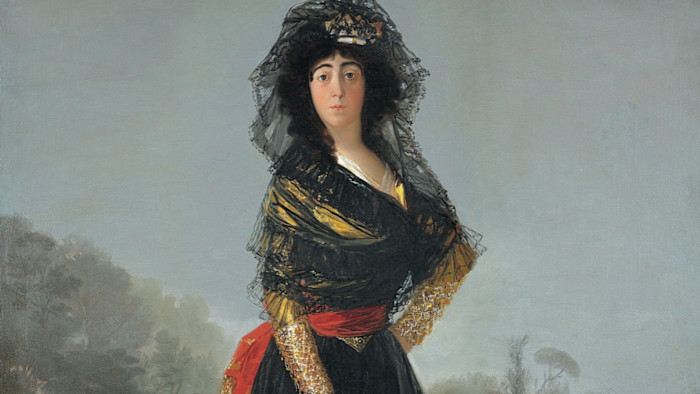
New York might seem like a robustly self-publicising city, equipped with renowned cultural brand names but lacking in the sort of secret marvels that are tucked into, say, London’s back alleys or marooned in distant neighbourhoods. You want to get a load of Goya in Manhattan? Everyone knows you head for the Met or the Frick. If that’s all you did, though, you’d be missing out, because one of his most mesmerising portraits, the imperious “Duchess of Alba”, has been holed up 70 blocks from Museum Mile for the past 120 years.
That painting, plus a clutch of others by Goya, Velázquez and El Greco, live at the Hispanic Society of America, a reproduction of Renaissance Spain that could almost serve as a location for a costume drama. Visitors pass through a richly ornamented terracotta arcade and into a double-height court with a floor of glossy red tiles. We haven’t quite slipped free of New York, though it feels that way: the Society is in the Audubon Terrace complex, at Broadway and 156th Street, an enclave of Beaux-Arts splendour at the edge of Washington Heights.
The Society was founded in 1904 by the railroad family scion and passionate Hispanophile Archer M Huntington, who had amassed a hoard of paintings, sculpture, decorative arts and books, and wanted the public to see them. He commissioned a museum design from his cousin, the architect Charles P Huntington, then spent the next quarter-century gradually transforming the entire block into an acropolis of intellectual achievement. He persuaded the Numismatic Society, the American Geographical Society, the Museum of the American Indian and the American Academy of Arts and Letters to erect their own buildings, united by Indiana limestone cladding, stylistic harmony and a lofty sense of purpose.
Over time, the other institutions moved downtown, leaving only the Academy and the Hispanic Society, which closed for renovation in 2017 and only reopened in 2023. For a while, Audubon Terrace was a ghost town.
Now the Duchess is back, headlining one exhibition, Spanish Style: Fashion Illuminated, 1550-1700, and segueing into another, the tiny Goya and the Age of Revolution.
Proud, disdainful, and immaculately outfitted in an inky skirt and matching lace mantilla, she serves as the museum’s principal draw and the culmination of Spanish Style. Two rings encircle her fingers: one engraved “Alba”, the other “Goya”. She points to the words inscribed in sand at her feet — “Solo Goya” — which appear upside down to us. The meaning, as so often with this enigmatic artist, refuses to settle. Is it a message from the painter, declaring himself her one true admirer? Or is it meant to assert that only he could have painted such a masterpiece?
The story begins much earlier: as the empire swelled during the 16th century, Spain was inundated with the spoils of distant dominions: Mexican cochineal, Colombian emeralds, Flemish lace, Neapolitan silks shot through with gold. In this atmosphere of abundance, competitive display became de rigueur. Yet luxuries had to be absorbed into an abstemious culture shaped by rigorous Catholicism and deeply entrenched tradition. The challenge was acute: how to fashion garments that were at once sumptuous and restrained, conservative in spirit yet modern in their assertion of worldly power.
Men stuck to sober black, the colour of prestige. Apparently basic, the deepest, darkest version required expensive dyes derived from Mexican logwood (“palo de Campeche”). Extravagance dwelled in details and accessories. In a 17th-century portrait of a “Man with a Dog” (tentatively attributed to José Antolínez), a dandy signals his wealth with studied discretion: billowing white sleeves, fine backstitching on the collar, a glove dangling casually to expose a bit of red silk lining. (The pooch, too, flaunts a wreath of ribbons.)
Women were both less and more restrained, encasing themselves in rigorously engineered undergarments, which they draped in costly silks. As Spain expanded its global reach, its fashion tightened around the waists of those who stayed at home. Starting around the time Columbus crossed the Atlantic, conical bodices gripped women’s torsos in whalebone slats, and farthingales kept skirts wide and legs invisible. Details evolved, but the general shape remained in place for more than a century. In a 1651 portrait by an unknown painter, the Spanish queen Mariana of Austria sports a preposterously capacious guardainfante, a structure assembled from wire hoops. The contraption turned Mariana into a fashion icon, but it was a wearable prison that, she admitted to a confidante, she escaped whenever she could.
Her Royal Highness wasn’t alone in chafing against her clothes. By the 18th century, as Spain’s superpowers waned, Paris supplanted Madrid as fashion’s capital, and soft bodies began to emerge from their constricting armour. Shoulders were bared, necklines dipped and flesh re-entered the visual field. Men loosened their collars and let their hair grow long, despite increasingly frantic admonitions from moralising officials. By the time Goya immortalised the Duchess of Alba in 1797, only faint echoes of Spain’s once-rigid dress codes remained. She wears black garments, set off by a scarlet sash, not as a demonstration of restraint, but as a form of forward-looking sensuality.
The fashion exhibition, artfully selected but abysmally lit, pivots abruptly into a puzzling sideshow that consists mostly of two Goya portraits of Spanish military officers. It’s ostensibly about the artist’s politics, so loosely linked to the US’s upcoming semi-quincentennial that it’s hard to perceive the connection. Dedicated to enlightenment ideals of education, emancipation and the act of challenging church and state authorities, Goya was sympathetic to the French Revolution. (He had nothing to say about the American one.) Initially, he hoped the spirit of liberty would bring real change to Spain. Instead, it brought a Napoleonic invasion. Out of that cataclysm emerged the series of 82 prints that the Hispanic Society is exhibiting in full, a few pages at a time: the magisterially grim and perpetually timely Disasters of War.
‘Spanish Style: Fashion Illuminated, 1550-1700’, to March 22; ‘Goya and the Age of Revolution’, to June 28, hispanicsociety.org
Find out about our latest stories first — follow FT Weekend on Instagram, Bluesky and X, and sign up to receive the FT Weekend newsletter every Saturday morning
Read the full article here