

Unlock the Editor’s Digest for free
Roula Khalaf, Editor of the FT, selects her favourite stories in this weekly newsletter.
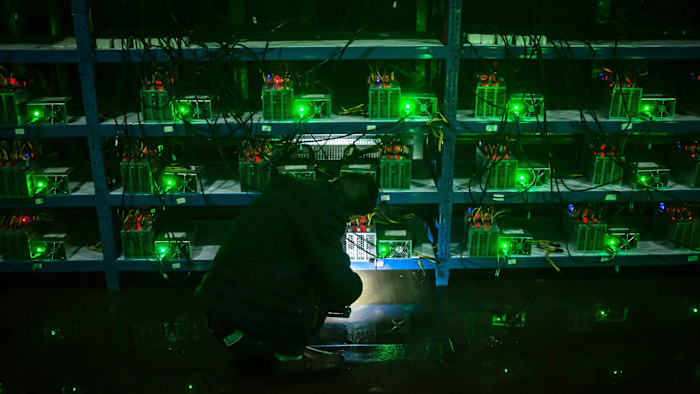
For quite some time now, the economics of bitcoin mining have been horrible. Here’s Fred Thiel, CEO of MARA, talking to Coindesk in November:
Bitcoin mining is a zero-sum game. As more people add capacity, it gets harder for everybody else. Margins compress, and the floor is your energy cost. [ . . . ]
You have hardware vendors running their own mining operations because customers aren’t buying as much equipment. The global hashrate keeps growing, which means everyone else’s margins keep shrinking.
Bitcoin was designed with the idea that transaction fees would eventually replace the subsidy, but that hasn’t happened. If Bitcoin doesn’t grow at 50 per cent or more annually, the math gets very tough after 2028 — and even tougher in 2032. Our strategy is to be in the lowest quartile in terms of production cost, because in a tight market, 75 per cent of the other guys have to shut down before we do.
By referring to 2028, Thiel means the next halving event, when the total of bitcoins miners receive for securing the network and validating transactions will fall from 450 a day to 225.
We’ve talked on these pages before about whether optional transaction fees can come to replace ever-decreasing mining rewards. For that to happen, a trader needs a good reason to transact on-chain, such as avoiding capital controls or dealing with criminals. Placing bets on bitcoin’s price generally means using cash-settled derivatives and avoiding all that faff, so even in volatile times there’s no rush to trade the underlying.
This month’s bitcoin sell-off seems to have encouraged a few traders to pay a fee for priority processing, but the totals are still tiny. On-chain velocity — a measure of how many bitcoins are in circulation — has improved slightly from a record low hit in October, but is only back to where it was in May. Meanwhile, according to Coinglass data, open interest in bitcoin derivatives over the same period has approximately halved to around $50bn.
And notably, unlike crypto’s flash-crash in October, there’s evidence that bitcoin miners have been switching off. Network difficulty (a ratchet mechanism in the blockchain mining algorithm that adjusts every two weeks) dropped by 11 per cent on Saturday, its biggest fall since China’s crypto ban in 2021.
Hashrate (an estimate of total power in the bitcoin network) also plunged last month, while the significance of mining pools to the network has shrunk, with more rewards going to miners of unknown origin. Given crypto mining rigs are nearly always made in China, the trend brings to mind Thiel’s mention of “hardware vendors running their own mining operations”.
Where does it end? With AI, according to Morgan Stanley. The broker today runs the numbers on turning the biggest publicly traded bitcoin mining companies into data centres and finds that the economics are much more attractive:
Our analysis shows a systematic shortage of AI compute–related supply, which drives the need for increasing volumes of “time to power” solutions. [ . . . ] Even if DC [datacenter] developers secured all large US and European Bitcoin company power access, they would still, in our view, be short access to power.
MS starts coverage of US-listed TeraWulf and Cipher Mining with price targets of $37 and $38 per share, implying upside of 159 per cent and 158 per cent, respectively. Mara, because it appears to be unwilling to give up crypto entirely, gets a price target 3 per cent below Friday’s close at $8.
The working is based on Hut8’s agreement in December with cloud platform developer Fluidstack to convert a crypto mining facility in Los Angeles into a data centre, with Anthropic lined up as the customer and all payments backstopped by Google. That deal raised the bar for how much a repurposing can add to a former miner’s equity value, at $18 per watt, analyst Stephen C Byrd and team argue:
So forget bitcoin and concentrate on the sheds, the team advises:
At a macro level, once a bitcoin company has built a data center and entered into a long-term lease with a creditworthy counterparty, that DC’s natural “investor habitat” is not among Bitcoin investors but among infrastructure investors who appropriately value assets with long-term, stable cash flows. Data center REITs such as Equinix (EQIX) and Digital Realty (DLR) [ . . . ] are the closest comparable companies to consider when valuing DC assets developed by Bitcoin companies. [ . . . ] We use the phrase “REIT endgame” to describe our valuation approach because, ultimately, these contracted DCs should be owned by REIT-like investors that appropriately value long-term, low-risk contracted cash flows.
Morgan Stanley’s house view is for total US data centre power demand to grow by 74 gigawatts between 2025 and 2028. Data centres under construction have 10 gigawatts of new infrastructure attached, with another 15 gigawatts of grid capacity available, which still leaves a bottleneck of 49 gigawatts.
Converting all US bitcoin mining sites could reduce this power shortage by between 10 and 15 gigawatts, Morgan Stanley forecasts. As quick fixes go, it’s second only by generation capacity to using natural gas turbines, and is more likely to succeed than placing data centres behind the meter at operational nuclear plants.
There’s a lot that could go wrong with the idea. We won’t get into AI commercialisation rates, likely improvements in model efficiency, and the sustainability of hyperscaler capex. Those are themes tackled at length elsewhere.
Crypto provenance is much less important, in the scheme of things, but still worth noting.
The US has the world’s highest concentration of bitcoin miners, according to Hashrate Index, with 37.5 per cent market share. Russia and China are second and third by market share, at 16.4 per cent and 11.7 per cent, respectively, after which there’s a sharp drop-off.
Any US retreat from bitcoin mining in favour of AI would concentrate network power in places not usually considered US allies. For a president whose re-election pledge was to make the US “the crypto capital of the world”, that may be a bit awkward. Or maybe it wouldn’t. Because, y’know.
Read the full article here