

If anything has characterised Matthieu Blazy’s tenure at Chanel so far, it must surely be a smile. Specifically that belonging to the model Awar Odhiang, who closed the designer’s debut show. Walking through a Grand Palais all spun with multicoloured planets, Odhiang unleashed a mega-grin. It was accessorised with a white silk T-shirt and a “piña colada” skirt. Bouncing down the catwalk with her own cosmic energy, she inaugurated a total shift in mood.
It was what they call in the industry a “moment”, and the climax of a season in which more than a dozen designers had made debuts. Anticipation about Blazy’s vision had reached a crescendo well before the unveiling of his interstellar show. He did it again in December, with a Métiers d’art presentation in New York in an abandoned subway station. The collection – surprising, chic and featuring a Superman sweater – combined expertise and wit.
The 41-year-old Belgian-French designer was not initially rumoured to be a frontrunner to lead the house founded, in Paris, by Gabrielle “Coco” Chanel in 1910. But according to Bruno Pavlovsky, president of Chanel haute couture and fashion, there was never any contest: “From day one, the way he talked about Chanel, about Gabrielle Chanel, and about what Chanel could represent left us in no doubt.” Blazy’s role as artistic director of fashion doesn’t include beauty, jewellery or watches, but as the most public-facing figure of the house, his influence is vast. Chanel is a behemoth, still held in private ownership by the Wertheimer brothers, and a sprawling empire whose revenues were $18.7bn in 2024. For many decades, the creative leadership was steered by the late designer Karl Lagerfeld. Blazy has been tasked with writing a new creative chapter and freshening up the “assortment”, as Pavlovsky describes it, in a deeply respectful way.
Last month, Blazy debuted his first haute couture show – a rose-tinted confection of mousseline and mushrooms filled with romance, Nelly Furtado music and cartoon birds. “Matthieu’s work is beautiful and his designs are exquisite,” says Nicole Kidman, who first started working with Chanel in 2004 as the face of its fragrance No 5. “From the fabrics to the silhouettes, it is divine.” “Light, free, comfortable, active, simple, anchored and delighted,” echoes Tilda Swinton, who was almost translucent in a gold spun bouclé skirt suit with raw raffia hem at the show. “There is wit and energy in these clothes and their spirit is catching…” Could it be that, after seasons of austere, cerebral quiet luxury, fashion has rediscovered joy?
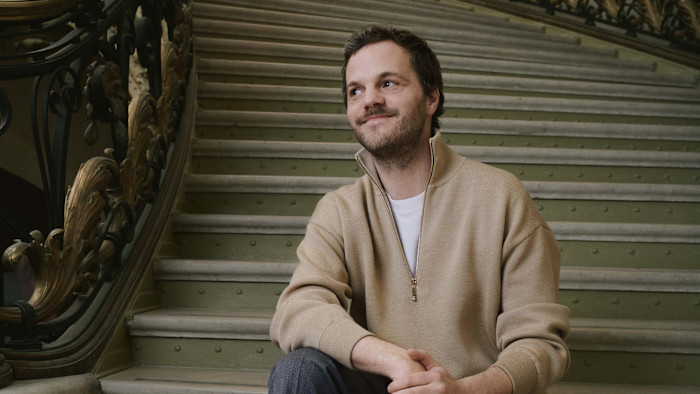
Days before that haute couture debut, I meet Blazy in his studio. Calm, quietly handsome, a little tired-looking, he wears the male designer uniform of jeans and sneakers with a navy sweater of his own design. The sweater opened his Métiers d’art offering, a surprisingly basic garment that one might not expect to find at Chanel. “I love it,” he says while pulling at the side seams. “I wear it every day.”
If he’s responsible for the new surge in fashion serotonin, he’s too modest to take the credit. Though he is happy to have introduced some levity into a world that feels quite bleak. “It started when I watched a documentary about Fred Astaire,” he says. “I thought it was amazing to see someone that was so joyful – someone that could really entertain – but at the same time be so good. Often something modern becomes cerebral, but I think you can say something funny and be very serious.”
Certain words – funny, playful, cute – are used cautiously in fashion. Especially when discussing matters of contemporary style. Blazy uses all of them with a refreshingly anti-intellectual confidence. “I like the idea of cute,” he says while showing off a bedazzled earring that finds a tweetie bird suspended on a bar (a nod, perhaps, to that famous Coco perfume ad of 1991 by Jean-Paul Goude). “It became almost a vulgar term in fashion. But I like cute. I love playful. Pretty is fine, too. Nostalgia is also beautiful. I am insanely nostalgic, you know?”
Blazy was born in Paris in 1984. His father is an expert in pre-Colombian art and his mother an anthropologist; he has an older brother and a twin sister. The family travelled widely, and the Blazy children were encouraged to engage with art. “It wasn’t didactic, we would have a choice,” he recalls of family outings. “When we went to the museum, we were free to roam.”
He studied at the prestigious La Cambre in Brussels and worked at Maison Margiela, Celine (under Phoebe Philo) and with Raf Simons at Calvin Klein. He was made creative director of Bottega Veneta in 2021, where he gained a reputation for exceptional craftsmanship and an affection for trompe l’oeil. Blazy often presents things that seem quotidian but are elevated, provoking a double take – a flannel shirt made of nappa leather or a silken denim. “I’m Belgian,” he says. “‘This is not a pipe’ – you know, this kind of Magritte thing. I think it engages people and I like the idea of the second look.”
Today, the studio is set up for couture fittings. Some half-dozen outfits are displayed on mannequins, with the shelves spilling with jewellery, scraps of sorbet-coloured lingerie and racks and racks of shoes. Unlike most collections, this one has been created without any sketching. “We’re fitting the clothes on the bodies of the women that are going to wear them,” says the designer, for whom this is a first-ever couture showing. “It’s an extraordinary process, but the magic only happens at the end. ”
The most exclusive expression of Chanel’s commercial output, haute couture serves only a few hundred clients. It showcases the skills of the atelier, alongside the 60 Maisons d’art and manufacturers – including Lesage and Atelier Montex (embroiderers), Lemarié (the feather and flower specialists) and Massaro (the shoemakers) – whose specialist skills the house is committed to preserve. It may seem niche but its cultural value is enormous, the creative apex of the brand.
Blazy must walk a tightrope, respecting the heritage codes on which the house has built its fortune while infusing it with something new. “The first time I went to the archive, I got overwhelmed,” he says. “There was so much great stuff that I felt paralysed. And then I stepped back and started to read the books that talked about aspects of [Gabrielle’s] personality that were never part of the myth that Chanel promotes. For example, I read that Chanel loved animal print…” It gave him the confidence to try new things. He’s also playing with the slim Chanel proportions to make them looser, and embracing a spectrum of colour outside the traditional black, white and beige.
“I don’t need to reinvent that slingback, or the iconic 2.55 bag,” says the designer of how far to push. “But maybe we can look at it from a different angle. To be modern you don’t have to be disruptive or crazy. It can be a small gesture – you just have to give a little twist.” Such as slashing the fabled Chanel jacket across the mid-line as he did for his opening look at the ready-to-wear show? That seemed like a big gesture. Blazy grins: “But it was a simple idea.”
“Listen,” he continues, “it’s very easy to make clothes that scream wow! It’s a quick and easy win. I’m interested in clothes that do not scream, but that are –” he drops his voice as though Coco might be listening – “just really fucking well-made.”
The couture show held at the Grand Palais began with the vision of a “bird on a mushroom”, something Blazy saw while on a trip to the Pyrenees. It spoke to his notion of Chanel women as a global flock. “Birds are free, they have a different point of view. And I thought it was a beautiful metaphor to talk about Chanel women, in general. I wanted to do something that was very universal and could be understood by anyone.”
He was also preoccupied by lightness. “I challenged the atelier, ‘Can we do Chanel in mousseline?’” Mousseline (or muslin) was not considered a sophisticated fabric until Chanel herself elevated it in the ’20s. Blazy wanted to push it further. “Can we do all the Chanel? Can we do the suits?” His first look was a classic Chanel skirt suit reinterpreted as a skein of dusty pink. Embellished with pearls and accessorised with a muslin 2.55 bag hung with a strap woven in gold thread. In the bag were muslin envelopes containing muslin letters, each embroidered with personal messages, contributed by the women walking in the show. The idea was nostalgic, romantic and demonstrative of a killer commercial instinct – the haute couture patrons are encouraged to choose from a “repertoire of symbols” so that they may embroider their own stories into the looks. It reduced the house icons to their most essential ingredients while acknowledging them as “spirits” that both hold up and haunt the house.
There were more daring gestures also. In the studio, Blazy points to a jacket and skirt made up of tiny ovoid panels, like a bird’s plumage, in a tapestry of pale arsenic yellow and grey. “I love this,” he says. “All the pieces are hand-dyed and then hand-cut. The point is for it to look like an incredible pigeon. I also like the colour. It’s a bit sick. In a good way.”
“Sick pigeon” is perhaps not a sales pitch Chanel is used to. But the piece encapsulates Blazy’s appetite for pushing the parameters of taste. “You can play it very safe, by the code, it reads Chanel, it’s very clear. Or you can allow yourself to go further, and sometimes fail and then reflect,” he says. “Without risk, it would not be a very creative process, it would be a recipe. I like a challenge. I’d rather try the idea and explore, and if it doesn’t work, at least we try.”
Despite the fanfare that has accompanied his initial outings, it’s hard to quantify the Blazy effect. His first collection will only arrive in stores next month. Chanel revenues were down 4.3 per cent in 2024 after a period felt throughout the industry of sluggish sales. But Pavlovsky says that things improved in the second half of 2025 following the previous year’s ups and downs.
“I don’t like to say things are returning to normal,” says Pavlovsky, “because we are not in a normal world. The reality is that it’s unpredictable, so you have to adapt yourself. But we have seen many clients back in the boutique because of the economic situation. We are seeing clients back in the States, and back in China too.” He adds: “We recently had a retail summit, with half of our top boutique managers and retail teams. I was asked one word to conclude our conference, and I said the word was ‘confident’.”
There has been criticism of Chanel becoming too expensive. The price of handbags has more than doubled since 2016. “We are working hard with Matthieu to build the right assortment for the boutique,” says Pavlovsky. “It’s not about being expensive or cheap, it is about finding the right price for the right garment. Chanel is not cheap, it will never be. But we don’t always have to be super-expensive.”
The Blazy bounce is building. His red-carpet outfits have been wildly visible: according to Launchmetrics, which measures brand performance, his dress for Selena Gomez at the Golden Globes earned a media impact value of $7.2mn for both the actor and the brand, outperforming all other appearances at the event. Michelle Obama wore a Chanel suit jacket and puffball earrings to promote her book The Look. A$AP Rocky, one of the house’s more recent brand ambassadors, makes a good case for the existence (maybe, one day) of Chanel menswear.
“In the past four months, Chanel has had a 47 per cent growth in search rate on ReSee,” says stylist and co-founder of vintage platform ReSee, Sabrina Marshall, “which is astronomical in the resale market. Matthieu Blazy has revived a fresh desire for Chanel.” Tami Kern, founder of Kern1, an online store dedicated to reselling rare pre-owned Chanel jackets, has also observed a spike. “It’s not simply that Chanel clients are suddenly buying more, it’s more specific. I’m seeing both new clients, who follow Matthieu Blazy and what he stands for, and existing Chanel clients asking for pieces that echo his styling cues.”
For example: “He introduced grey as a new Chanel shade, as though he blended the house’s black-and-white codes; clients responded immediately. I saw the same effect with the Métiers d’art show [staged in December]. Clients asked whether I had vintage Chanel with animal motifs. The red jackets I’d had sitting in stock for a while suddenly flew off the shelf. Lastly, I’m seeing more interest in buying the full look. Blazy has made the suit feel relevant again.”
Blazy’s day starts with the team at 9.30am. “Before that, there is time to do my own things for work with the press, or do research, but then it’s clothes, shoes, bags,” he says. “From 9.30am to 7.30pm I work on product. And then at 7.30pm, I have my last meeting, and then I have time to do my own thing.”
What does he do when he’s not working? “I go to the south of Italy, where my partner [an artist whom he prefers not to name] is based. I didn’t go a lot in the first year at Chanel, trust me, but yeah, when I’m not working I like to get out of town. Or I go to galleries, museums, I walk in the park. I love to watch my partner gardening. But I also love to go out and dance. I work hard, but when I don’t work, I go back to places that ground me. You know, like seeing my brother’s kids.”
If he’s nervous about the weight of expectation he hides it well. But “I feel the pressure,” he admits. “When I’m not at work, at night, the pressure is immense.”
Pavlovsky is adamant that he must give Blazy sufficient creative “oxygen”. Blazy is overseeing 10 collections a year, and Pavlovsky wants “to give him space”. Chanel seems unusually nurturing, especially at a time when designer careers are more precarious than at any time in history.
“I’ve worked at many, many houses, but there is a culture here that I have found really incredible,” Blazy says. “Everything comes down from the leaders. I don’t feel alone at all. We can talk about everything, what’s good, what is not good. But the daily relations are very enjoyable. It feels very much like teamwork. I drive, but the car is full.”
Says Pavlovsky: “Our conversations are very concrete. There’s no blah blah blah.” Most importantly, he is helping Blazy negotiate the “gap between a collection and making billions with the collection. And you cannot make billions if you don’t make things impactful at the boutique. We talk a lot about creation, because that’s the beginning and the impulse of everything. But we have 270 boutiques all over the world.” Fortunately, he concludes, “Blazy is a good student.” And while he doesn’t shoulder the responsibility for making things impactful, he’s very much “an active part of the day-to-day dialogue”.
Success can be just as scary as failure, when you have to sustain and surpass expectations. Blazy’s career is scorching hot. He has opened the doors and allowed in a gust of air. His Chanel is joyful and unexpected. This master technician might well be fashion’s Fred Astaire but his is a complicated choreography. “I feel the pressure,” he says, then sweeps a hand towards the studio. “But the good news is, I love my job.”
Photographer’s assistant: Barney Couch. Production: Parent
Read the full article here