

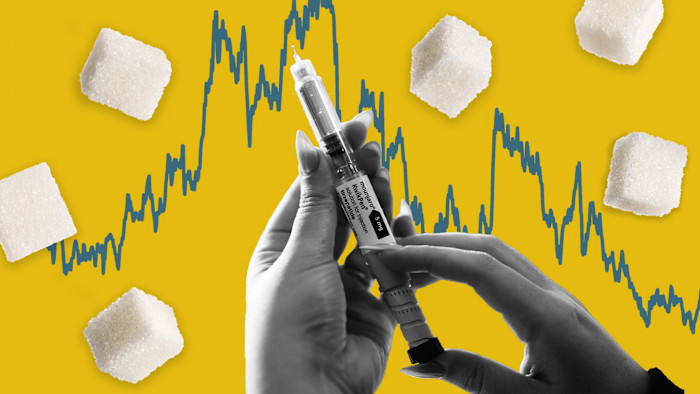
Sugar prices have tumbled to their lowest level in more than five years as weight-loss drugs accelerate a drop in demand by pushing consumers to ditch sweet treats in favour of protein.
Raw cane sugar futures in New York dropped to less than 14 cents a pound on Wednesday, the lowest since October 2020 and less than half the level they hit in late 2023. Traders say the move reflects a sharper than forecast slowdown in consumption in the US and other wealthy economies, while demand in developing countries is growing at a slower pace than expected.
So-called GLP-1 weight-loss injections — which work by activating the glucagon-like peptide 1 receptor hormone that makes people feel fuller — have been a crucial driver of reducing cravings for sweet flavours. GLP-1s are the basis of medications including Novo Nordisk’s Wegovy and Ozempic and Eli Lilly’s Mounjaro and Zepbound.
“The drop in consumption, or the speed of it, has taken the [sugar] industry unaware,” said Gurdev Gill at broker Marex, adding that Mexico and the US have been the clearest examples, while demand data in Europe has also been “challenging” for sugar prices.
While sugar consumption in developed markets has been edging lower for years as people increasingly opt for healthy snacks, “with these peptides now it feels like the more developed markets have really seen a large sea change in consumption”, he added.
In its December 2025 supply and demand outlook report, the US Department of Agriculture trimmed its estimate for sugar use by 23,000 tons to 12.3mn tons through 2026 because of a drop in human consumption.
“I suspect part of the reason is that GLP-1s are pretty widespread in parts of the US,” said Stephen Geldart, head of analysis of London-based sugar merchant Czarnikow.
Sugar markets are particularly vulnerable to changes in consumer behaviour because demand is concentrated among a relatively small group, he added.
“The top-20 per cent of consumers account for around 65 per cent of sales of products like cookies and ice cream,” he said. “If those ‘super users’ end up on GLP-1 drugs, you get a non-linear reduction in sales.”
That has helped drive prices lower even as global sugar production has remained broadly stable at about 180mn tonnes a year, with output staying high in Brazil and India and no major producer yet signalling sharp reductions.
“Production and consumption have been quite balanced in recent years and you’re not really building stocks,” Geldart said. “Yet futures [prices] have halved in the last two years. People have been slow to recognise there is an issue with consumption in some key markets.”
Marex’s Gill added supply was unlikely to fall quickly in response to declining prices. Sugarcane requires large upfront investment and long planting cycles, while many farmers are insulated from global prices by government support. “We aren’t seeing signals in most parts of the world to lower production,” he said.
Short positions — bets on lower prices — rose sharply late last year and are currently close to their highest level in five years. Positioning in the market is “extremely bearish”, said Czarnikow’s Geldart.
The first GLP-1s in pill form, which are expected to make the drugs more affordable and increase uptake, were approved in December. The impact “will become bigger and bigger as the prices of the GLP-1 drugs become cheaper and adoption becomes more widespread”, said Kona Haque, an agricultural commodities specialist.
However, while sugar prices have been falling, parts of the dairy market are moving in the opposite direction. Whey prices have surged as GLP-1 drugs and broader health trends drive demand for protein-rich products.
Demand “has moved up dramatically”, said John Lancaster, head of Europe, the Middle East and Africa dairy and food consulting at broker StoneX. Prices for high-protein whey products, used in protein powder and bars, “have gone up massively over the last year and a half. We’re pretty much at record high prices in Europe and the US.”
Clinicians warn that, without dietary adjustments and lifestyle changes, a significant share of the weight lost because of GLP-1s can be muscle rather than fat. That concern has pushed doctors and nutritionists to recommend higher protein intake, feeding demand for whey concentrates and isolates that were developed for sports nutrition.
UK shoppers, for example, have flocked to protein-rich foods, with cottage cheese sales up 50 per cent year on year in January, according to data from Worldpanel by Numerator.
João Paulo Frossard, a consumer food analyst at Rabobank, said food companies are adapting to the shift by reformulating products and focusing on nutrient density rather than volume growth.
“This is not a fad. It’s something the industry now has to plan around,” he said. “Every bite counts if you’re eating less.”
Additional reporting by Philip Stafford
Read the full article here