

Unlock the Editor’s Digest for free
Roula Khalaf, Editor of the FT, selects her favourite stories in this weekly newsletter.
We know the trend, yet each new individual stat is still gobsmacking. The average Chinese woman now has 0.98 children. Last year, the country reported the fewest births since records began in 1949, Thailand the fewest since 1950 and France since the second world war. Fertility rates keep hitting unprecedented lows, then falling further.
The declines are steepest in one region: the landmass stretching from Europe to China, plus Japan. Populations here have already peaked, estimates the UN. It thinks China’s will halve by 2100, although that now looks an underestimate. A study published by The Lancet in 2020 predicted even lower fertility than the UN’s estimates, and forecast that many European countries and Japan would shrink by half, too. That’s drastic. Imagine the world of our grandchildren in this northern belt: hotter, with AI having acquired currently unthinkable capabilities, and half as many people.
A quick caveat first. Readers with long memories will recall my writing last month that competition for land was intensifying in part because (according to the UN) the world’s population should keep growing until the 2080s. That’s true. However, most of that growth will happen in sub-Saharan Africa. So what might the depopulating places look like?
As it happens, we have a precedent on which to base this thought experiment. There was one period in history when western Europe’s population approximately halved: during the “Black Death”, the bubonic plague borne by fleas on rats, from 1345. For all the differences between then and now, it’s illuminating to see what followed, as recounted by the Oxford historian James Belich in The World the Plague Made: the Black Death and the Rise of Europe (2022). Counterintuitively, the halving probably improved the lives of survivors and their descendants.
Belich starts by piling up evidence to show that half the population did die in that first wave — more than previously thought. Further waves continued for three centuries. England, for instance, only recovered its pre-plague population by 1625.
Back then, populations shrank through catastrophe whereas ours is shrinking by choice, yet in one way the two collapses were similar: humans disappeared, while all land and goods survived. That left more of everything to go round. The total economy may have shrunk, but it grew per capita. The boom times lasted until about 1500, when populations rose again and wages fell.
Plague doubled the effective supply of homes. Survivors abandoned poor properties for better ones. As may happen in our future (and is already happening in shrinking Japan), “many farms and some villages were abandoned; towns and cities were not”. Late this century, there could be a glut of housing even in cities as childless old people die with nobody to inherit their homes.
After the plague, writes Belich, “Most people ate and drank better as well as dressed better . . . Average meat consumption of townsfolk at least doubled.” The English grew accustomed to sugar and gin. And with fewer children, parents invested more in each one’s education — a trend today, too. Belich describes “post-plague competition for scarce manpower”. Prices for slaves soared. More relevantly for our descendants, cities that before the plague had restricted immigrants began competing to lure them, offering citizenship or tax holidays. And new demographic groups took up wage work. Post-plague, it was women. In coming decades, it will probably be the over-seventies — which could alleviate the pensions crisis.
After the Black Death, even these revolutionary measures couldn’t create enough workers, so society used its new wealth to invent or improve labour-saving devices. The handgun was a game-changer, while gunpowder “replaced human energy with chemical energy”, and shipping was revolutionised, with bigger sailing ships making oarsmen redundant. All this added up to the “expansion kit”, with which, starting in today’s Canary Islands in 1402, Europeans colonised the world. Historians have long debated why Europe achieved hegemony. For Belich, “the biggest missing piece” of the puzzle is the plague.
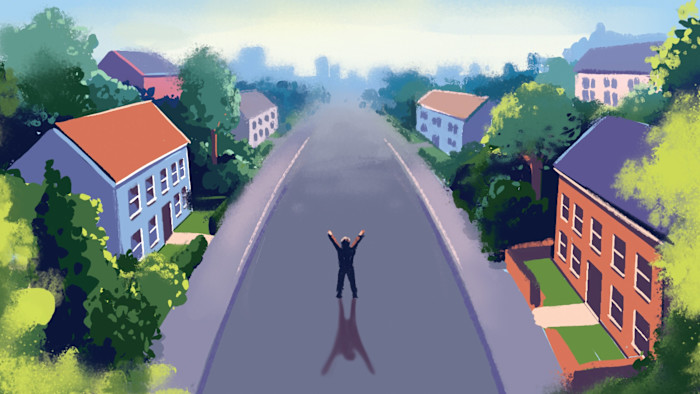
Picture your street in 2100, presuming climate change hasn’t washed it away. With half the population, some homes have been combined into vast single residences. Other buildings have been torn down, to make way for cooling mini-jungles. The future inhabitant of your home, born in 2026, now in their seventies — which by that time might be considered middle age — could find life cornucopian.
Email Simon at [email protected]
Find out about our latest stories first — follow FT Weekend Magazine on X and FT Weekend on Instagram
Read the full article here