

“Resolution to try and write a few lines every day,” the painter Gwen John (1876-1939) recorded on a loose sheet of paper in the early autumn of 1911. She didn’t have in mind a diary, exactly. Rather, she instructed herself to “Give a survey of your mind from time to time — its current and rhythm.” In her notebooks, John had long been in the habit of writing things down: impressions of colours seen while walking in Paris; notes on technique for paintings; extracts from the books, often religious or philosophical, she was reading; drafts of letters she might never send. But that winter, she began to make notes of a different texture. In ink or unsharpened pencil, her hand loosening, she addressed herself.
Diaristic, self-reflective, mysterious, these notes describe John’s internal weather, the ebbs and flows of creative feeling. And they reveal the extraordinary resilience she demanded of herself in living as a painter. “Live largely and deeply,” reads one, dated February 2 1912. “Do not be afraid.”
The loose sheets make up one folder of John’s considerable written archive, which includes diaries, notebooks, exercise books and letters to correspondents including her brother, the painter Augustus John, and Ursula Tyrwhitt, her oldest and most trusted friend from the Slade School of Fine Art. (It was to Ursula she wrote, in February 1910, “I cannot imagine why my vision will have some value in the world — and yet I know it will.”)
A selection of these writings has been brought out of the archive for the first time as part of a new exhibition of the Welsh-born artist at National Museum Cardiff. The exhibition draws attention to the later part of John’s career, when, during the 1920s and 1930s, she stopped painting in oils to devote herself to producing a vast body of works on paper. John vowed these were “quite as serious” as her paintings. Yet this was also the period when she developed a distinct practice of writing alongside painting. John wrote in preparation for painting, but also to make a record of private thoughts and feelings. By turns technical, poetic and also to do with faith, her notes show an artist capable of finding literary forms for her visual imagination. Leafing through them, it is possible to trace her aesthetic concerns, but also to glimpse something more special — the thinking, dreaming, imagining mind revealing itself on the page.
“Look at everything, every thought, attentively.” In 1911, John was at a threshold in her life and work. In her mid-thirties, she left central Paris, where she had lived for several years in a series of rented rooms (those plain, glowing interiors, with basket chair and open window, preserved in her paintings), for the leafier suburb of Meudon. And she broke away from the sculptor Auguste Rodin, with whom she had long been having an affair, towards a new kind of personal and creative agency. It marked a period of renunciation and solitude, one that brought her closer to her art, and also to her deepening faith. In her notes, she called it la retraite. “I must be a sainte too,” she wrote. “I must be a sainte in my work.”
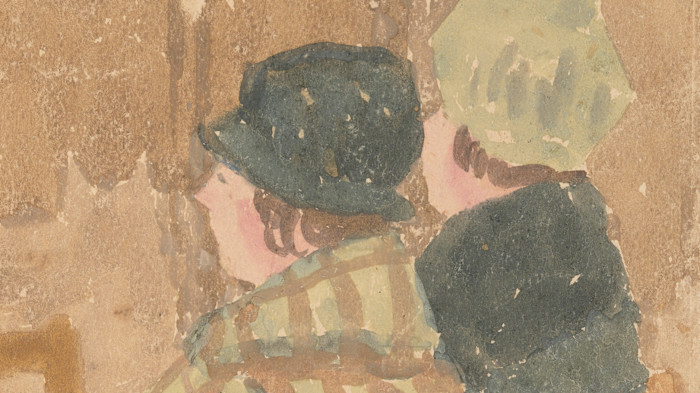
In Meudon, John began to produce works in series, or by repetition. Views from her window, studies of trees, primroses. In the Church of Saint Martin, where she attended mass, she got into the habit of drawing her fellow worshippers. She recorded her impressions quickly, sketching in graphite or conté crayon, before returning to her studio to produce a finished work in gouache or watercolour. These congregational drawings, of women and children sitting on ladderback chairs, ears and noses in profile, comprise a remarkable portion of the works on paper. They show her developing concerns about form and colour, and they also reveal the role of writing in her creative process. Alongside drawing, John used her notebooks as preparation for the making of visual works. She developed an associative method for memorising and calculating colour. “To remember colours it is a great help to have each connected with something,” she counselled Ursula. In her notes, she developed an Imagistic shorthand, in which colours find their visual and organic equivalents. Some are beautifully specific (“the green ball holding the snowdrop petals”), whilst others are less distinct and more tonal (“nuts and nettles”).
On the page, John’s notes read like poems. She laid them out simply, suggesting a degree of pleasure in clarity and precision, in the effort of reaching towards description via direct, tangible images.
April 1921
Nettle leaf yew tree cut
elderberry fish flying
lilac heart
October 1921
Colour
Plaid cloak (green fawn) white nettles.
hedge. Blackberry leaves and flowers, straw and stalks.
Church late afternoon.
Few of these notes can be conclusively matched with finished works, though Lucy Wood, senior curator at National Museum Cardiff, has found a study of two women sitting in church, one in a checked cloak. Seeing the finished study and the note side-by-side, it strikes me that John had crafted a metonymic and visual portrait. She might be likening the women to nettles or leaves, slender and quietly lustrous, their heads bobbing in prayer. Straw and stalks suggest the paperiness of age. There is no subject here, though by noting the occasion on which she observes the women, John might be placing herself at the scene, an artist working furtively but with pleasure in the glow from high windows.
John’s works on paper were becoming increasingly abstract. In her studies of flowers or congregants, she reduced her forms and, unlike the gauzy mutedness of her oil paintings, worked to keep the colours flatter. Cornflower blue, lavender, green, chestnut, gold: they have a creaminess, a slight chalkiness, like bars of soap. She was attempting to look beyond an object’s formal properties to something immaterial; to discover what she referred to as its “strangeness”. This could best be achieved through repetition, drawing or painting the same thing over and over until its properties became unfamiliar. And she was concerned, too, with a work’s “atmosphere”. In her preparatory notes, atmosphere — explained as “the notes [colours] seen at a distance” — seems to be a quality apart from the formal elements of the work. It suggests an overall tonality, a harmoniousness, which also has to do with feeling. For John, writing down the atmosphere was a shortcut to the finished work she had in mind. A child in church, for instance, made her think of a “faded brown pansy”.
Occasionally, her notes are opaque. One of her most enigmatic statements, repeated throughout her notebooks, refers to the “turning of the leaf”. Is this to do with colour, atmosphere or faith? It suggests the attempt to capture change, the moment at which something begins to mutate and fade. Or, it sounds almost mystical, the turning of the self towards something great and new. A leaf is also a page. John’s written archive can be so illuminating, intricately connecting her thinking with her practice. But like any shorthand, it was private, and there are things we will never know.
“A beautiful life is one led, perhaps, in the shadow, but ordered, regular, harmonious.” In Meudon, John tucked herself into work and faith. Both required habit, discipline, a certain degree of refusal of the world. She took classes in Roman Catholicism (a not unusual pursuit for an artist in France at the time) from the local Dominican convent, and by 1913 had taken her first Communion. Commissioned by the convent, she painted a series of portraits of its 17th-century foundress, and began to work from the young nuns. They intrigued her, these women who had chosen lives of solitude and prayer. (In her paintings, she liked them for being “a little sulky and sad”.)
As her notes progress, John’s writing takes on a numinous quality. Pages are filled with prayers (“Make me the humblest . . . ”) and meditations, which appear to be written exercises — in her neatest hand — of a spiritual nature, beneath titles such as “Laws”, “Rules” or “Thought for the day”. Words such as “harmony” cross over from the technical (as in, an accordance of colour) into the spiritual, where it suggests the artist’s quietude, her most desired state of being. These notes are often melancholy, and have the flavour of one writing to herself from the depths of isolation. And they can be fairly stringent. In the wake of her relationship with Rodin, John strove to suppress the “animal” and sacrifice “earthly life” for all the attributes of saintliness: the childlike, littleness, simplicity, timidity. “Too much care for material things,” she wrote in one list, cautioning against herself. “Too much sensual rêverie.”
Are these notes a little disappointing? It can be dispiriting to read a woman suppressing her desires, and idealising a life of asceticism, self-censure and humility. (“Your pictures —” reads one note, “the transformation of your sins, your faults.”) In accounts of John’s life and art, faith is the aspect most often missing. It is unfashionable, and problematises claims of her as a feminist figure. But there is a way in which her saintly aspirations might be considered radical. In the late 1920s, she developed an obsession with Thérèse of Lisieux. Thérèse was one of the first saints to be photographed (often dressed as Joan of Arc), and her image proliferated in French Catholic culture. Drawn to archetypes (the saint, the nun, the convalescent, the pilgrim, all of which appeared in series in her paintings), John responded fervently to the image of this young religious woman. Using a photographic prayer card, she drew Thérèse repeatedly, and she followed her teachings, which encouraged her to find holiness in small sacrifices and in the ordinary. To John, determined to live alone and by painting, the life of this young saint represented not restriction, but self-possession and possibility.
One word which rolls through John’s writings is recueille. “I am recueille, am I not?” she asked herself in August 1931. By this, she meant a quality of collectedness, a requisite for both spirituality and for painting. The proximity of these two things is interesting — the sense that for an artist, creativity might spring from the same secret place in which faith is nurtured. Both art and faith are underpinned by the same practices and habits of mind. They are akin to one another, and each is a life of vocation. What a saint asks of herself, an artist must ask of herself too. These, John listed: concentration, control, silence, effort; also, love. In her writing, the rules John sets for herself — to “put away secondary things”, to “stand courageously alone” — might as easily apply to the artistic life as to the religious. Writing brought both aspects of her life together, a space in which to set out her thoughts and explore this complex, interwoven practice. Like her church drawings, and those of Thérèse, John’s written meditations were exercises in a kind of mindfulness. And in their repetitiousness, they modelled a kind of worship. Sitting down in her studio, or to her notebook, she asked only, “Let it be unbroken — continuous.”
And so we might think of devotion in its broadest sense, as a practice encompassing both prayerful and creative feeling. In her final years, John turned a loving eye upon her fellow worshippers. Sitting in church, she drew the children entering in their pairs, the hatted women, the nuns with their starched cornettes. They enlivened her spirit. Because the religious life, in all its stringency, wasn’t quite enough. “If I cut off all that there would not be enough happiness in my life,” she drafted in a letter to her neighbour, Véra Oumançoff, who had scolded her for drawing in place of prayer. But John had discovered her own path to faithfulness, and some quiet happiness there was.
Harriet Baker is the author of “Rural Hours: The Country Lives of Virginia Woolf, Sylvia Townsend Warner and Rosamond Lehmann”. “Gwen John: Strange Beauties” is at National Museum Cardiff to June 28
Find out about our latest stories first — follow FT Weekend Magazine on X and FT Weekend on Instagram
Read the full article here