

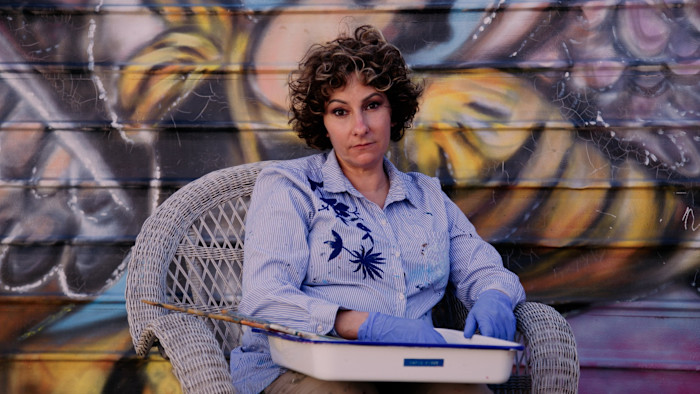
“I don’t consider myself a creative person at all,” Greta Waller tells me, in the kitchen of her south Los Angeles bungalow, despite abundant evidence to the contrary.
She’s partway through repainting the cupboard doors of her kitchen with blue and white designs inspired by a large collection of Staffordshire “flow blue” plates mounted on a wall nearby. Currently squatting in her front room is a large electric organ, acquired for free through Facebook Marketplace. “I’m going to paint it,” she explains. “We do not play it.”
To the side of the kitchen, she has cleared a table beside an easel. Here, she paints still lifes while her kids — three boys, aged four, nine and 10 — busy themselves after school. Some of those paintings, of varied subjects, from bowls of cherries to charred black lambs’ hearts, will be presented at Frieze Los Angeles by the LA gallery Fernberger, which held its first show of Waller’s work in May 2025.
Waller, 42, a voluble woman with an impish smile and a mass of curly brown hair, has been painting all her adult life. She tells me of a time she rented a warehouse, where she lived for a year with no bathroom, just so she could make a 16ft-tall painting of an avalanche. (It’s now in storage, still unsold.) Another time, she pulled over on a family road trip in Oregon and begged her children to sit quietly while she painted a mountain.
“It’s a sickness,” she says. “I have to do it. I won’t be well, I’ll be irritated, if I don’t do it.”
Waller knows plenty about sickness. Since 2015, she has supported herself and her family by working as an emergency medical technician. After moving to Los Angeles from New York in 2008, to study at the University of California, Los Angeles, she was working in a pizza restaurant when she noticed ambulances speeding past the window.
“Maybe I could do that,” she thought. “I’m fast at painting.”
Working as a paramedic, Waller tells me, is not dissimilar to painting, especially en plein air, as with the New York street scenes she used to do when she lived in that city. “You have your tools, you have your procedure, you have your set-up. It doesn’t matter where you do it, but you’re there to do it efficiently. Get in and get out.”
Herein lies the basis of her dubious claim to uncreativity: observational painting, for Waller, is a disciplined practice of looking. “I’m very practical in my mind,” she says. Sometimes, she gets a similar satisfaction from searching for things washed up on the beach. “What else are you doing when you’re driving the ambulance at 80 miles an hour? You’re scanning. You have to see everything very quickly.”
She only paints from photographs when unavoidable — as with a giant canvas depicting an elevated panorama of Los Angeles, viewed from the hillside of Runyon Canyon, which leans against one wall of her backyard studio. (She would require a helicopter, she jokes, to get that canvas into and out of position.)
Painting from life is a bit like treating an injured person, she says. “You cannot get tunnel vision. You have to treat the whole.” You could be fixating on a person’s blood pressure, for example, while “they’re bleeding out in their back from a bullet hole”.
Such regular encounters with violence and tragedy, you might imagine, could leave deep emotional scars. Waller dismisses this suggestion, saying that the hardest things about her most recent job were the two-hour commute to her station in Crestline, in the San Bernardino Mountains; the gruelling 48-hour shifts; and the militarism of life working within the fire department, where snap drills and misogynistic asides were routine. When she recently became pregnant, she was persuaded to resign in order to “remain in good standing”. She hopes to return to work as a paramedic after her daughter is born.
In contrast to the chaos and stress of her paramedic work, there is a quiet focus to Waller’s paintings. She has pictured glowing coals, ECG printouts, oysters, cityscapes, hunks of meat, sea urchins, X-rays and sundry other subjects, but one of her favourites is ice. She purchases blocks of crystal-clear ice from a company that supplies ice-carvers, and she stores them in a chest freezer in her studio, ready to paint still-life settings of the ice blocks.
As a demonstration, she lifts out one such rectangular obelisk, and places it gently on a panel of draped green curtain. The painting she started the day before rests on an easel.
“I don’t know why I paint ice,” she says, before telling me all the things she finds amazing about it. Ice is constantly changing, she says, so you have to work fast. It’s a prism, which absorbs and distorts everything around it. Ice also generates rainbows. “Rainbows are the hardest thing to paint, because they’re so pure,” she says. “I paint ice because it’s a portal into abstraction.”
For Waller, abstraction and figuration are inseparable, “parts of a whole.” In recent paintings of glowing coals, which she first noticed in a backyard barbecue grill, recognisable form collapses into colour and texture, just as it does in a fire. She tells me of her ambition to paint the electrocardiogram printouts that she saves from work at large scale: “Eventually I will become completely abstract,” she says. “It will be all minimal.”
The unique mix of subjects in Waller’s output — usually borne out in her exhibitions — lends itself to a symbolic reading. Images relating to bodily (dys)function, such as a bloody tooth spat into a porcelain sink, or close ups of flesh or meat, might seem to resonate poignantly with the vanitas themes of melting ice or decaying fruit.
Not necessarily, counters Waller. Her choice of subject is primarily guided by what is visually elusive, and what is most challenging to capture. “The hardest thing I’ve ever painted is seaweed,” she says. “It changes to that crispy-looking seaweed in, like, 20 seconds. Too fast. But that’s amazing. I love seeing the shift right before my eyes.”
She likens such a transition to watching “a bruise heal” and thinks of it as a kind of liveliness that is visible but fleeting. She’s seen it go when people die, and she’s seen it come back, too, as they revive. “I don’t know if that’s soul or energy.” It’s what she strives for in her paintings.
As I depart her studio, I comment on a small painting of a starfish. “That one’s only halfway done,” Waller responds. “It doesn’t have the magic in it yet. You’ll see.”
February 26-March 1, frieze.com
Find out about our latest stories first — follow FT Weekend on Instagram, Bluesky and X, and sign up to receive the FT Weekend newsletter every Saturday morning
Read the full article here