

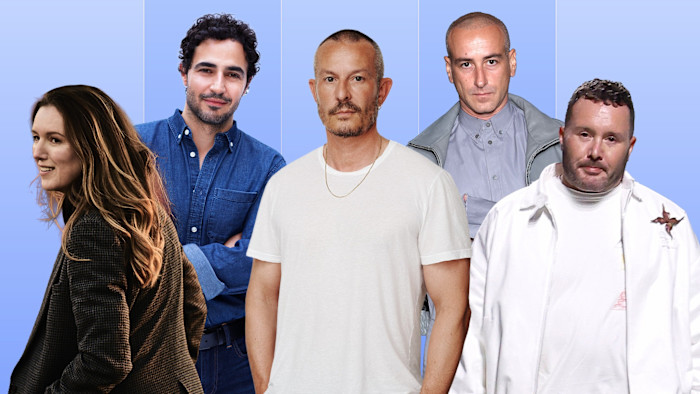
Jonathan Saunders is used to being busy at this time of year. The Scottish fashion designer and former chief creative officer of Diane von Furstenberg, who ran his own eponymous luxury label and consulted for top brands, including Louis Vuitton and Alexander McQueen, was showing off a debut collection last week. Looks included an Italian wool trenchcoat with a cream blouse and David Bowie-esque balloon trouser, stonewashed denims and silky 1980s-style dresses, cinched with belts at the waist.
But while the fashion week season is upon us, these clothes weren’t destined for a high-end runway and dissection by critics and buyers before being sold in six months’ time. After his appointment last spring at & Other Stories, the affordable fashion brand owned by Swedish retail giant H&M, Saunders’ latest designs will be heading straight for the high street — and he couldn’t be happier about it.
“What’s so exciting about this is the breadth of the audience and customer I am designing for now. I feel like I am reflecting society,” he says from his studio in Stockholm. “It is a really interesting and humbling kind of design exercise and challenge for me, especially at a time when people are deeply questioning what they invest in when it comes to their fashion purchases.”
Saunders is far from the only designer with decades of experience honed at the tip of the luxury pyramid who has migrated to a top creative position for a mass-market retailer instead. In the US, Zac Posen, known for his ball gowns, is overseeing the turnaround under way at Gap. Kim Jones, one of Britain’s best-known designers, with stints leading Fendi as well as menswear for Dior and Louis Vuitton, was hired last year at Areal by China’s biggest down-clothing retailer Bosideng.
Meanwhile, Fast Retailing, the third-biggest clothing retailer in the world, announced last month it had hired Francesco Risso, who left Italian fashion house Marni last year to helm up its fashion label GU. Risso joins the former Givenchy designer Clare Waight Keller at the group; she was appointed the first global creative director of Uniqlo in 2024.
One-off collaborations between starry designers and high-street behemoths have happened for decades. The difference now is that these are permanent hires. Ones that leave broader questions for the entire fashion landscape, from the companies that once parroted high fashion and now have luxury-trained tastemakers running their creative studios, to the luxury fashion houses redefining their value proposition in a volatile trading market.
Waight Keller, who famously designed the wedding dress of the Duchess of Sussex while at LVMH-owned Givenchy and who also helmed Chloé, says she moved away from the idea of another job in luxury after the pandemic triggered a seismic shift in wardrobes and how people wanted to dress. After thinking carefully about the future of fashion, she felt there was more to learn by working with a Japanese high-street giant than another European conglomerate.
“At the end of my time at Givenchy I felt I was working on strict, hyper-tailored clothes in delicate fabrics that didn’t have a place. A major change in the luxury model now is that it is mainly driven by accessories sales and then clothes that complement them,” she says. “Luxury can offer great occasion wear. But as a designer who designs clothes, I wanted to go somewhere I could design amazing clothes that people would be wearing every day.”
Large numbers of aspirational shoppers have been alienated by vast price hikes in recent years, meaning many luxury names are now fighting for a tiny, albeit very wealthy, audience. Like Saunders, Waight Keller saw appeal in taking her luxury point of view and translating it for a far bigger audience, democratising certain design principles that previously stayed within high fashion realms.
She also wanted to test herself on how to make beautiful clothes that were also practical, affordable, durable and available in far more sizes. And she was drawn to working in a part of the industry she says employs more women in senior leadership positions, partly because it offers a different pace and priorities.
“What comes with luxury fashion is a spotlight, and that spotlight and the show cycle involves creating constant buzz and social media impact,” says Waight Keller, a churn she calls “challenging”. “Now, it’s my customer who is my reviewer. I do think many women have a different approach and a different way of designing; it’s very customer-centric in that sense.”
Consultant Mimma Viglezio points out that the move away from the luxury treadmill by some designers doesn’t just reflect the scarcity of top positions in that space given recent management shake-ups at dozens of houses. In some cases, the migration offers a less stressful life, greater job security and possibly even more creative freedom.
“The fast-fashion groups have deep pockets and can pay designers at least as much as they were paid by luxury employers, so these designers can get paid very well without the pressure of a fashion show four times a year,” Viglezio says.
Notions of status, influence and taste are also being upended at the moment. “Perhaps, with top designers at the helm of fast-fashion giants, those companies will copy less and produce more original designs, with speed and power that luxury doesn’t necessarily have and for a far bigger audience. It’s a seismic shift.”
Sustainability discussions have been largely sidelined from the fashion conversation lately, making it easier for mass-market brands trying to redefine their public perception. While Spanish behemoth Zara has yet to hire a big-name creative director, it has been elevating its global branding by collaborating with the coolest photographers, stylists and tastemakers.
As the likes of Chinese-controlled Shein and Temu become the latest industry bogeymen in terms of rock-bottom prices and enormous production volumes, H&M and Uniqlo are vying to emerge as purveyors of good taste at good prices for a discerning global middle class.
Headhunter Floriane de Saint Pierre notes that many of these high-profile hires have been by Asian companies (beyond Jones, Waight Keller and Risso, former Hermès womenswear creative director Christophe Lemaire designs Uniqlo’s “U” sub-wear brand with Sarah-Linh Tran, while Kris van Assche designs Antazero for Chinese sportswear group Anta). While some Asian markets like to support local designers, international reputations continue to hold huge sway.
“Chinese groups in particular relied on shadow creative consultants for many years and are now actively poaching western marquee creative leaders,” says de Saint Pierre, adding that such names bring both “a power of personal brand and career expertise, but also creative credibility and sophistication from leading luxury houses”.
At one time, taking on a role for a mass-market player might have been considered a step down for designers whose visions were given top billing in Milan or Paris. But priorities change. Talking to the Financial Times last October, Jones explained that “the average cost of a Bosideng coat is between €300 and €600”.
He added: “I think it’s important to be realistic about what people can afford now. In Asia you have a lot of wealth, but in Europe many feel as if their wealth is going away. People still want to be part of this, but many can’t really afford to be.”
While the new & Other Stories knits may use fine-gauge cashmere and merino wool and there is plenty of pure silk, there is still a question of compromise for all designers making this switch, given the environmental implications of manufacturing seasonal trends on such a mass scale. Saunders, whose first collection will be available in stores next month, says his design philosophy of bold pops of colour or mixing materials hasn’t changed in his new position — and that he has a renewed sense of mission.
“But the audience is broader, the end use is broader and it draws up a sense of reality to the clothes, which is really important for this brand, as is offering value for money,” he says. “Expectations are high now and rightly so, as people have a much more global understanding about what’s out there and are more discerning in terms of what they will invest in. It should be pushing us to really strive for quality, wherever we are and whatever we design as designers.”
Follow us on Instagram and sign up for Fashion Matters, your weekly newsletter about the fashion industry
Read the full article here