

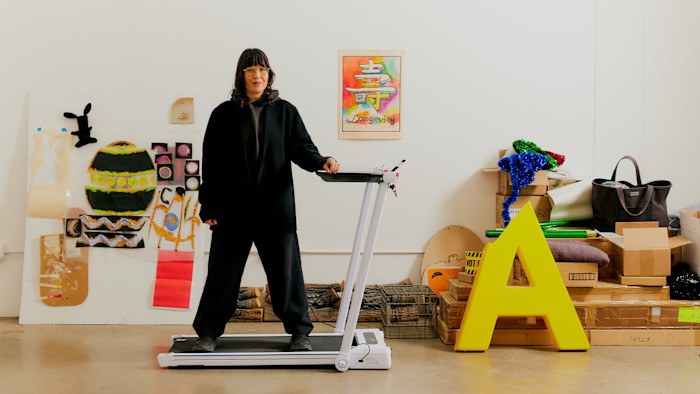
“I came to the west coast a little bit accidentally,” admits artist Amanda Ross-Ho, recalling her move to Los Angeles from Chicago in 2004. Her plan to attend graduate school on the east coast hadn’t worked out, and an offer from the University of Southern California felt like an enticing risk. “I was attracted to the weirdness of the choice — because I had planned something else. It was a bit of a dice roll.”
There was also a private impetus to the decision. Her father had spent a year in Los Angeles when he immigrated to the US from Shanghai in 1955. “It was the first place he landed, and he hated it. He was 19, he couldn’t speak English, he couldn’t drive a car. LA was a site of trauma for him. I think, intuitively, I came to heal that.”
We meet at Ross-Ho’s studio, an old textile factory in East Los Angeles. “I’m attracted psychically to spaces that have formerly been for textile production,” she says, with a laugh. “I make a lot of textiles.” The artist, who turned 50 last year, has an easy-going, humorous air — one that perhaps signals her career as a teacher (she is a professor of sculpture at the University of California, Irvine), but also belies her frenetic activity.
She is in the midst of preparations for a public performance at Frieze Los Angeles, one of seven special commissions by LA artists being produced by the Art Production Fund. “It is nerve-racking, because I’m a card-carrying control freak. Everything I do, I orchestrate so tightly — and one of the things I like about performance is you can’t do that.” She has been working for some years with Fac Xtra Retreat (FXR), an Asian American performance collective in LA (what she calls a “very discursive and improvisational” activity), but solo performances are a relatively new departure.
Over the past 20 years, Ross-Ho has been best known for multi-part installations — often meticulously fabricated — that play with scale, injecting humour or absurdism into mundane objects. To one side of the studio are three giant mannequins: the bottom halves of female bodies, scaled up to the size of public monuments. Her 2012 work “OMEGA”, built with the assistance of Hollywood prop makers, was a gigantic replica of a vintage photo enlarger of the type that her parents had used in the 1970s.
“What’s interesting is that scale doesn’t just have a size implication. It’s a temporal thing,” she says. Her project for Frieze embraces both aspects. Each day of the fair, she will walk around the perimeter of the soccer pitches adjacent to Santa Monica Airport, pushing a 16ft-tall inflatable ball printed with a Nasa satellite photograph of the world.
The result will be a deceptively basic piece of live theatre — the artist becoming a kind of modern-day Atlas and Sisyphus (the mythological characters compelled to hold up the heavens, and roll a boulder uphill, for eternity). “It’s really simple, but it’s also an athletic challenge,” she explains. “It might look like comedy; it might look like struggle.” The absurdism might feel like a tongue-in-cheek allusion to public art’s tendency, at times, towards the grandiose.
The project has its origins in an earlier performance, “Untitled Figure (THE CENTER OF IT ALL)”, staged in Portland in 2023 — for which Ross-Ho skated on a public ice rink, repeating the same circular formation for 30 minutes. On that occasion, the recurring action — a so-called “school figure” for training a skater’s body — had an autobiographical resonance. “I was a figure skater as a child. I did this every day of my life for 12 years.” However, she hadn’t skated for three decades prior to performing the work. “Close to the thing, I realised: not rehearsing is the piece. Just going in cold.”
Life and art have been intertwined from the beginning. Ross-Ho grew up as an only child of artist parents in the Chicago neighbourhood of Edgewater. They lived in a 19th-century house that had previously been home to a hippie commune. She vividly remembers the room in which her parents slept, a vast space that had formerly been two rooms, and where the residue of the demolished wall remained visible — “a long, visceral scar”. “I saw this as a really nice metaphor of making a family, taking down these two spaces. But then later, they built a room divider upholstered in hippie fabrics.”
Her parents, Ruyell Ho and Laurel Ross, were at the heart of Chicago’s art community in the 1970s and 1980s. Ruyell was on the periphery of a “mythical” grouping of artists that included renowned collagist Ray Yoshida. “My dad was a painter, but the main thing he did was photograph artists’ work. My mom, who’s about a decade younger, was an artist — photography was her medium.”
When she was 14, her parents separated and she began living with each of them in turn. By this time, her own future as an artist was a foregone conclusion. “Art was sort of the family business. There was a period right out of high school when I was a little ambivalent — I had to question: ‘Am I just going with the pull, or is this an actual autonomous choice?’ But then, at a certain point, you’re like: ‘This is totally it.’”
She studied as an undergraduate at the Art Institute of Chicago, then stayed in the city for seven years. “It was a vital time for Chicago — a very particular moment of its development in the late 1990s.” Increasingly, though, she felt constrained. “I’d been there such a long time and I had so many close ties — I needed to leave.”
After enrolling in the MFA programme at the University of Southern California, she began working on film sets as a prop assistant. “Moving to Los Angeles and immediately jumping into that space — it was so cliché in some ways, but it was also brilliant because it unpacked all of these things. I was like, ‘Oh, now I understand what the Paramount lot is.’” At USC, she met her partner, artist Erik Frydenborg, and together they helped to create props for the photographs of one of their tutors, the artist Charlie White — including pools of fake blood and a set representing Jonestown, scene of the notorious 1978 massacre.
Soon Ross-Ho’s own practice took precedence over prop creation, but production design has remained a touchstone. For her installation “Untitled Thresholds (FOUR SEASONS)” (2025), currently on view at the Hammer Museum as part of its Made in LA biennial, she created four giant doors garlanded with scaled-up decorations for Halloween, Christmas and lunar new year. What seems like an anthology of “tat” — painstakingly recreated at 170 per cent of its original size — carries a personal subtext: the objects derive from the care home in which her father is a resident. “The doors have the illusion of being aged — that was intended to feel like a contrast with the ephemerality of the objects. But the really ephemeral thing is the people who you don’t see.”
Ross-Ho’s works have frequently glanced back to the lives of her parents and her own early life in Chicago — art acting as a form of memory. “Trying to figure out what to do with inheritance has been one of the things I’ve been struggling with, but also have been totally intoxicated by for a long time. It’s both a gift and a burden.” Last month, she created an installation in an artist-run gallery in Chinatown, Leroy’s (a former Vietnamese restaurant); “Untitled Damages (ROOM DIVIDER)” features two groups of photographs — taken by each of her parents in the 1980s and since ravaged by water damage — installed around a wall that harks back to the dividing screen in their bedroom.
For Ross-Ho, the performance at Frieze represents a decisive shift. “It’s really a love letter to Angelinos, and to the people who know the work I do, but I’m always interested in subverting expectation.” She laughs to imagine the sheer duration of each day’s performance. “Part of me gets nervous: ‘is it going to be entertaining?’ But that’s not my job. That’s not the job of art.”
‘Untitled Orbit (MANUAL MODE)’, February 26-March 1, Frieze Los Angeles, frieze.com; ‘Untitled Damages (ROOM DIVIDER)’, Leroy’s, Los Angeles, to March 1, leroys.biz; ‘Made in LA’, Hammer Museum, to March 1, hammer.ucla.edu
Find out about our latest stories first — follow FT Weekend on Instagram, Bluesky and X, and sign up to receive the FT Weekend newsletter every Saturday morning
Read the full article here