

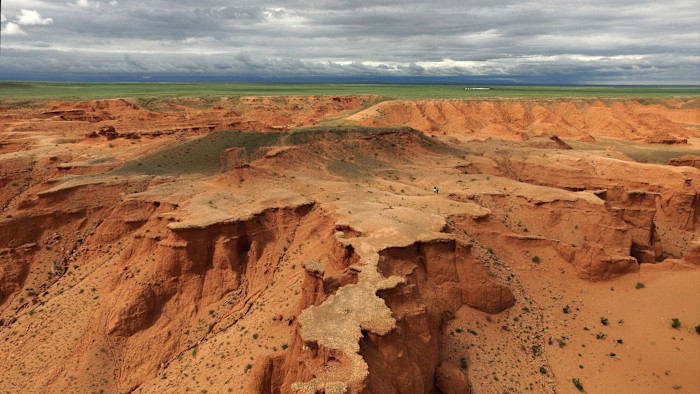
The tracks in the red sandstone told a story. They showed that a pair of Sauropods, giant dinosaurs with long necks, had walked here side by side more than 80 million years ago. “Think of them interacting like a family of elephants,” said Mainbayar Buuvei, squatting low to the ground to trace the outline of a footprint with his finger.
The footprints were deep — more like moulds made by the weight of the dinosaurs pressing into the soft, muddy ground. Those impressions were then filled with leaves and dirt, which had hardened to create a natural cast of the dinosaur’s foot. “You can see the skin and a nail,” said Buuvei, showing a claw on the side of the footprint.
It was late afternoon in August at the Khongil site, in the Gobi desert of Mongolia, where the stony ground yielded to an outcrop of craggy red sandstone holding the fossils and footprints. The Gobi is one of the world’s richest paleontological regions. Some of the most well-known dinosaurs were discovered here: the speedy Velociraptors of Jurassic Park fame and the strange humpbacked Deinocheirus with freakishly huge claws.
But there are thieves in the vast steppelands too. Fossil poachers have for decades been looting bones from the unprotected land to sell on the black market. Buuvei’s 18-year career as a paleontologist in Mongolia has given him insights into the poachers’ brutal methods. He’s come across headless skeletons and smashed bones where poachers have used dynamite to blow up sites to reveal their loot.
“Along with discoveries, there were always illicit digs, trash and destruction left behind,” said the 42-year-old, who is working on his doctorate in paleobiology at the National University of Mongolia. “I don’t like talking about them, because I consider it one of the greatest crimes against nature and humanity.”
It’s illegal to sell Mongolian fossils but occasionally specimens do surface from the black market. In 2007, Nicolas Cage reportedly paid $276,000 to outbid Leonardo DiCaprio for the skull of a Tarbosaurus bataar, a carnivore nearly as large as a Tyrannosaurus rex. In 2015, he returned it to Mongolia voluntarily after the US Department of Homeland Security informed him that it might have been stolen.
Paleontologists argue that the commercial digging and sale of fossils is a loss to science, making the specimens inaccessible. The commercial dealers say as long as they follow the rules, there is nothing wrong with free trade in the fossils. Prices are climbing higher. In 2024, hedge fund billionaire Ken Griffin paid more than $44.6mn for Apex, a 150-million-year-old Stegosaurus, in a fine art auction held by Sotheby’s.
But for Buuvei, the fossils represent something more fundamental. They are an important part of the reclamation of Mongolia’s cultural heritage, as the young democracy seeks to reinvent itself after decades as a de facto Soviet satellite state. The country of 3.5 million people only emerged from single-party socialist control in the 1990s.
“It is meaningful to do research here in Mongolia, on our own land. Because this is the history of the place where we were born and raised — fossils are Mongolia’s origins, the animals and plants that once lived here,” he said. “For me, what is special is that this research allows Mongolia, and Mongolian people, to be recognised worldwide.”
Buuvei had just returned from more than a week at a remote site on the border with China on a joint expedition with some paleontologists from Japan. The group was on a high after uncovering prehistoric turtle and mammal fossils.
In his black Toyota Land Cruiser, this Mongolian Indiana Jones was looking more paramilitary than colonial explorer, dressed in an all-khaki outfit, with a black baseball cap and navy-blue Crocs decorated with Kobe Bryant shoe charms. Other adventurers rolled into the site in a UAZ SGR, a brown Soviet-designed van ubiquitous in the country.
I had met Buuvei at a guesthouse close to where he grew up. A collection of six gers (the white circular tents traditionally used by the country’s nomadic herders) were each furnished with three simple single beds. Herds of horses, sheep and goats roamed freely over the steppe. The first night I slept in the ger, I thought someone had turned on a flashlight. It took a moment before I realised it was the shining moon, appearing over the open hole at the top.
Now we were deep in the desert, 10 minutes’ drive away from the Flaming Cliffs. A famous paleontological site three hours from the city of Dalanzadgad, the Flaming Cliffs are a sacred site to some paleontologists. This was where the American explorer and paleontologist Roy Chapman Andrews discovered a nest of dinosaur eggs more than 100 years ago, revolutionising our understanding of how dinosaurs reproduced.
“The preservation is beautiful,” Chapman Andrews wrote in his book On the Trail of Man. “Some of the eggs have been crushed, but the pebbled surface of the shells is as perfect as if the eggs had been laid yesterday.” The fossilised eggs were front-page news in America, but the discovery almost immediately brought him into conflict with Mongolian authorities. In order to fund his next expedition, Chapman Andrews decided to auction one of the eggs. In 1924, a Colgate University trustee claimed it with a bid of $5,000. That year, Mongolia banned the sale of fossils.
The Flaming Cliffs may feel like a sacred site to some, but it is also a commercial one. There is a small arcade where vendors in open booths sell camel souvenirs, and a shop offering soft-serve goat’s-milk ice cream and coffee. It was late afternoon by the time we arrived, and tour buses were pulling up to the entrance gate, which stood incongruous and alone, without any attached fencing. The light from the setting sun changed the colour of the cliffs from dusty brown to glowing pink.
Tourists are able to walk freely on the paleontological site. A group of young Koreans held hands and jumped in the air for a photo, uncomfortably close to the cliff edge. Older Europeans trundled past in shorts and heavy hiking boots.
“It’s impressive,” said Gianmarco Mastore, a man in his mid-forties from Milan who had come to Mongolia looking for “peace and silence and wide spaces with few people”. He was enjoying imagining what had been here millions of years ago, “but it’s just rocks now, all the bones are in New York”.
Mastore was not entirely correct. Under Mongolian law, fossils cannot be exported though that had not stopped their sale in the past. But in 2012, a high-profile case marked a turning point. Fossil dealer Eric Prokopi was arrested in connection with a “scheme to illegally import dinosaur fossils into the US”. He was ultimately convicted of conspiracy to smuggle illegal goods, possess stolen property and make false statements, and was jailed for three months. The US repatriated dozens of bones in his possession to Mongolia.
The government had torn down the Soviet-built paleontological building to make way for a museum dedicated to Genghis Khan, the warrior who conquered Asia to the Adriatic Sea and established the great Mongol Empire, killing an estimated 40 million people in the process. So to house the fossils returned by the US, Mongolian authorities turned to the old Lenin museum in the capital city of Ulaanbaatar, which was converted into a Natural History Museum. Just over a decade later, those returned US specimens form the main exhibit.
Outside the museum early on a Saturday morning, people were setting up stalls to sell school supplies and knock-off Labubu dolls. Inside, the modest display betrays the fact that Mongolia is home to one of the greatest fossil deposits in the world. The third floor still houses a bronze cast celebrating communism, depicting Lenin, Marx and Engels, surrounded by taxidermied animals, such as the saker falcon and sand lizards.
But the main exhibit is a full skeleton of the Tarbosaurus bataar, recovered from Prokopi. Simple plaques detail the dinosaur’s weight. “It’s all American,” said a museum worker in broken English.
The scale of the thefts in Mongolia has opened up a new avenue of paleontological research, where scientists are trying to match returned bones with the sites where they came from. Last September, Buuvei travelled with Phil Bell, a vertebrate paleontologist at the University of New England in Australia, to sites across the Gobi where fossils had been poached. They have their work cut out for them. There are hundreds of fossils waiting to be studied.
Bell had always wanted to travel to Mongolia. But his first experience when he arrived shocked him. “For me, it was a real Mecca to go there that first time, but mixed with a real horror at seeing the extent of poaching,” he said. “There were a litany of nasties.” Compared with other places where he works, Canada’s badlands, for example, Mongolia does not have the resources to protect its natural treasures, he said.
Mongolia’s economy is dependent on mining, with coal, copper and gold accounting for the bulk of its exports, making it vulnerable to swings in commodity prices. Nomadic herders are moving to the cities in search of a better life. The population of Ulaanbaatar has exploded in the past 24 years to around 1.7 million people, representing half of Mongolia’s population.
In June, Mongolia’s prime minister Luvsannamsrain Oyun-Erdene resigned after public outrage over his son’s lavish lifestyle. Thousands of young protesters took to the streets of Ulaanbaatar, venting their frustration at widespread corruption and rising living costs.
One paleontologist I reached out to implied that the Mongolian Institute of Paleontology was tainted by such corruption. But Bell said that over the past decade the institute had been reformed. He cited the work of researchers including Zorigt Badamkhatan and Buuvei as a positive force. “There is a new generation,” said Bell. “That’s where the hope lies.”
As a boy growing up near the Flaming Cliffs, Buuvei had thought the fossils were dragon bones. “Local people wouldn’t touch them, they greatly respected them, we thought this was a dragon tomb,” he said, as we drove to the next site.
Buuvei was driving with two of the Japanese researchers. Kentaro Chiba, a lecturer of vertebrate paleontology at the Okayama University of Science, said he was proudly “anti-carnivore” and was excited to visit a locality known for its herbivores. The conversation turned to the rising prices of fossils. “I definitely think it’s a bad thing because I can’t get access. But as long as it’s legal [somewhere in the world], we can’t stop it,” said Chiba. “The best practice we can do is to make sure scientists and researchers can get digital casts of those commercial ones. Then the rich guys can enjoy their own fossils.”
Chiba said that now museums around the world cannot afford fossils, adding it’s a good thing that Griffin is loaning his specimen to the American Museum of Natural History. “But there’s no guarantee other fossils coming out to auction next will go the same way.”
The team drove up a hill to enjoy the expansive view of the plains, starting up the generator and turning on Starlink to access the internet. This was the first year that the paleontologists could get online while on a dig. “Thanks for the emails, Elon,” someone quipped.
Camp was set up and meals that mostly involved sheep were cooked. The team had various injuries, one had injured his clavicle lifting a jacket, the name for a plaster cast filled with fossils. A senior geologist was wearing a back brace after years of work in the field. Chiba unpacked Japanese calligraphy brushes and ink. “It’s amazing for writing on plaster,” he said. He learnt the technique from a Japanese team who worked in Mongolia in the 1990s. “In Canada, I used Sharpies, but those things didn’t work.”
After lunch, we prepared to go out fossil hunting. The scientists each readied their own pack. Buuvei passed me a pick axe to dig.
I walked with Buuvei and Nyamjargal Javzandulam, a soft-spoken 28-year-old researcher studying dinosaur teeth. We were looking for bones or flakes of bones on the sandstone outcropping littered with gleaming, semitranslucent agate.
Buuvei picked something up, a little bone fragment that was matt white. It left a powdery residue on my finger. After a couple of hours, we returned to the camp, unsuccessful. Javzandulam was still happy to be out. “We are under the eternal blue sky,” she said, raising her arms above her head, a reference to an ancient Mongolian deity.
Someone had got a call from a villager in the area that an Ankylosaurus skeleton, a large armoured dinosaur, was exposed. It was a prime specimen and was likely “fully articulate”, which in paleontologist speak means it had all or most of its bones. That made it valuable both to the researchers and potential poachers.
Buuvei had made arrangements with the villagers to go and cover it. “We need much more resources as well as time and effort to excavate the full skeleton,” he said. “For now, we will bury it and protect it until the right time.”
Find out about our latest stories first — follow FT Weekend Magazine on X and FT Weekend on Instagram
Read the full article here